


Using the tools of science and psychology to deepen your spiritual growth.
Please Note: These newsletters are meant to be read in order.
19: The Goal and Function of Meditation
Edition #19: Inside the Invisible
I have received several questions this past week about meditation. As I looked at them altogether, I realized that I had been assuming things and not everyone had the same understanding that I did. As a result, I thought I better pause our essay series once again and attempt to address some of these questions. In many respects, they are very basic questions, and for that reason, they are important to address. The questions included: Is meditation really that important? What will meditation do for my spiritual life? Do I need to practice every day? So here is my attempt to address them. This is for those of you who have ever wondered about the purpose of meditation, or how it functions in our inner world.
On the face of it, meditation is a very strange process. You are supposed to sit completely still for long periods of time in order to what? See God? Have a spiritual experience? Heal some dread disease? Calm your anxious mind? What exactly is the purpose of meditation?
This is not unimportant. If you are not clear about the purpose of your meditation practice, you are likely wasting your time. Knowing why you are doing something – the purpose of it and the goal towards which you are aimed – gives you a clear focus and the ability to self-correct when your practice starts getting wonky. So, let's start with a bit of background.
We live in a divided world, and we ourselves are frequently of two (or more) minds. According to the great spiritual masters of all the major religions, this division is artificial in nature. Our true nature is to be in union. This union is variously understood, depending on the practitioner's belief system. It may be a union with God, a profound union within your own self, often described as self-realization, or a communion with the Divine. The purpose of meditation is to facilitate our perception of this underlying union.
The Importance of a Clear Target
One of the requirements for success in any endeavor is having a distinct and measurable target. If you don't know what you are trying to achieve, how will you know if you have achieved success? Perhaps more importantly, how will you self-correct if you don't know where the target lies? You simply don't know if you are left or right of the target, whether you are north or south of it. In this essay, I hope to provide some clarity regarding the target of the spiritual life.
Each of the six major world religions, Hinduism, Buddhism, Taoism, Judaism, Christianity, and Islam, teaches some form of deep, wordless prayer. Each religion has its own name for this process, but for our discussion, we will lump all of these terms together under the label ‘meditation.’ Each religion has various practices that fall under the general label of meditation.
There are two common problems for those trying to implement these practices. First, there are too many targets. I am most familiar with Christianity, and there are literally hundreds of different prayer practices that are commonly called 'meditation.' If you are to be successful in your spiritual quest, having multiple targets is just not helpful. If there is one clearly defined target, your chances of hitting that target go way, way up.
If you add to this problem within Christianity the hundreds or thousands of practices described by Hindus, Buddhists, and so on, the situation goes from really difficult to impossible. Which practice should you follow? Perhaps more importantly, why should you follow this method and not that one? Or any method at all?
That brings us to the second problem. None of these methods give us a clear target for which to aim. They say, in effect, “Do this practice and enlightenment, or salvation, or communion with the Divine will occur.” While that may be all they can say, it leaves the spiritual practitioner with precious little to go on. I've noticed that there are very few enlightened or realized spiritual masters roaming around. You may have noticed the same thing. So, how do we know that we are practicing in the correct fashion? How can we self-correct if we don't know what the target is?
Accepting this lack of clarity as the normal state of affairs seems wrong. In our era, we have actually gathered a considerable amount of information about the spiritual journey from the perspectives of the different world religions. What we haven't had was a compilation of this wisdom. We have tended to see these different religious systems as competing with one another. We have yet to understand them as simply having different perspectives on a common problem. This seems inexcusable given the wealth of spiritual knowledge available to us from these multiple sources.
The Unitive State
The end state of the spiritual quest is variously described as union with God, communion with God, enlightenment, and self-realization. While these descriptions appear to describe different phenomena, my research into the major world religions leads me to believe that these differences are simply matters of perspective. If you view an object from the left side, from the top, and the back, you are highly likely to get three different pictures, resulting in three different descriptions of the same object.
In our case, regarding the goal of spiritual practice, the different perspectives are provided by the theologies and worldviews of the different religions. Each of the major world religions views spiritual matters through the lens of their particular revelation. For example, the multiple gods and goddesses of the Eastern religions are markedly different from the one God described by Judaism, Christianity, and Islam.
Supporting this notion – that a common process underlies these apparent differences regarding the ultimate spiritual goal – are the descriptions of the end states of the spiritual journey as described by these different religions. In my book, Inside the Invisible: The Universal Path to Spiritual Transcendence, you can explore this in-depth.
All six describe a unification that takes place during and at the end of the spiritual journey. Not surprisingly, these religions describe this unification somewhat differently, given their theological differences. For example, Advaita Hinduism and Dzogchen Buddhism speak of this as an interior unification of the personal self, the ego, with itself. This is congruent with their particular theologies. Christianity and Islam describe a union with God as the end state of the spiritual quest. Judaism, because of its belief that G_d is totally Other, believes that the closest a person can come to the Divine is a deep communion.
The point here is to look beyond their apparent differences and notice that they all speak of a unification of some kind. This has some interesting implications, both for the spiritual journey and for the practice of meditation.
To have a unification, especially a unification of this kind, indicates that there must be a profound underlying separation. Most of us, and most of the time, are unaware of any kind of spiritual separation. We go about our typical day without thinking about God or noticing any separation from the Divine. This merely shows how profound our separation is. We don't even know that there is one!
Of course, this is not surprising. We don't typically notice the presence of God as we go about our daily round, do we? It is as if we are blind to our spiritual life most of the time. This is a separation of the most profound sort! The practices of meditation are designed to overcome this felt separation.
How Does It Work?
All forms of meditation are ultimately aimed at helping you achieve stillness. This is the ultimate goal of meditation. From birth, our minds are involved in constructing our reality. We don't notice this construction process because so much of it happens before we have language. One of the more interesting findings of recent psychological research has been that almost all of what we remember is mediated by our language. Have you ever wondered why you don't remember things in your first few years? Because you didn't have language yet, you could not lay down long-term memories. Hence, no early memories.
The goal of meditation is, first, to get you to stop talking to yourself. Notice what happens as you begin to meditate. Your mind rumbles around for a bit, and then you finally settle down into a brief stillness. That stillness ends when you notice it and comment to yourself, “Ah, I think I've got this now.” It usually takes a while for a novice meditator to recognize this comment as just another thought and that you are back constructing your artificial reality again.
This stopping of thoughts cannot be any kind of suppression of thoughts because that is just more of the same – it's just a fancy kind of thinking. The stopping – the acquisition of stillness – will first come in little moments, interspersed among your thoughts. Then, it will gradually lengthen as you are able to maintain your focus. When this happens, you start to make true spiritual progress.
As you continue your practice, your stillness deepens and lengthens. As this happens, you begin to perceive the reality which underlies our multiple separations. You start to see how your self-talk constructs your reality. You begin to perceive the subtle, unitive reality that lies underneath all of our mental busyness. Your perception will continue to deepen and finally unite you with the Ultimate.
To learn more about this journey, you can read Inside the Invisible where I describe this journey in detail.
So How Do You Achieve Stillness?
It is one thing to say that the target or goal of meditation is the achievement of stillness. But for anyone who has ever tried meditation, you know how difficult stillness is to achieve. So, to end this essay, let's focus on achieving this interior state.
Most of us have a constant stream of chatter in our heads – our self-talk. As I understand it, there are two main ways of achieving stillness, and you are likely to choose one or the other based on whether you prefer to process cognitively or emotionally.
The cognitive path involves letting go of your self-talk. While this sounds easy, it is most certainly not! You let go in this moment, and in the very next moment, you are off chattering about something else. Almost always, I find that my self-talk during meditation is of earth-shaking importance – things like remembering to pick up some eggs and milk when I finish my meditation. Perhaps you have had similar experiences?
As a result, the 'letting go' process is constant. You let go of this thought, the next one, and the one after that. Sometimes this is so arduous that you get up from meditation more tired than when you sat down. If you can step back for a moment and look at the whole process, you will see just how undisciplined our minds are. At times, this whole business of trying to achieve stillness reminds me of herding cats.
In addition to the 'letting go' process, there are other approaches. These different approaches involve the same kinds of processes as 'letting go.' Some people describe it as the process of surrender. You surrender your passing needs and the self-talk accompanying them to draw closer to the Divine. Still others, notably the anonymous mystic who wrote The Cloud of Unknowing, describe a related process that he calls humility. Humility, as our anonymous author describes it, is the process of seeing yourself as you actually are, not as you imagine yourself to be. So humility, as it is understood here, is not some mental self-flagellation but rather a cultivation of self-observation that results in a recognition of our deepest self – a self already profoundly connected to the love of God.
On the other hand, the emotional path involves the internal cultivation of qualities like love, compassion, gratitude, etc. This path typically pulls attention away from the intellect and moves it into your heart center, sometimes called the heart chakra. This spiritual center in your chest is the place that the spiritual masters of all the major religions say is the place where it is easiest to encounter the Divine.
Let's take the cultivation of gratitude as an example of this process. You sit in your meditation, letting go of the initial distractions and minor discomforts. Then, you move your attention from your head into your heart center. This movement is not always clearly understood. Many think that their attention permanently resides in their head – a kind of fixed feature like your nose or mouth. Anyone who has ever stubbed their toe or barked their shin knows the fallacy of this. When this kind of trauma occurs, absolutely ALL of your attention is directed to the point of injury! This shows that attention can be placed wherever you need it to be.
What people haven't known is how to move their attention out of their heads in a more gentle manner. You begin by feeling the sphere of energy that surrounds your head, the energy we typically describe as our ‘self’ or our ‘ego.’ Then, slowly, move this energy down your spinal column and into the region of your heart, taking several minutes or so to complete the journey. Just feel that sphere of energy getting heavier and heavier until it comes to rest in your chest. Then, when your attention is rooted in your heart, begin to cultivate gratitude.
When I say, 'cultivate gratitude,' I do not mean that you make up a feeling about some false thing that you think you should be grateful for. Instead, think about those aspects of your life for which you really feel gratitude. For example, I have had a knee problem since childhood from playing sandlot football. When my knee is not hurting, it is easy to feel gratitude for that. I often start here, with my not-hurting knee, and I generate feelings of gratitude for that. Then, my mind turns to other things I'm grateful for. Some days, it is quite a list.
As these feelings of gratitude multiply, I find a kind of quiet developing – the stillness we talked about earlier. If I stay with it, this stillness gradually deepens until I find myself floating in a wordless ocean of gratitude. It is here, in the stillness, that the emotional and the cognitive practices of meditation flow together and become one.
As you can see, with both the cognitive and emotive approaches to meditation, entering into stillness takes time and constant practice. To achieve genuine stillness, daily practice is required. For most of us, this means daily practice over a period of years. As my own practice has deepened, I find that I am learning to live within this inner stillness, so that its cultivation is becoming a constant feature of my inner life. It is a deeply peaceful place; and when I can enter this state, it often feels like I am coming home.
Conclusions
We have covered a lot of ground in this essay. We discussed the importance of making a clear target for our meditative practice. We have identified the pre-existing and underlying unitive state that is not perceptible by our ordinary consciousness. We discussed that the goal of meditation is stillness because it is through our inner stillness that we can pierce through our apparent separation and perceive what is ultimately real. It is through stillness that we can perceive the Divine. Finally, we talked about two different meditative methods that can take us into stillness – a cognitive-based method and an emotional one.
As one of my seminary professors encouraged me, I would encourage you to "read, mark, learn, and inwardly digest" this material. It will serve you well on your spiritual journey.
With love,
P.S. Several of you have expressed the desire for an online meditation class. If there is enough interest, I will try to figure out how to hold a group class on the web. If you have an interest, please write me at ken123Kaisch@gmail.com.
Humility as a Tool → Letting go → Fear → Openness → Acceptance & Growth
If you are finding this newsletter course helpful, you may want to consider Dr. Kaisch's latest book, Inside the Invisible: The Universal Path to Spiritual Transcendence.👇
18: Letting Go of the Ego
Edition #18: Inside the Invisible
Last week, we took a stab at letting go of our identification with our ego, our small sense of self. Using the Dis-Identification Exercise, we explored letting go of our body, our emotions, and our intellect to see what happened. Since I haven’t received any reports of people’s heads exploding or a sudden mass vanishing of readers of this newsletter, I have to suspect that everyone survived this.
You see, we are like the ugly duckling in Hans Christian Anderson’s fairytale of the same name. We think of ourselves as beings that are much smaller in stature and capability than we actually are. In the fairytale, a swan’s egg was put in a duck’s nest. When the baby swan hatched, the mother duck and her little babies all looked at this interloper as ugly, awkward, clumsy, and somehow defective. Since all the baby swan heard were these horrible things about himself, he believed them. He concluded that he was a defective duck. He only realized the truth about himself when he saw a flock of beautiful swans soaring overhead. At that point, he realized his true identity. He was not a duck; he was, in fact, the most beautiful and graceful of birds.
This story accurately depicts our human situation. We think of ourselves as limited, and often defective or lacking. This is a grotesque misunderstanding. It completely overlooks the fact that the Divine dwells within us. Within the Christian faith, it overlooks the astounding message found in John 14. Here Jesus says, in effect, “I am in my father and my father is in me. In just the same way, I am in you and you are in me.”
Let me state this as clearly as possible: God lives within you. Whatever you have been told about yourself, if this is not central to your understanding, then your understanding is incomplete. As a result of all of the misinformation we have received over our lifetime, we have identified with the limited, small self and have been unaware of the larger Self that is within us. The purpose of our work here is to let go of that small self so that we can participate fully in the Self, which is our true nature as human beings.
If this understanding were only found in Christianity, we might have to dismiss it as delusional. Unicorns, after all, don’t really exist except in our imaginations. But this Christian understanding is echoed in the scriptures of every major religion around the world. I especially like the Hindu formulation of this truth, “Thou art That.” In this formulation, ‘That’ refers to God, that Other that we all are searching for.
Think about this with me for a moment. We have searched over and over in so many different ways to find a valid path to God. Feeling separated from the Divine, it seems like there is an abyss that surrounds us – an unbridgable chasm that keeps us from our goal. But when we look carefully, this abyss is actually something we have created with our own thoughts.
Jesus tells us there is no abyss. Our minds tell us there is. So, who are you going to believe?
Most of the time, we believe ourselves. We fashion the truth about ourselves with our thoughts and our emotions. We decide we’re pretty or ugly, smart or stupid, good or bad, healthy or unhealthy. And then we put our trust in our own decisions, often with terrible results, and always with self-limiting results.
Our egos have created a protective envelope around us. The original purpose of these envelopes was to protect us from hurt. Sadly, hurt is an arrow that pierces all of our defenses. Our efforts in this regard, as you have no doubt noticed, are both ineffective and inadequate. Even though we recognize these inadequacies, we have not suspected that there was anything else, so we continue to hang onto that small self that we have created.
At this point, I need that crazy announcer for Ginsu knives to shout, “But wait, there’s more!”
The “more” is God. You are not the little self you have created and held onto all these years. You are a child of God, and God himself lives within you. When you
let go of the little self you have created, when you explore what is beyond that little self, you will experience the Divine.
So, how do we let go of this little self?
We will probably be more successful at this letting go if we understand more about the ego, so let’s look at the components that make up our little selves. What exactly is this ‘I’ composed of? Certainly, it contains all of our thoughts and emotions. As such, it contains all our value judgements, all our understandings about ourselves and the world around us. Using the image of the protective envelope that we developed above, it is as if this envelope serves as a movie screen, and we are projecting all of these thoughts, emotions, and judgments onto the screen. Then comes the sleight-of-hand! We identify with our projections. We think we are those projections.
This description sounds abstract, even a bit otherworldly, like it can’t really be real. Well, let me give you a real-life example. Back in the 1970s, before ethical considerations were considered important, one of my psychology professors conducted a study at a nearby elementary school. He gave an individual intelligence test to all of the fourth-graders towards the end of the school year. He then told the teachers who would have them for fifth grade that certain students were bright and others were kind of slow. Unbeknownst to the teachers, he was lying.
In actual fact, he had randomly assigned students to the bright group or the slow group. He returned to the school at the end of the students' fifth-grade year and interviewed the teachers. The teachers, believing that he had given them accurate information, confirmed the information he had given them the previous year. The ones he said were bright had, in fact, been generally perceived by the fifth-grade teachers as bright, and vice versa.
On the basis of his authority as a psychologist and as an expert in testing students' intelligence, this professor created a false reality for the teachers. Sadly, on the basis of the teachers' interactions with their students, I suspect the students also began to perceive themselves in this false manner. This experiment shows how we create false realities for ourselves with the thoughts that others have about us and with our own thoughts.
The message that most of us have received all of our lives is that ‘God is far away in the heavens,’ and we are down here on earth, and the only way that we will meet God is after our death. Because we have been told of this by people we have trusted, we have come to believe it. Once again, who are you going to believe? Are you going to believe your parents and all of those who gave you this information, or are you going to believe Jesus and the great avatars of all the major religions who say that God is within you? The choice is always ours, isn’t it?
To counter this mistaken identification, this mistaken programming, I have come across a spiritual exercise, found in many religions, which invites us to let go of these identifications. It is one of those exercises that can be a bit frightening because it is something that most of us have never done before. That being said, it also offers us the great promise of freedom from our projections, and freedom from the tyranny of our small self. As we let go of the small self, which effectively blocks our perception of the Self, we open ourselves more and more to that wonderful Presence that lies within us.
Spiritual Exercise #4
Letting Go
1. Position your body comfortably, spine erect, and ground yourself in your physical sensations. Close your eyes and slowly become aware of the sensations of your physical body. Feel the sensations as they flow through you. The sensations in your head… In your neck and shoulders… Your elbows… Your wrists and the palms of your hands… The sensations in your knees… Your ankles and the soles of your feet.
2. Move your awareness to the region of your heart and establish your attention there.
3. Observe the flow of thoughts and feelings from the perspective of your heart center. No need to chase after these experiences; just be aware of them.
4. As you become aware of each object-of-awareness, let it go. Simply release it, and refocus your attention in your heart center.
5. Continue this process of letting go. Let go of your thoughts over and over again. Let go of everything that comes into your field of awareness. When fear or other emotions come up, let go of them as well.
6. After doing this for some time, you may become aware of the “self” who has these contents of awareness. It is as if you step back from the moment-to-moment flow of data and become aware of the larger context in which this data flows.
This awareness will come to you naturally, in its own time. When it occurs, view the “self” as just another content of your awareness. Let go of this “self.” And let go of what comes after the sense of self. And let go of what comes after that as well. Continue this process of letting go.
(To close your meditation)
7. When you’re ready, let yourself come back to this place. But the feeling return to your feet… Your hands… Your face. Take a deep breath and open your eyes.
I want to encourage you to practice this exercise on a regular, daily basis. Like many new things, it takes a bit of getting used to and a bit of practice. Let’s face it, most of our lives have been aimed in the opposite direction – towards acquiring things, not letting go of them! So this will likely feel very strange and unfamiliar when you first try it.
That being said, how else can we get to that expansive Self that lies hidden behind our ego, our small self? We have to find ways of letting go, and that is exactly what this exercise facilitates. Please remember to email me at ken123kaisch@google.com when questions arise about your practice.
With love,
P.S. Several of you have expressed the desire for an online meditation class. If there is enough interest, I will try to figure out how to hold a group class on the web. If you have an interest, please write me at ken123Kaisch@gmail.com.
Humility as a Tool → Letting go → Fear → Openness → Acceptance & Growth
If you are finding this newsletter course helpful, you may want to consider Dr. Kaisch's latest book, Inside the Invisible: The Universal Path to Spiritual Transcendence.👇
17: Cracking the Ego
Edition #17: Inside the Invisible
Over the past several months, we have spent considerable time exploring our human nature. We have looked at the nature of the mind and the nature and stages of spiritual growth. This week, I would like to return to a more practical matter and share a spiritual exercise designed to break through the hard shell of our selfishness, the obdurate ego.
You may think, at this point, that I have a rather negative view of the ego. That would be a significant misunderstanding. I believe that God created the conditions under which our sense of self is formed, and like all of his creations, when he looked on them, he found them good. I also have come to believe that our sense of self – our ego – is an intermediate step in our spiritual development. If we are to follow the Divine, we need to find ways of bursting through the ego’s constraints.
Let me try to explain what I mean by this, and to do so, we need to look at our early developmental stages. A newborn has no ego, no sense of self. She is simply open to experiencing everything. There are no filters to screen out certain events, and there are no thoughts because she does not have language yet. There are simply streams of sensation that pour through her consciousness. Adults who find themselves in the presence of a newborn soul are often struck by the innocence and the purity exhibited by these beautiful babies.
As the child acquires experience in this new body, she finds certain things are uncomfortable and others give her joy. As she learns language, she begins to incorporate into her growing sense of self those instructions which the adults give her. She learns that it’s okay to smile and laugh, but not okay to cry and fuss. She learns how to cooperate with the person who is feeding her. On the other end, she learns that bowel movements can be repugnant to the people around her. From these early beginnings, she learns the full repertoire of human behaviors.
Each of the instructions that she takes in from outside sources ultimately becomes a part of a relatively enduring sense of self – that part of us that we call the ego. Many of these instructions are helpful for her survival. They help her avoid adult anger. They teach her to avoid dangers and the fears that accompany threats to her person. If you will, the ego becomes the basic toolkit necessary for survival in human society. All of this is good and appropriate, but there is a darker side to this as well.
Let me illustrate how this works. The child is taught to be a good little boy or girl, and this establishes and reinforces certain patterns of adult–approved behavior. It also defines bad behavior, which is all the stuff that isn’t considered ‘good.’ So what is the developing child supposed to do with all the behaviors that are not considered okay? Behaviors that are ‘bad?’
The great Swiss psychiatrist, C.G. Jung, stated that all of these rejected parts of the self, the parts that we call negative or bad, don’t just disappear. Instead, they formulate a shadow self, embracing the so-called dark side of our human nature. Our shadows are composed of all of the parts of ourselves that we reject – the ‘not-me’ parts of us. You know, the angry, hateful, depressed, fearful parts that we have such a hard time accepting. These are the parts that we would like to have magically disappear.
So our ego is fundamentally a survival mechanism. It is that part of us that helps us survive from birth through early adulthood. As such, our egos are essential to human development. We cannot do without them. That being said, our egos come with significant limitations. While they function to keep destructive events away from us, they also keep us from accurately understanding both the world around us and our own selves. In addition, our egos tend to keep our negative thoughts and feelings inside of us, where they can wreak destruction. How many times, for example, have you found your mind repeatedly going over a negative situation or conversation, until you’re just sick of it?
You can think of your ego as constructing a wall. While that wall keeps negative things outside of itself, when negative things do get in, it holds on to them. We can see here that the ego is a two-edged sword: it confers benefits and at the same time burdens us with negative consequences.
The most profoundly debilitating consequence of an adult ego is that it keeps us from realizing our essential nature. We tend to identify with our bodies or with our minds when our actual identity is that we participate in the fullness of the Divine. The Christian mystics and indeed, the mystics of all religions, clearly state that we are one with God. They clearly state that God dwells within our hearts. Yet, because we identify with our bodies or our minds, we are unable to perceive the great treasure within each of us. Jesus himself says, “The kingdom of God is within you.” (Luke 17.21). Because of the ego's limiting effect, we fail to perceive this great truth.
Our primary spiritual task is to let go of our ego’s constraints so that we can experience our true self. Our true self is not limited to this body. It is not limited to the ever-changing play of emotions we experience. It is not limited to our ideas. Our true self participates fully in the Divine and has no limits. Indeed, one way of understanding the salvation that Christ brings to us is to understand that he is freeing us from the too-narrow constraints of our ego so that we can participate fully in the love of God.
So this is the task that is before us – to let go of our self so that we can experience our true nature as full participants in the Divine. To assist with this task, I have found the Dis-Identification Exercise developed by Roberto Assagioli to be extremely useful. Assagioli was an Italian psychiatrist who was a pioneer in inner spiritual work. He developed this exercise to help his clients let go of their false identifications so that they can experience the truth of their true nature.
This exercise works best if you can have someone read it to you. We have not yet found someone who can help us embed MP3 files in our text. If you have these skills and are willing to help us with this, please contact me at ken123kaisch@gmail.com. If you cannot find someone to read this for you, I suggest that you record it, since the exercise is much more effective if you can simply listen.
To begin this exercise, sit comfortably in your meditative position. Then slowly read the Dis-Identification Exercise adapted from Assagioli , or record the exercise and listen to the tape. Let yourself quietly affirm the truth of these words.
Spiritual Exercise 3
The Dis-Identification Exercise.
I have a body, but I am not my body.
My body is a precious instrument of experience. All that I can experience is mediated by my body, my senses. Through my body, I come to know the world outside of me and the world within me. Through my body, I act and do things in the world. But I notice that my body may find itself in different conditions of health or sickness; it may be rested or tired, but that has nothing to do with myself, my “I.” The changes my body goes through do not change my “I.” From this, I realize that I have a body, but it is only an instrument. Therefore, I affirm that I have a body, but I am not my body.
I have emotions and feelings, but I am not my emotions.
My emotions are a wonderful, many-colored palette that I use to value things and experiences. When I say I love someone, I am describing how I value that person. When I say that I’m angry at someone, I am describing another kind of value. I use this rich variety of valuing to order and understand my experiences. But I noticed that though my emotions change, sometimes swiftly and sometimes slowly, the “I” that has these emotions does not change. I noticed that I remain myself – in times of hope and in times of despair, in moments of calm and moments of irritation, my “I” is the same. From this, it is clear that my emotions are not myself. Therefore, I affirm that I have emotions and feelings, but I am not my emotions.
3. I have an intellect, a mind, but I am not my intellect.
My intellect is my instrument for wrestling with the world. Through my intellect, I take big things and divide them into smaller parts so that I can understand them. Then I recombine those small parts into a larger whole. I use my intellect to grapple with the vast complexity of things, so that I can master them. But I notice that though my thoughts change frequently, the “I” that has those thoughts does not change. I can think of many things, but I don’t become those things. As a result, I realize that I have an intellect, but it is only an instrument. Therefore, I affirm that, while I have an intellect, I am not my intellect.
4. Instead, I affirm that I am the center of pure awareness. When I go inside my self, my “identity,” I experience a vast space, open and without limit. My awareness is free to move in any direction, as quickly or as slowly as I would like. There is no limit to my movement. There is only this wonderful, vast awareness that I am…
5. Let yourself continue to explore these depths within. Take some time, perhaps five or ten minutes, and go wherever you please. If you find yourself distracted, simply bring your attention back to the vast spaciousness within yourself, and continue your inner journey.
(To close your meditation.)
6. Let yourself come back to this place. Let the feeling return to your feet… your hands… and your face. Take a deep breath, and when you are ready, open your eyes.
I would strongly encourage you to record this exercise and play it back for yourself many times. It is one of those great tools for opening our perception of what really is, as opposed to something that we think it might be. Just reading this over will not give you the necessary result. You have to open yourself to it’s deep truths for this spiritual exercise to be effective.
Because of our deep identification with our bodies, emotions, and intellect, we are often afraid to let go of those parts that we believe to be the whole of us. Mistaking these parts for the whole, we wonder what will become of us if we release them. Will we simply disappear? Will something terrible happen if we find ourselves without the partial self with which we identify?
Most people experience a great sense of freedom when they practice this exercise. It allows us to address our fears and our self-imposed limitations quite directly. As a result of doing this exercise multiple times, you begin to see that we are much more than we have thought ourselves to be. Here we begin to understand what participation in the Divine truly means. It means that we are, at our deepest levels, identical with the Infinite.
Once again, the Biblical story of Jacob and Essau comes to mind. We, like Essau, have forsaken our birthright for a bowl of gruel. This is not what God created us for!
With love,
P.S. Several of you have expressed the desire for an online meditation class. If there is enough interest, I will try to figure out how to hold a group class on the web. If you have an interest, please write me at ken123Kaisch@gmail.com.
Humility as a Tool → Letting go → Fear → Openness → Acceptance & Growth
If you are finding this newsletter course helpful, you may want to consider Dr. Kaisch's latest book, Inside the Invisible: The Universal Path to Spiritual Transcendence.👇
16: What Is Salvation?
Edition #16: Inside the Invisible
I was asked a great question by John from Nebraska this past week: what is salvation? This is such an important question that I put aside the essay I had been working on so that I could answer it fully.
In our era, there is much confusion about the notion of salvation. Many Christians seem to delight in asking others, “Are you saved?” To some degree, this seems just a part of the general combativeness and aggression that we’re living in. But unless you know what salvation really is, you’re in no position to address this question. So, let’s look at this issue carefully.
To start such an examination into an old theological issue is always fraught. There are many established positions on the matter, and it is very easy to find yourself getting lost in minutiae. To circumvent this, I prefer to start by examining the term ‘salvation’ in more ordinary contexts. So let us begin.
There are two parties involved in every saving act. For example, if someone is saved from drowning, the two parties are the savior and the one who is saved. In the same way, there are two parties in the Christian notion of salvation. There is God, in the person of Jesus, who is saving the person in need.
This leads us to the next question: What is the person being saved from? The traditional theological answer is that we are saved from sin. Our Eastern Orthodox brethren even have a graphic depiction of this. Many of their crucifixes – both painted and sculpted – show the cross of Jesus being planted over a skull. This skull represents the skull of Adam, the vehicle through which sin entered into our consciousness. This graphic depiction is intended to show clearly that Christ died to redeem the sin of Adam.
So, what exactly was Adam’s sin? His sin was disobedience. At that very early point in humanity's development, there was only one rule: don’t eat the fruit of the Tree of the Knowledge of Good and Evil. Adam clearly disobeyed this and was cast out of the Garden of Eden, and as a result, became subject to pain, suffering, and death. In traditional Christian theology, Adam’s sin was seen as a kind of mass infection. Every person since Adam has been similarly infected with the consequences he bore: pain, suffering, and death.
In my view, this is a pretty good explanation of salvation, but when you look closely, it has a number of flaws. For one, it violates our current sense of fair play. Why, for example, do you have to suffer and die for something someone else did? A someone you don’t even know who lived thousands of years ago! Kind of hard to swallow, isn’t it? Looking at the matter more deeply, this is not consonant with the New Testament notion of a loving God. The God who would condemn the entire human race for one person’s mistake is cruel and sadistic, not loving.
Second, how does Jesus’ death make up for Adam’s mistake? I’ve heard a number of explanations over my lifetime, but none of them hold up in the face of scrutiny. Again, was Jesus’ torture and death really the action of a ‘loving’ God? It seems cruel, mean-spirited, and sadistic to me. And how, exactly, does torturing a man to death lead to the commutation of Adam’s mistake? I mean, all humanity is still subject to pain, suffering, and death, so what did Jesus’ sacrifice really accomplish?
The traditional theology that informs Jesus’ death is lacking on several fronts. It is based on the Old Testament’s version of the Divine – harsh, judgmental, and even cruel. It is clearly not the Christian understanding of God. Second, it misunderstands the true nature of the infection by not understanding the true nature of Adam’s mistake. And believe me, it was a massive mistake, although you could also argue that it was necessary for humanity's development. And finally, the traditional understanding omits a crucial part of the human psyche – our proclivity towards guilt and self-blame. On these grounds, I believe, we need to reformulate our understanding of salvation.
***
So let’s begin by looking at the crux of the issue – Adam’s mistake. God told Adam that he was not to eat the fruit from the Tree of the Knowledge of Good and Evil, which, along with the Tree of Life, was situated at the center of the Garden of Eden. Prior to eating the forbidden fruit, Adam appears to have been in a very primitive state of consciousness. Without the dualistic conception of good and evil, everything would appear to Adam as acceptable. Indeed, God told him that he could freely eat from every tree in the garden except that one. And after Eve appears in the narrative, they are both naked and without shame, again indicating a primitive state of consciousness with little or no differentiation between good and bad. This is in stark contrast with virtually every human culture since that time, with our massive taboos regarding sex and appropriate dress.
In a strange way, Adam's state of consciousness sounds like the consciousness present in my dog, Maggie. Maggie approaches each new object with curiosity and interest. If there is a sharp sound or a sudden movement, she will typically recoil. On the other hand, if there is an interesting smell, she typically moves towards it. There is no a priori judgment of good or evil; everything is evaluated on its own merits, after first experiencing it.
Prior to eating the forbidden fruit, Adam appears to have no ego. If he has a sense of self, it seems very primitive, at the level of an animal's consciousness. Maggie, for example, responds to her name and seems to have a kind of rudimentary sense of self. With both Maggie and Adam, there is a sense of timelessness here, with no urgency because they are living in each and every moment. There appears to be no sense of the future and no sense of the past. As a result, there can be no planning. This is a devastating handicap because virtually every human endeavor relies on planning. You cannot hunt or gather without planning to go where the food sources are. You cannot have a community of individuals who live together without extensive planning.
When this biblical story is examined with a critical eye, Adam's so-called mistake begins to seem necessary for human development. From a psychological perspective, Adam’s mistake marks the beginning of the development of an ego – a separate sense of one’s self. This ego could be described as the very beginning of humanity. Of interest, Adam’s ego developed in response to an outside influence, God’s demand that he not consume the forbidden fruit.
When humanity lived in an animal’s state of consciousness, we were simply another species: just one among many. But once we formulated an ego, we became radically different. This difference is clearly apparent if you take a moment and look around you. You live in an elaborately constructed house, with a varied and interesting diet of food sources that have been derived from many different countries and delivered to your local supermarket. You leave your house and get in your car, bus, or taxi, and are driven to your supermarket where you choose from a wide variety of tasty foods. What other species has created such amazing complexity? The answer, of course, is that none have.
***
With the appearance of an ego – due to the influence of an external force, in this case God, – duality has entered into human consciousness. Suddenly, there are an array of new conceptual tools: the notion of good and bad, of right and wrong, and many others. Along with these tools comes the notion of time, differentiating the present moment from past and future. Suddenly, humanity is able to plan by using past experiences to predict and prepare for the future. If you will, the appearance of the ego appears to have spread throughout all humanity as a kind of massive infection.
At first glance, these new tools confer astounding advantages to the human race, but on closer examination, we quickly discover a dark side. We begin to apply the notion of good and bad to ourselves, and in the process create the emotions of guilt and shame. We find that planning can also be used for destructive ends. Initially, human beings would fight person to person, but with the ability to plan, we became able to gather larger groups to fight battles and wars with horrific consequences.
This is the state in which we find ourselves today. We are each driven by our egos. This means that we live in a state of almost perpetual dualism, and we find ourselves constantly looking for ways to enter into unity. We long for the peace that Adam and Eve enjoyed before the Fall. We long to quiet the constant back-and-forth chattering in our own minds. We long for deeper connections with one another – connections made elusive by our constant judgments.
This is the state of humanity when Jesus appeared. We, who are so internally divided by our conflicting judgments and the demands placed on us by others, experience a vast abyss between ourselves and the Divine. Not only do we experience this abyss with God, we also experience it with each other. Perhaps even more debilitating, we experience it within our own minds, within our own sense of self. Thus, we are fragmented, both internally and externally.
Psychologically, we tend to blame ourselves for these vast chasms, which lead to our isolation and loneliness. This infection is passed from parent to child every time the child is praised or blamed for an action. This infection is passed through our social institutions, through churches and schools and governmental institutions in the same manner. On every side, the developing ego is bombarded with messages to “do this” or “do that” in order to gain somebody’s approval.
Spiritually, this has greatly stifled our development. Instead of being free to explore our own innermost nature, we avoid anything that smacks of deep reflection. This avoidance has hindered us spiritually. Jesus and all the great saints have consistently pointed to the Presence of God that is always within us and immediately accessible. Because of our guilt, however, we avoid exploring this most intimate of connections. And this is what Jesus came to save us from.
With the entrance of God’s Son into the world, we are assured that God’s condemnation of Adam has been lifted from humankind. As a result, there is no actual abyss between ourselves and the Divine. The only abyss that exists is the one in our own minds, the one we hang on to. This means that we are now free to plunge into unitive states or to hold back. To enter into God’s embrace, or to hold ourselves apart as separate egos. Free choice – God’s ultimate gift to humanity – is restored to us once again.
It’s important to note in all of this that the salvation given by Jesus is free. Nothing is required of us. We don’t have to believe in a certain way. We don’t have to perform propitiating rituals. As a result, that often–asked question, “Have you been saved?” turns out to be simply ridiculous. Of course, you have been saved! And it doesn’t require anything of you. It doesn’t even require that you adhere to the Christian faith. The Son of God, in his infinite generosity, has destroyed that felt sense of separation from God that we have. The hidden gift here is that we are now free to heal all of the other separations we experience – the separations from each other, and the separations within our own psyche. Now we are free – truly free – to enter into union.
With love,
P.S. Several of you have expressed the desire for an online meditation class. If there is enough interest, I will try to figure out how to hold a group class on the web. If you have an interest, please write me at ken123Kaisch@gmail.com.
Humility as a Tool → Letting go → Fear → Openness → Acceptance & Growth
If you are finding this newsletter course helpful, you may want to consider Dr. Kaisch's latest book, Inside the Invisible: The Universal Path to Spiritual Transcendence.👇
15: Stages of Spiritual Growth – Part II
Edition #15: Inside the Invisible
Last week, we started our examination of the stages of spiritual growth as they are described by all of the world’s major religions. In effect, collating that massive amount of data gives us a map of the territory ahead. And I have always found it easier to get to where I want to go if I have a map. How about you?
We started last week by looking at the first two steps of the Way: faith formation and the necessary behavioral changes for traveling the Way. Today, we will start with the third step, learning to concentrate our attention, since our attention is the fundamental tool necessary for this journey.
We have a structural problem that is largely invisible to most. The primary tool that we have for the spiritual journey is our attention. While we think that we can control our attention, very, very few of us actually can. Instead, our attention chases after this and that, and everything under the sun. If, by chance, we have a moment's calm, our ego will make up stuff for our attention to go chase. You see, the ego understands that it is under assault when we begin to walk the spiritual path. It understands this far better than we do, because at this stage in the journey, our ego is the primary obstacle to union with God. And our ego is a fierce opponent!
So, to make progress, we need to learn how to maintain a constant and focused attention on a single subject. When we begin, it makes virtually no difference what that subject might be. It could be something spiritual, like the image of a cross; it could be something mundane, like a small stone. (In actual fact, the small stone might be better as a meditation object because you are unlikely to make up ideas about that stone, where you will undoubtedly start making up ideas about the cross.)
It’s like learning to lift weights: it doesn’t matter if you start with a fancy, expensive set of barbells or if you start lifting with a soup can. The package the weights come in makes no ultimate difference to your success or failure. What matters is that you keep your focus on lifting, and gradually lift more and more weight.
You see, the moment you sit in meditation, your ego-driven mind starts racing around to distract you. The funny part about all of this is that we think we are in control of our mind. This is manifestly not true! Let me demonstrate. If you were actually in control of your mind, when you tell it to “Stop!” it should stop, right? So go ahead and try stopping your mind. Try stopping the ceaseless flow of ideas. It doesn’t work, does it? This is pretty clear evidence that we do not control our minds. Instead, our mind, driven by our tiny ego, actually controls us.
More than that, our ego actively fights us when we start aiming our attention towards the Divine. Think of it this way – when you start on the spiritual journey, you are actually engaging in combat. Our foe is that invisible entity we call the ego. This ego constantly generates content for us – content that we label ‘ideas.’ We think these ideas are important, but how many of them over the course of the average day actually are important? I can’t speak for you, but very few of my ideas have much importance at all. What is more, many of these ideas are rather nasty. We criticize everybody under the sun, including ourselves. As a result, our ego typically creates a rather negative environment for us, and because this environment is rarely looked at, we take it for granted. It’s as if our ego actually hates us.
And look at what happens with our thoughts. Because they are “my” thoughts, they become precious, valuable beyond measure. If you doubt this, just listen to the current political debates going on around us. People take sides, often with little understanding of the issues, and then they fight to the death to prove their side is right. Reason often disappears in these debates, and all manner of foolishness is put forward in support of “my” position. And why is this position so important and valuable? Because it is mine!
When you draw back a little and watch this kaleidoscope of shifting content in our minds, you realize that ‘you’ – your self – are not in control of this. We stream a constant blather of random comments and observations in our heads, but we have very little to do with its generation, content, or cessation. While we have identified with the content flowing through our awareness, we actually have no real control over it. We can’t even get it to stop.
Once you realize this, you start withdrawing from this ceaseless, nonsensical ego-generated content. You start to notice the context of this content – the field in which this content appears and dances around for us. In other words, you start paying attention to the larger Self, not the ego-self. Our spiritual development, then, consists of learning how to pay attention to this wider field, and this is where focused attention comes in.
The more we learn to live in the field of the Self, the deeper and farther we go spiritually. However, our intention to live in the Presence is not unopposed. Our egos give fierce battle to our intentions. “Look at that bright shiny object! OMG, there it goes again!!” Over and over again, our ego throws up powerful seductions to pull our attention away from our quest. And if this content doesn’t pull you away, then the ego generates another seductive bit to grab your attention.
Rather than focus on the content of the mind, it is far more fascinating to look at the process that lurks invisibly behind all of these seductions. To move forward spiritually, we need to shift our focus from content to observing the process that underlies all of the content. The best metaphor for this is the movies. When we watch a movie, we see the flickering images on a silver screen. We are so captivated by the images that we fail to see the screen on which they are projected. We focus on the shifting patterns on the screen, but fail to see the actual object itself, which is the screen.
That’s all for this week. Next week, we will continue to explore the stages of spiritual growth. As I said last week, I am also working on a new focus for meditation that is extraordinarily powerful. So stay tuned in the coming weeks. There is some great stuff in the works…
With love,
P.S. Several of you have expressed the desire for an online meditation class. If there is enough interest, I will try to figure out how to hold a group class on the web. If you have an interest, please write me at ken123Kaisch@gmail.com.
Humility as a Tool → Letting go → Fear → Openness → Acceptance & Growth
If you are finding this newsletter course helpful, you may want to consider Dr. Kaisch's latest book, Inside the Invisible: The Universal Path to Spiritual Transcendence.👇
14: Stages of Spiritual Growth – Part I
Edition #14: Inside the Invisible
Over the last several months, we have been focused on some of the rudiments necessary for a truly spiritual life. We have introduced a number of concepts which were, no doubt, rather a surprise to you. If you were raised Christian, you probably learned that Satan was the enemy. How strange it must have been to hear that our own egos, that Desire–Beast within us, was the true enemy. And yet, even that Me–Me–Me part of us was created by God as the motive force that can carry us closer to God. At least, it can carry us for a time. But then, like all tools, it outlives its usefulness and needs to be discarded. We have talked most recently about how to measure spiritual progress. That carried us into a radical understanding of the kind of changes that we need to make. It is no longer enough to tell the truth; now we must so identify with the truth that we become the Truth. This means developing an integrity of the highest order.
This seems like a perfect place to put a pause on our interior work so that we can look ahead and see the full scope of the spiritual journey. I’ve always found it easier to get somewhere new if I have a map. The same principle works in the spiritual life. If we have some idea of where we’re going, if we have a map of the ground ahead of us, it seems far more likely that we will achieve our goal of drawing closer to the Divine. So, let’s spend the next several weeks going over what lies ahead. Much of this material is covered in depth in my book, Inside the Invisible: The Universal Path to Spiritual Transformation. But for those of you who have not yet read the book, these next few weeks will give you an idea of the journey that is ahead of us.
Most of us start this journey lost in a wilderness of conflicting claims about God and confusion about who and what to believe. We are brought up with the understanding that chasing after our own desires is the sum total of human life. If we are lucky, there is someone in our lives who challenges this notion. Perhaps someone took you to a church, a temple, or a mosque when you were a child. Perhaps an exceptional teacher challenged you to look beyond your own needs and to consider the needs of others. However this happened for you; something changed in your outlook, and you began to consider that there was more to life than just taking care of your own needs.
As your outlook expanded, you began to develop a faith. ‘Faith’ is a churchy kind of word that is used to describe trust. You began to develop a growing trust that there was something greater than yourself. As this trust developed, you may have begun to sense a Presence – a Presence that was different in kind than anything else you have ever experienced.
Perhaps this sense of Presence came after you experienced a great loss. Perhaps it came through the love and kindness of someone in your life – a grandparent, a mentor, or your best friend's mom – you saw that there was more to our humanity than just following the dictates of our selfish egos. At that point, you really didn’t know what that Presence was, but you knew there was something more to this life. However, you came to this, you began your search, and step by step, you became open to those great but invisible truths that all point to the existence of God.
I find it fascinating that it is often a great tragedy or loss that brings us to this understanding. This is how it happened for me, many years ago. When I was in college, in my sophomore year, a dear friend of mine was killed in a car wreck. It was winter, and he spun out on a patch of black ice and collided with a tree. He died before the volunteer fire department could cut him free. This was my first encounter with a tragic death, and the pain of my loss turned my world inside out. That night, I couldn’t sleep. I wandered around the streets of our little town, raging inside, asking God why did Bert die. Why did you take this gentle and gifted man away from us in such a horrible way? Why? Why? Why?
I walked by a church and thought I might go in to pray. Of course, at two in the morning, the church door was locked. I thought of this as an apt kind of metaphor – that here is this remote and uncaring God doing terrible and arbitrary things to his creatures, and we are his helpless victims shut out from grace and love. I was in a terrible state, raging with a surprising force. And then, out of nowhere, the sky in front of me opened up.
Two winged angelic creatures took hold of the sky and parted it as if parting a theater curtain. In the space that was created, Bert appeared to me, head and shoulders, serene and gently smiling. (As I write this, tears fill my eyes as I remember seeing him again.) He spoke to me and said, “It’s okay, Ken. I’m in a much better place. You don’t have to grieve for me.” It was like I was suddenly seeing into that vast Presence, experiencing in my own flesh the love and kindness of the Divine. And then the angelic beings let go, and the curtain fell back into place. Everything was the same as it had been before – the night sky and the black tree branches against it. But for me, everything was completely altered. There was a certainty in Bert’s words to me, and with that certainty, my grief turned to joy. My loss was no less, but it was transformed. I had seen the Truth, and it was the complete opposite of what I thought had been true. God was not some uncaring and vicious monster, and my loss was only a tiny part of the full reality – the reality that I had just glimpsed.
I believe that I experienced a special grace in those moments. The depth of my pain and loss somehow transcended the abyss of death, and once again, I was able to see and be with my dear friend. But what do you do with an experience like this when you’re 19 years old? When your friends look at you strangely as you tell them the story?
This put me on the road, a road I’m still traveling. In a strange way, this experience allowed me to jump the stage of faith development. After this experience, I knew that God was real and that I was cared for and loved. I still didn’t know what to do with that, mind you! After all, I was just a 19-year-old kid. But it began my exploration in a very deep and serious way. It gave rise to questions like, What is the purpose of this life that we are leading? Perhaps more importantly, what is my purpose, and how can I realize the richness, the fullness, the gentleness that Bert showed me on that dark and gloomy night?
* * *
But my story takes us away from my purpose today – to talk about the stages of spiritual growth, from the very beginning to the end, which is a realization of the Presence of the Divine in everything we do and experience. What all of the great religions say comes next is behavior change. “If you wanna get to heaven, you’re gonna have to change,” to paraphrase the words of an old folk song.
When you compare the writings of the great spiritual teachers of all the major religions, they all agree that four behaviors must be changed if we are to be successful in our search for the Divine. They include: 1) no lying, 2) no stealing, 3) no sexual improprieties, and 4) no violence. At first, I didn’t understand why these four misbehaviors, out of all the possibilities open to human beings, were singled out. Further thought soon made it clear.
In each case, we engage in these behaviors to gratify our own selfish desires. Instead of working for the good of all, we engage in behaviors that result in the good for ME. Let’s go back to Newsletter #4 and review how this works. Let’s take stealing, for example. Imagine that someone points a gun at your chest and says, “Give me your money, or I will blow you away.” The thief is saying that, in effect, his needs are more important than yours. This is the essence of self-centeredness, isn’t it? “My needs are more important than you or your life.”
Me-me-me!
In effect, the thief has drawn an impenetrable boundary around himself of Me-first, and that boundary blocks him from uniting with God. How can you be on a spiritual path, which is God-centered, while refusing to center your life on the Divine? Clearly, the me–me–me part in all of us gets in the way and blocks our spiritual progress.
The same holds for the other behavioral changes that are necessary for a truly spiritual life. When we lie, we do so for self-centered reasons. Once again, our self-centeredness blocks our spiritual movement. Furthermore, since the Divine is often referred to as the Truth, it seems obvious that telling untruths is harmful to us spiritually. When we violate sexual norms, we do so for our own selfish gratification. When we adopt violence to solve our problems, again, we act out of extreme selfishness. In every case, we are choosing self-gratification over everything else.
Take a minute and reflect on the arc of your life with me. Much and perhaps most of our lives are spent gratifying our own desires. We rarely think about God, and we rarely pay attention to the needs of others around us. In truth, our selfish egos run our lives.
Let’s look at what that entails. We work hard in school to get a good job to make enough money to buy all the stuff that marketers say will make us happy. But does it? Does that new car make you happy for more than a moment or two? Or does it magically transform into the burden of monthly payments to the finance company, the car insurance company, and the auto repair guy? When you reflect on it, the ego’s dictates do not bring us happiness. Usually, following our selfish desires results in losing our freedom and finding ourselves in misery. Is this what you want from your life? Even more importantly, is this all there is?
Of course there is more, but with the constant barrage of others exhorting us to follow our own selfish needs, it is hard to discern those small, still voices echoing in our own hearts. You would not be here, reading this, if you had continued to ignore that whisper within. But you are here, and you are listening. Even more importantly, you want to be able to hear more. You want your heart to be more open to the ever-flowing love that flows from God and sustains you day after day.
So let us rejoice and be glad, for the Divine is always ready to welcome us home.
That’s all for this week. Next week, we will continue to explore the stages of spiritual growth. As I said last week, I am also working on a new focus for meditation that is extraordinarily powerful. So stay tuned in the coming weeks. There is some great stuff in the works…
With love,
P.S. Several of you have expressed the desire for an online meditation class. If there is enough interest, I will try to figure out how to hold a group class on the web. If you have an interest, please write me at ken123Kaisch@gmail.com.
Humility as a Tool → Letting go → Fear → Openness → Acceptance & Growth
If you are finding this newsletter course helpful, you may want to consider Dr. Kaisch's latest book, Inside the Invisible: The Universal Path to Spiritual Transcendence.👇
13: Spiritual Transformation
Edition #13: Inside the Invisible
In my heart of hearts, I would like just one simple old-fashioned miracle – just one. And what would that miracle be, you might ask? Well, it would be the same miracle that you want too. We all would like the Divine to touch us and to completely transform us. We want to be made whole. We want that deep peace that flows so freely from God. And thiswanting defines our problem. If we look closely enough, it even shows us the way forward. The way to that spiritual transformation for which we all long.
Put bluntly, I want God to transform me. Here again, we see plainly the actions of our selfish ego. “I want this special spiritual goodie for myself.” I want–I want–I want! ME-ME-ME. The more we put our energy into our selfish wanting, the more we distance ourselves from our goal. To put it as clearly as possible, it is like we make a goal for ourselves and then turn our backs and run as far away from that goal as we possibly can.
Yes, we want to be holy. We want to be more open so that we can hear clearly what God is trying to teach us. But unless we conform our actions to our goal, we will never attain it. We have to do something different if we want to BE different.
* * *
Let me give you an example. This morning, as I was reading the news, I came across the story of a mailman who found a $10 bill lying in a driveway on his route. Rather than pocketing the money, he went to the home, rang the doorbell, but no one was home. He then wrote a note describing what happened, attached it to the $10 bill, and put it in his customer's mailbox.
This is a very ordinary story about a very extraordinary event. The postman in this story is clearly a man of extraordinary integrity. He is absolutely committed to honesty and right living. I suspect he no longer has to think about doing the right thing; he has transformed his being in such a way that he does the right thing automatically. He has become the INTEGRITY he has practiced. While outwardly he may look like an ordinary human being, on the inside, he is a spiritual giant.
This is the transformation that the great spiritual teachers have all pointed to. They tell us, in a myriad of ways appropriate to their time and culture, to BE the change we are seeking. If you look closely, you’ll discover a startling and fundamental difference between their understanding of reality and our conventional understanding. This difference is what keeps us from realizing our fundamental nature as children of the Divine.
You and I want God to magically transform us. The great spiritual teachers, on the other hand, invite us to transform ourselves. We resist hearing this, of course! But when you get right down to it, who are you going to trust? Are you going to continue to trust God’s power to do magic (which apparently hasn’t worked very well for you), or are you going to get off your butt and do the hard work of changing yourself?
As I write these words, I find myself giggling. I’m giggling at my own stubbornness and stupidity. I’m giggling at my stompy feet and my anger at God for not doing MY will. As if I were the king of kings, whose every wish must be fulfilled. What nonsense! And yet it’s the truth, isn’t it? We try to push off the hard work onto someone else – someone who doesn’t have the responsibility for doing the work. As a result, we push off our own transformation, and then we blame God for the lack of results.
In my talk last week, I spoke about adopting a Rule of Life. This involves adopting a clear precept and then conforming your life to that precept. I gave us an example, one of the four basic behaviors that are necessary for spiritual growth: don’t lie. A simple enough thing to talk about, but extremely difficult to put into practice.
The spiritual transformation we are seeking is a complete transformation. It’s not simply an outward transformation. It’s not like changing a suit of clothes so that you look different. Rather, it is a fundamental change in our being. It is the change from our self-centeredness to being other-centered. It is the change that happens when we truly love our neighbors as ourselves. It is the change that happens when we love God with all of our heart, with all of our soul, and with all of our mind.
As we draw nearer to God, we will find ourselves happier and more at peace. When we find ourselves in conflict, we will be able to look at others with much more understanding. This understanding is a result of compassion because we realize that others very rarely do the wrong thing on purpose. Rather, they are driven by past patterns, by injuries perhaps long forgotten, but injuries which still drive angry and hurt reactions. And why would this expanded understanding make us happy?
The answer is actually quite simple, but you might have to stretch your mind a little to understand it. Once again, let’s look at what the great spiritual teachers have to say about this. For example, one of the Muslim names for God is the Real. Many of the great saints talk about the Divine as the Truth. Jesus, for example, says that he is the Truth. Of note, he goes on to say he is also the Way and the Life. While this is often interpreted as Jesus saying he is the only way, I think it is far more likely that he is saying that this way of the Truth is also the path to total transformation and eternal life.
In other words, when our Me-Me-Me turns into Thee, then we will realize in our own flesh that wonderful spiritual transformation for which we all seek.
* * *
Let’s circle back to where we began today. We began by describing our selfish desire for God to magically transform us. As we explored the differences between our selfish desires and God’s plan for us, we made clear that our efforts to push our own responsibilities off onto God simply will not and cannot work. As you work to integrate these ideas into your own life, you will find that developing a purity of intention is critical to your success.
It’s hard to talk about this purity because there is so little support for this understanding in our culture today. Everything is organized around the gratification of our selfish desires, and very few talk about anything deeper. As I search my own experience, one of the few places that focused on purity and taking responsibility for oneself was the Boy Scouts. All Scouts had to memorize the Scout Oath, which is:
“On my honor, I will do my best:
To do my duty to God and my country, and to obey the Scout Law;
To help other people at all times;
To keep myself physically strong, mentally awake, and morally straight.”
Notice that there is nothing wishy-washy about this formulation. There is a straightforward commitment to do one’s best at all times. To do one’s best, one must first BE one’s best. This is the kind of commitment that is required to walk the spiritual Way. This is what is required of each one of us. It makes no difference at all that we fail from time to time. Of course, we fail! Clearly, we are in the process of transformation. Just as clearly, we have not arrived at the completion of that transformation. We are still a work in progress, and we are all in need of all the help we can get. So let us pray for one another – for those within our Invisible community, and for all of those around us who are searching desperately for the Truth.
* * *
That’s all for this week. Next week, we will start exploring the stages of spiritual growth as described by the mystics of the six major world religions. I am also working on a new focus for meditation that is extraordinarily powerful. So stay tuned in the coming weeks. We have some great stuff in the works…
With love,
P.S. Several of you have expressed the desire for an online meditation class. If there is enough interest, I will try to figure out how to hold a group class on the web. If you have an interest, please write me at ken123Kaisch@gmail.com.
Humility as a Tool → Letting go → Fear → Openness → Acceptance & Growth
If you are finding this newsletter course helpful, you may want to consider Dr. Kaisch's latest book, Inside the Invisible: The Universal Path to Spiritual Transcendence.👇
12: How To Measure Your Spiritual Progress
Edition #12: Inside the Invisible
We are all here because we want to make progress in our spiritual lives. We want to open ourselves to that Magnificence which we call God, and we want to experience that profound peace – that marvelous ‘settledness’ and comfort that only God can provide. So, how do we know if we are making progress? Maybe what we think is a deepening of our spiritual life is really just another illusion, thrown up by our always–inventive egos. To keep ourselves from diving too deeply into dead ends, it seems vital that we develop some method of discernment. So that is our task for this week.
Every generation of spiritual seekers has to figure out some way of measuring what they are doing. As a result, each of the major religions has had to come up with a solution. Within the Christian church, this solution was first developed for clergy and then for those who took on monastic vows. Most people are familiar with the notion of a rule of life when it’s applied to Catholic clergy. Before a man is ordained a priest in the Catholic Church, he commits to a life of poverty, chastity, and obedience. These three vows become the standard against which he measures his spiritual progress.
Now, please understand me. I am not suggesting that you adopt these three vows. They are extremely difficult to follow, and failure here often results in a great deal of shame and guilt, emotions that damage us spiritually. Furthermore, we don’t need to maintain an ecclesiastical structure to evaluate our own spiritual progress, so these particular vows are unnecessary for us. That being said, adopting an explicit rule of life does give us a yardstick to evaluate our spiritual progress.
I would like to suggest several possible rules that will enable you to evaluate your own progress. These rules are adapted from Buddhism, and they revolve around the practice of generosity, ethical discipline, and patience. These three areas are familiar to every spiritual seeker, for each of the major religions emphasizes these practices, each in its own way. They are part of the common spiritual heritage shared by all humanity. Let’s look at each of these in turn and explore how we can use them as tools to measure our own progress.
Generosity.
Generosity is the practice of giving freely to others, without expectation of return. This includes sharing material things such as money, clothing, and the like. It also includes sharing knowledge and offering protection.
We have a great example of the principle of generosity in the story of the Good Samaritan in the Christian scriptures. In this story, a Jew is badly beaten, robbed, and left for dead by the side of the road. The people one would expect to help this poor man, fellow Jews and clergy, passed him by without helping. His enemy, a man from Samaria, not only stops and helps but also transports him to an inn and pays for his medical care. Clearly, the Samaritan is engaged in the deeply spiritual practice of generosity, giving both his time and his money, and offering profound protection.
I strongly suspect that this Samaritan had turned the spiritual principle of generosity into a rule that he used to guide his life. It probably went something like this: whenever I see someone in dire need, I will do my best to help them. Let’s look at what this entails. First, it entails putting our own needs to the side. This involves making someone else’s needs more important than our own. It is, in effect, a direct assault on our ego. It is us saying, “There is something more important than gratifying the Me-Me-Me voice in our own heads.”
The spiritual effect of this is an opening of our hearts. This opening allows the love of God to pour into us and to transform us.
Many of us witness or practice this generosity in our daily lives. You see it when a mother picks up a crying child and soothes him. You see it when a father takes on an extra job in order to provide money for his daughter’s education. In both cases, the parent puts aside their ego-driven selfishness in order to care for someone in need. Yet, because there is no clearly articulated rule of life here, these profoundly spiritual acts go unnoticed, both by those who engage in them and those who observe them. Adopting an explicit rule helps us first to see what is happening around us, and then to use these data to evaluate our spiritual growth.
So, how might you adopt generosity as a rule for your own life? First, avoid “heroic” gestures! You know, things like giving all your money to the poor and that sort of nonsense. These kinds of gestures are almost always ego-driven, so instead of diminishing our egocentrism, they actually reinforce it.
So start small. Look for some small way that you can be generous towards others. Perhaps, on Monday mornings, you might get coffee for the people you work with. Perhaps you might volunteer to do the cooking or the dishes. The actual action doesn’t matter so much as your intention, your open heart, and your doing this action on a regular basis.
Let’s talk about that last part a bit. When you do something on a regular basis, sometimes you are in a good mood and sometimes you feel grumpy. If you only get your workmates coffee when you’re feeling good, you are probably not making much spiritual progress. It’s when you feel grumpy – when you really don’t want to do it but you do it anyway and you use the occasion to deliberately open your heart – that’s when real spiritual progress starts to accrue. That’s when you confront your fiercely self-centered ego. It goes something like this: first, you open your heart to serve someone else, and then that heart-opening allows you to be more open to the love that God always and faithfully pours into us.
The purpose of adopting a rule of life is to confront your self-serving ego. It is our egos, remember, that block us from fully enjoying God’s Presence and Love.
Ethical Action
All the major religions of the world state that four behaviors will hinder our spiritual progress. These include lying, stealing, sexual improprieties, and violence. This means that, if we are to make spiritual progress, we need to clean up our lives and eliminate these behaviors. The sad thing is, while we give lip service to these ethical precepts, we rarely change our behavior.
Let’s take lying as an example. It is a rare person who believes that lying is acceptable, and it is equally rare to find someone who lives by this principle. If we are honest with ourselves, we have to admit that we lie all the time. We lie to protect ourselves, and we lie to protect the feelings of others. In almost every case, our lying is the result of our ego's need to “look good.”
Ahhhh… Here it is again – that self-centered ego furiously shouting “Me–Me–Me!” It keeps popping up – again, and again, and again, doesn’t it! It’s important to recognize that the ego is not inherently bad or sinful or wrong. It is a tool that the Divine has created and used for our survival. But, like all tools, it has a limited application, and we need to learn to discard it when it has outlived its usefulness. While the ego can keep us alive in this world, it is simply an obstacle to our spiritual progress.
So, how can we use these four ethical precepts to construct a rule of life? As always, it’s best to start small. Pick one of these precepts – lying, for example – and fashion it into a rule for yourself. For example, you might decide to stop your own white lies. No matter the situation, you might decide that you will always tell the truth unless someone’s life is at stake. Then comes the hard part…
To be successful with a rule of life, two things are necessary: truthfulness and humility. To be successful, you need to discern between truth and falsehood. And then, even when it is difficult or painful for you, you must stick to the truth. This is where humility comes in. We need to acknowledge when we break our own rule. We all would prefer to see ourselves as perfect, but none of us is even close. So if we're to make spiritual progress, we have to be real with ourselves. We have to acknowledge when we are at fault and not try to make excuses or “pretty up” the mistake. It is here that we directly confront our ego, our self-centeredness. It is here that we say that God is more important to us than our own self-serving ways. In doing so, we create an opening for God’s love.
* * *
This is pretty heavy stuff, isn’t it? I don’t know if reading about this is difficult for you, but writing it certainly is difficult for me, so I’m going to stop now. The things we are talking about now are the difficult part of the spiritual path. It’s hard to look at what’s required if we are to make progress. It’s even harder for me to
acknowledge my shortcomings publicly as I struggle to share this with you. So let us hold each other in prayer this week, trusting that God is working his will in our hearts. Trusting that the Divine is working even harder than we are to bring us to our true Home.
With love,
P.S. Several of you have expressed the desire for an online meditation class. If there is enough interest, I will try to figure out how to hold a group class on the web. If you have an interest, please write me at ken123Kaisch@gmail.com.
Humility as a Tool → Letting go → Fear → Openness → Acceptance & Growth
If you are finding this newsletter course helpful, you may want to consider Dr. Kaisch's latest book, Inside the Invisible: The Universal Path to Spiritual Transcendence.👇
11:The Nature of the Mind: Part III The Function and Importance of Humility
Edition #11: Inside the Invisible
I hope you had some fun with your ego this past week. I find it amusing to push back against its demands from time to time. It has ruled us too long without ever being questioned. I recall a political button on the coat of Alosha, my Russian translator on my 1992 trip to Moscow. It said, “Question Authority!” I was shocked and amazed at his courage back then. The more I reflected on it, the more I have come to understand the importance of pushing back, especially against those unseen forces that are pushing at us and shaping our behavior. There are many kinds of oppression, but the oppression of the unchecked ego is perhaps the most significant I have experienced.
So how can we start pushing back when we feel the demands of our egos insisting that we do this or that? The answer is found in the spiritual literature of all of the major religions. Universally they state that humility is the key to spiritual freedom.
Humility! I can’t think of a single word that is more contrary to the American understanding of “the good life” than humility. Humility is simply not a word that is used in polite conversation. How could it possibly be essential to the spiritual life?
Of course, it only takes a moment’s reflection to see how humility is the exact antidote to the ego's excesses. The ego says, “Me–me–me. I am the center of the universe, and it is MY will that must be obeyed.” The ego whispers to us, “You won’t be successful/acceptable/loved unless you follow my directions.” What we saw in our time together last week was that following the ego’s directions will ultimately lead us to a state of complete isolation. The seduction that drives our egos is the belief that our ego boundaries can protect us from hurt. Sadly, nothing could be further from the truth. The ego can do many things, but it cannot protect us from being hurt.
So then, what is humility? The best definition that I found in all of my years of searching is the one given by the anonymous author of The Cloud of Unknowing. He said that humility “is… A true knowing and feeling of a man’s self as he is. Any man who truly sees and feels himself as he is must surely be humble indeed.”
To see ourselves as we truly are – that’s quite a tall order, isn’t it? It’s far more common that we see ourselves as we imagine ourselves to be. I, for example, am six feet tall, with a full head of hair, and of course, I’m irresistibly handsome, not to mention incredibly intelligent, blah blah blah. You know this BS well because you have your own version, don’t you?
The world that each of us inhabits appears to be centered around ourselves. From my perspective, you – my readers – exist because you are breathlessly anticipating your next newsletter from me. From your perspective, however, I am, at best, an interesting adjunct to you because, in your world, you are the center of the universe. The truth is, neither of us is the center. In actual fact, there are approximately eight billion of us competing for the center position. Pretty crazy, isn’t it!
When we zoom out and see ourselves from the perspective of everyone else in the world, our presumptions are laughable. Here we are, each competing to be the center of the universe! The sad truth is that none of us are this center. And yet, paradoxically, we carry the true center within each of us. To discover this deeper truth, we need to let go of our presumptions and experience what actually is. We need to experience Reality – the reality that the Divine makes its home in the hearts of each of us.
This brings us to the heart of humility. It involves our letting go of the position we aspire to. It involves accepting our natural limitations and living within those limitations. To do otherwise is an attempt to assume God’s position. Who really is at the center of the universe? It’s not you. It’s not me. It is the Divine. And the major obstacle to our realizing and experiencing this divinity within ourselves is our assumption that we are more than what we truly are.
So, you might ask, why don’t we just let go of this silly assumption? It clearly doesn’t work. So what’s the payoff?
When I let go, when I stop trying to control everything around me, my first experience is one of fear. I am afraid of what will happen if I let go. I’m afraid I won’t be good enough, and everyone in my life will reject me. I am afraid that I will be alone. As a result, I use my ego to put up walls to protect myself from the possibility of this happening.
Paradoxically, the more I put up my walls, the more I am alone. Those who are totally self-centered, those sad people who are consumed by their narcissism, are, in fact, totally alone. Their self-centeredness drives others away. The deep sadness here is that they cannot see they are doing this to themselves. They are creating for themselves the outcome they fear the most.
If we can get over our initial fear – and that’s a big if – what happens next is a feeling of openness. We open ourselves to all that is. In effect we are opening ourselves to the actual reality that we are one small part of humanity. By opening ourselves to what is, we have opened ourselves to Truth. Truth, when it’s used in this sense, is another word for God. It’s another word for Reality.
The limiting factor here is our fear. When we are afraid, we circle the wagons; we put up our boundaries, we hunker in the bunker, and we try to protect ourselves as best we can. So how can we overcome our fear? Ultimately, our fears are existential. We’re afraid that we will be overwhelmed and destroyed by our fears. So, we hang onto them, desperately.
In over 50 years of counseling people, I have yet to see psychology or any of the social sciences provide a clear remedy for this existential fear. I do, however, find a clear remedy in the holy Scriptures of all faiths. In Christianity, the religion most familiar to many of my readers, we find “Perfect love casts out fear” (1John 4.18). In Hinduism, Krishna tells Arjuna, “Simply surrender unto me. I shall deliver you from all sinful reactions. Do not fear.” (Bhagavad Gita 2.3, 18.66). In Buddhism, in the Dhammapada (1.5), we hear, “Hatred does not cease by hatred, but only by love; this is the eternal law.” I could continue with other citations on this topic, but I’m sure you get the idea.
Our egotism is ultimately a spiritual problem. As a result, it can only be solved by a spiritual means. To make spiritual progress, we have to let go of our fears. That means we need to separate ourselves from our egos and our ego-driven desires. Clearly, we cannot do this by ourselves. Our egos are not going to let go of us voluntarily. That would be a kind of self–suicide.
Thankfully, we have a marvelous ally in this struggle. God is on our side. If we can let go just a little bit, if we can acknowledge ourselves for what we are, if we can be humble, then the spiritual power that is God has an opening. In this opening, God’s perfect love takes hold like a little seed. That seed, if nourished with just a bit of water and sunshine, will grow and crack open that rock, no matter how large, no matter how solid, no matter how tough that rock might be.
This is the importance of humility.
Humility is founded on an honest and balanced perception of yourself. A humble person recognizes both their strengths and their weaknesses. Many in our culture think that humility is about the avoidance of arrogance and that certainly is part of the equation. The other part is avoiding false modesty, that position of falsely deprecating oneself. Humility involves an openness to taking responsibility for your mistakes, and a willingness to learn from them. With humility, you recognize that we are all equal as human beings.
There are many obstacles to the cultivation of humility. First and foremost, our egos keep taking the false position that we are the center of the universe. When you realize that 8 billion other human beings are vying for this position, you realize it’s absurdity. Other obstacles include the fear of appearing weak, a sense of personal insecurity, and low self-esteem. Often times our outward achievements and visible success push us towards arrogance. People who are emotionally defensive focus first on protecting the ego and this militates against humility.
All of these obstacles can be overcome with honest self-reflection. It also helps if you have a circle of friends and colleagues around you who feel free to challenge your self-centered assumptions. Two other practices are also helpful in cultivating a profound sense of humility. First, when you find opportunities to serve others, you’ll find that, as they become more and more important to you, your own self-importance seems to diminish. The other practice that is helpful in this regard is the cultivation of gratitude. We are each the recipient of countless gifts and blessings from the people around us. As we open ourselves to others, both through service and through gratitude, it is we ourselves who experience the most profound blessings.
All of this comes about as we open our hearts: to God, and to the people around us. Our heart opening results in a profound acceptance. This is not only an acceptance of others and their needs and concerns. More profoundly, it is an opening and acceptance of our own needs. Only as we become aware of our deepest needs will we be motivated to turn to God. The most stable and solid motivation for the spiritual journey is the one based on our own loneliness, our own desire for the deep, deep love that only the Divine can provide.
* * *
Well, that’s enough for this week. I want to encourage you to continue observing your self-centeredness. I don’t mean for this to be some kind of exercise in beating yourself up. Instead, just observe yourself as you truly are. With any kind of honesty at all, humility is the natural result of this kind of self-reflection. As always, please keep up your meditation practice. I look forward to engaging with you again next week.
With love,
P.S. Several of you have expressed the desire for an online meditation class. If there is enough interest, I will try to figure out how to hold a group class on the web. If you have an interest, please write me at ken123Kaisch@gmail.com.
Humility as a Tool → Letting go → Fear → Openness → Acceptance & Growth
If you are finding this newsletter course helpful, you may want to consider Dr. Kaisch's latest book, Inside the Invisible: The Universal Path to Spiritual Transcendence.👇
10: The Nature of The Mind: Part II The Function and Limits of the Ego
Edition #10: Inside the Invisible
Let’s pause for a moment and look again at the nature of the mind. We find ourselves in quite a pickle. On the one hand, we need our sense of self, our ego, to function in the world. On the other hand, that sense of self becomes an obstacle in our spiritual journey. How could this possibly be?
I hope you will indulge me as I spin out the story that I think explains our predicament. While this story is a product of my imagination, I think it explains how we got to this place. In addition, this story incorporates the notion of evolution, and thus might properly be considered as an hypothesis rather than a totally imaginative story. So let me begin…
Life appears to have originated through a variety of means on this planet. The first form of life that was able to spread widely was based on photosynthesis. The early one-celled organisms like algae developed photosynthesis to extract energy from the sun, which they used to power their microscopic lives. This form of life spread widely over the planet and, as it proliferated, developed into the many forms of plant life we see today.
The next significant development in this process was the development of critters that got their energy by eating those organisms that relied on photosynthesis. These critters were unable to utilize the sun’s energy directly, so they used it indirectly by consuming those organisms that employed photosynthesis. From here, there was a proliferation of lifeforms and we see their progeny today around the world.
There was an essential and little-noticed change that occurred when those critters that ate other critters began to develop. The animals that were successful developed rudimentary forms of an ego. They developed a drive to succeed. Actually, this may be an overstatement – they developed a drive to fill their little bellies. After hundreds of thousands of years, this drive morphed into what we now identify as the ego – the sense of self.
What this means is rather intriguing. If these hypotheses are correct, it means that God was responsible for creating the ego. That unitive consciousness we call God brought the components necessary for life together in one-celled organisms that used psychosynthesis for energy. In a later development, the Divine brought into being other organisms that consumed the photosynthesis–dependent critters. Life continued to evolve into more and more complex forms, and human beings are the current result. We have here an example of one form of life being superceded by another, more complex form. That process continues to this day.
We human critters have used our egos, first to feed our bellies, and now to drive ourselves to whatever we think constitutes ‘success.’ Our definitions of success have given us the modern world, with all of its wonderful complexity: with its extraordinary quantities of food, complex transportation systems, worldwide communications systems, medical miracles, and all the rest. Our egos have also given us pollution, inequitable distribution of food and other resources, and complex political systems that are constantly at war. What a bargain!
We are at an interesting inflection point. It appears that our egos, while giving us unimaginable successes, have also driven us to the brink of extinction. We are at a point where we need to look beyond the satisfaction of our personal, ego-driven desires. To do otherwise is to risk catastrophic breakdowns.
I think it no coincidence that there is a resurgence of interest in spirituality around the globe at just this point. Humanity as a whole seems to intuit that we cannot continue as we have in the past. We need to do something radically different – something that does not take us into World War III or ecological collapse. To do so, we need to find ways of functioning that are not ego-driven.
This is a significant challenge for all of humanity. Our egos appear to have taken us as far as they can. To go forward from here, we need to find ways to progress that go beyond the Me-Me-Me selfishness that has driven our massive accomplishments. You may think that I am in error on this point but imagine the alternative. Imagine some eight billion ego-driven individuals, each trying to assert “My Way” and “Me First!” It’s simply a recipe for disaster and enormous pain for all of us. It is a classic “no-win” situation.
Contemplative spirituality in all of the world’s religions presents a doable alternative. In my understanding, contemplative spirituality offers the only possible alternative to our present ego-driven society. While recognizing the importance of the ego, contemplative spirituality also recognizes the limitations of the ego. It offers a clear alternative to our ego-driven cultures – an alternative that can actually be implemented. It is not an easy alternative. It is not easy to trust that there is anything beyond the ego when all we have known to date is our ego-driven structures. I can’t think of any alternatives to this. Can you?
* * *
This week, let’s begin to push one of our spiritual exercises and take it further. This is exercise provides a way that we can take our spiritual practice into every part of our daily lives. By extending our practice in this way, we intensify its effectiveness. If you will, it provides a kind of turbocharging for your spiritual work.
To date, we have introduced our spiritual exercises as if they were something to be done as a kind of formal sitting meditation. Now we will extend our practice into our ordinary daily activities. In Week 7, we introduced you to heart-centered meditation. You learned to let your attention drift down from your head until it came to rest in the center of your chest. There you opened yourself to the Presence of God. You practiced here for a time, then left your meditation and went about your other activities. Now I want you to explore carrying your heart-centered focus with you throughout your day.
Extending Your Heart-Centered Meditation
Find a quiet place where you won’t be disturbed. Turn off your cell phone and deal with other potential distractions.
Be seated, close your eyes, and simply observe, while refraining from judging what you experience here.
Notice the flow of your thoughts and emotions. No need to chase after them or elaborate. Just observe.
Notice the flow of sensations through your body. No need to get caught up in them. Again, just observe what is.
Now, gently bring your attention to the region of your heart. Most start with feeling their attention in their head, where we think the self or ego lives. Gently feel your attention move slowly down through your neck, your shoulders, letting your attention come to rest in the region of your heart.
When you feel it resting here, open your heart to the Presence of the Divine.
Rest here without moving for the period of your meditation.
When you are distracted, bring your attention back to your heart and rest here with God.
When you are ready, let the feeling come back into your feet, your hands, and your face. Take a deep breath and open your eyes.
As you leave your formal meditation, carry your heart-centered awareness into your usual activities. Instead of operating from your head (your ego), let your heart guide you. Listen for its guidance. Remember that it is a still, small voice within you.
There is no need to strain yourself here; just be aware of what is happening in your chest and listen closely. As a friend told me once, ‘Learn to listen with your third ear, the one in your chest.’
If you feel a prompting to do something, experiment with it and see what happens.
Go through your day with your attention centered in your heart, listening for the Spirit’s promptings. When you lose focus, if it seems appropriate, come back to your heart and open yourself to God’s holy Presence again.
Remember, our goal here is not just to do these practices. Our goal is to use these practices to let go of our self-centered behavior so that we can enter into the fullness of God’s love. To overcome the constraints of our limiting egos so that we can realize the joy and bliss for which we were created.
* * *
Well, that’s all for now. I had two goals today. My first goal was to give you something to think about. As you see from the narrative above, it turns out that you are not just following these newsletters for your own benefit; you are also pioneering new structures for human beings that go beyond the limitations of our egos.
I also wanted to give you something concrete to do. Hence this powerful extension of our heart-centered meditation. Next week, we will deepen our discussion even further and examine what is necessary for each of us to move forward in our spiritual life. As you are no doubt noticing by now, this is not an easy journey. It is, however, a journey where the future of humanity and our planet are at stake. So, practice your meditation diligently, because you’re doing it for more than just yourself. You’re doing it for your children and your neighbors, and for people on the other side of the globe that you will never meet in this life.
With love,
P.S. Several of you have expressed the desire for an online meditation class. If there is enough interest, I will try to figure out how to hold a group class on the web. If you have an interest, please write me at ken123Kaisch@gmail.com.
Humility as a Tool → Letting go → Fear → Openness → Acceptance & Growth
If you are finding this newsletter course helpful, you may want to consider Dr. Kaisch's latest book, Inside the Invisible: The Universal Path to Spiritual Transcendence.👇
9: The Results of Meditating from Your Heart
Edition #9: Inside the Invisible
By now, you may be wondering what meditation will do for you. The concept of sitting and doing nothing is about as foreign to the modern American consciousness as anything we might imagine. For most of us, we have been exhorted since childhood to do do do. Perform! Produce! And now produce even more! These have been the Montrose mantras driven into our brains since childhood. And while these exhortations may result in an abundance of material wealth, they are not likely to enhance our closest relationships, and they certainly do not help our search for God.
Our material success depends on our drivenness, and our drivenness depends on our ego. As a result, we have created an internal structure that we call the “self”. In its most basic terms, our “self” is a tool. This tool has been refined by generations of our forebearers to garner success, however, you might measure success. But every tool has its limitations. The limitation of the ego is that it can start us on our journey to God, but it cannot take us to the goal of union with God.
Here is why. The ego is about boundaries. This is mine, and that stuff over there is not mine; it’s yours. There is a very clear boundary between my stuff and everything else. The ego defines the dimensions of success for us: getting into this favored school, obtaining this special job, advancing up the corporate ladder, and getting this particular partner. The ego defines what it wants and then drives us to obtain the desired objects. It is a highly effective tool that has been developed over many millennia. Its roots are found deep in the animal kingdom, and those species with the strongest egos (also read, the strongest drive to success) are the ones that have survived.
So here’s the good part. The ego was originally created by God, and it functioned to help creatures survive and thrive. It is a fabulous tool for that purpose. But all tools have their limits. For example, I could use a hammer to chop down a tree. If I hit the head of the hammer in the same spot, over and over again, for a very long period of time, I would eventually break all of the wood fibers and the tree would fall over. It would be a very inefficient use of my time and a very poor use of the hammer. The hammer is much more effective pounding nails, but it could be used to chop down a tree.
In the same way, the ego is a very effective tool for creating boundaries and pushing us toward success. It is not at all effective in bringing us to God. While it can start us on the journey, it cannot bring us Home.
For spiritual purposes, the ego is a tool that can be employed during the start in the middle of the journey. It can set the goal and it can help us as we start. For example, it can help us start a meditation practice. Starting meditation goes against much of what we have learned as necessary for success in our culture. I mean, really, sitting down with your eyes closed and doing “nothing” – what benefit could that possibly bring?
So, let us look at it now from the other side, the spiritual side. While the ego is about setting boundaries, the spiritual journey is about transcending boundaries and entering into union with the Divine. So you see, the ego can get you started, but it cannot take you to the end of the journey. The ego sets boundaries, it doesn’t transcend or dissolve them. It’s the wrong tool for the job.
The spiritual journey is about entering into successively deeper experiences of union. For our journey to be successful, we need to find ways to overcome the very boundaries that our ego erects.
When stated this clearly, it’s likely to bring up fear for you. Our egos are about maintaining control, and the spiritual journey is about giving control over to God. In fact, I have heard some of my Christian friends rail against meditation for just this reason. They fear that if you empty your mind, demonic forces might come in and take over. Their fear is unfounded, and no one has ever shown any evidence that this sort of thing occurs. As a matter of fact, the opposite occurs. Abundant research verifies that those who have meditated for a long time show more significant levels of happiness and inner peace. Besides, imagine how nice it would be to have that constant chatter in your head be still for a change!
Let me illustrate this by means of the poem. This poem was written by the 13th century Islamic mystic, Jelaluddin Rumi. It is to my mind, one of the most lovely of poems, for it speaks of entering into the mystery that is God. In the words of Rumi:
The clear bead at the center changes everything.
There are no edges to my loving now.
I’ve heard it said
there is a window
from one soul to another.
But if there is no wall,
there is no need for the window
Or the latch.
The clear bead of which Rumi speaks is the heart, that spiritual center in your chest. He says poetically that when the heart is clear – when it has been purified from sin and is no longer cloudy or opaque – there is no need for our ego boundaries. He speaks here of a heart that is united with the Unseen. When our hearts are clarified and purified like this, when they are in union with God, our boundaries disappear. And it’s not just the boundary between us and God that disappears; it’s the boundary between us and each other, and the boundaries between us and the natural world.
In a word, it is freedom. Freedom to live from our deepest nature which is and always has been in union with the Divine.
How different this is from our normal ego-driven state. We have boundaries all over the place. We like this one and that one and that one over there, but we don’t like these others. And those strange ones over there, we don’t even see or acknowledge them. They don’t exist for us. And with all of these boundaries, we often find ourselves alone. Utterly by ourselves. And this state is so hideous that human beings cannot survive it. They find ways to check out and end their lives.
Rumi goes on to say, “If there is no wall, there is no need for the window or the latch.” There is no need to be alone. When we find ourselves alone, it is because we have erected walls and closed the latches. And our Lord tells us that all of this is a lie. The gospel of Matthew tells us, just before Jesus ascends into heaven at the end of the book, “Know that I will be with you always, even to the end of time.” This is the promise of Christianity and the promise of all of the major religions. God is not some strange being, far, far away. God is right here, with us, in our hearts, an abiding Presence. And there is nothing that we can do that can possibly separate us from the love of God.
The spiritual journey is to realize and experience that holy Presence within us. The most amazing thing about this journey, in my understanding, is that we have already succeeded. We're just not aware of it yet! The focus of our spiritual work is to remove the artificial boundaries that separate us, one from another, and from God.
6
That’s all for this week. I hope you spend some time thinking about how your ego functions. Watch what you feel attracted to and repulsed by. Notice when you feel you have to do something and delay the doing of it for just 30 seconds or so. Instead of blindly doing what your ego directs, push back a little. See what happens when you do. Remember, it is just a tool, nothing more. And like all tools, it has a proper function and use, and a much wider range of inappropriate uses. And keep up your meditation practice. Especially when it seems difficult. (That’s when the ego is pushing back at you! LOL)
Next week, we will continue exploring the nature of the mind. In addition, we will show you a way to turbocharge your practice. So stay tuned…
With deep affection,
P.S. Several of you have expressed the desire for an online meditation class. If there is enough interest, I will try to figure out how to hold a group class on the web. If you have an interest, please write me at ken123Kaisch@gmail.com.
Humility as a Tool → Letting go → Fear → Openness → Acceptance & Growth
If you are finding this newsletter course helpful, you may want to consider Dr. Kaisch's latest book, Inside the Invisible: The Universal Path to Spiritual Transcendence.👇
8: The Nature of Mind: Part I
Edition #8: Inside the Invisible
By now, if you are practicing the spiritual exercises of the past weeks, you are coming to see the nature of your own mind. I find it fascinating to watch these mental processes – talk about ‘streaming!’ The internet and Netflix are pikers compared to my restless, ever-moving, mind. There is a ceaseless stream of chatter about everything and nothing, and for years it seemed impossible to get it to stop.
Recently, I read a fascinating book by a Harvard neuroscientist, Dr. Jill Bolte Taylor. She had a massive stroke in her 30s that destroyed her ability to use words. As a result, she could neither speak nor think. She remarked, much later, on the marvelous interior stillness that she experienced during those years. Can you imagine – to live a life where you are not beset by the constant chattering in your head?
In effect, we have been captured by our chatter. It owns us, not the other way around. We have come to believe that our “I,” our self, is reality. Our sense of self is maintained by our constant internal chatter. We talk about everything; it is a never-ending stream of words, often full of ‘sound and thunder, but signifying nothing.’ When I began trying to control this inner blather, it seemed like an impossible task. No matter what I did to try to contain it, the chattering monkey in my head eventually seduced me, and I began to listen to it even though I knew it would lead me nowhere. I felt helpless.
I tried suppressing this mentation. That sometimes worked for a few minutes, but I always felt this oppressive weight when I did so. After a time, I realized that this was a dead end. I was replacing my inner stream of chatter with this oppressive weight. I tried meditating for long periods, but all that did was make me the hapless victim of my thinking for longer periods. I finally decided to stop resisting this chatter and simply look at what was going on.
Here is what I found. My mind – and by that I mean my ability to reason and think – appears to have two primary functions: analysis and synthesis. When we analyze something, we focus our attention and break down what we observe into its component parts. Synthesis, on the other hand, is the process of combining those parts together, often in new and unusual ways. That’s it. That’s all my mind does. Everything else is just entertainment.
Entertainment? Yes, when you look at it dispassionately, it is just one of my ways of entertaining myself. I comment about everything around me. I gossip to myself. I make snide comments, and nasty ones, too. I make value judgments and criticize constantly. And on and on – you know this because you do it too.
To what end? What is the purpose of all this chatter? Very little actually escapes my head with a verbal comment, so why am I doing this? What is actually going on? Basically, I am talking to hear myself talk. And with every comment, I am reasserting my place as the center of the known universe. Ahh… our common fantasy, this. I am the center of all I survey. In effect, I am assuming God’s place as ruler of the universe. As Bill Cosby used to say, to great effect, “Righttttttt…”
Our ego steps in and starts proclaiming, “Me-me-me!” All of our interior self-talk has the function of reinforcing this ego position of superiority. It reminds me of The Wizard of Oz. The wizard speaks with a thunderous voice and proclaims himself to be the All-Powerful Oz, the great and wonderful Oz. The magnificent bull-shitter, Oz. That’s me, and I suspect it may be you as well.
Most of the time, we don’t notice the amazing self-centeredness of our self-talk. We simply accept it as normal and natural, since it has been with us for all of our conscious existence. And then, something different happens. We are silenced by the beauty of a sunset. We are awed by the courage of someone rushing into a burning building to save a little girl. Our inner chatter is stilled, and in the sudden silence, we find ourselves open in a startling new way.
It is in this inner stillness, in this silence, that our hearts open to the Divine.
Which brings me to our third spiritual exercise. This practice will help you quiet your mind and the ceaseless production of (often useless) thoughts. In this exercise, you will use your imagination, a faculty of the mind, to still the mind.
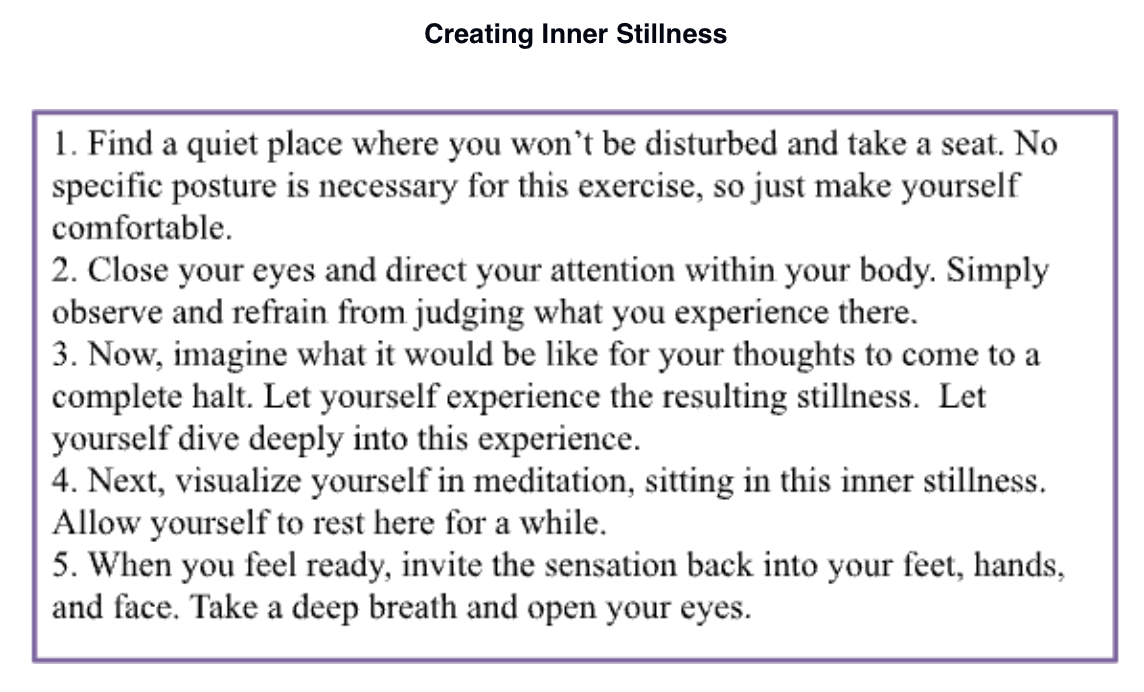
This is a process that you can employ frequently and to great advantage. In effect, you are giving yourself a specific target to aim at. This practice allows us to focus our attention, and to pull it away from the trivial chatter that is too often our most frequent companion.
So, use this stilling exercise multiple times a day. It prepares you for a much deeper meditation experience. Underneath all of our chatter is a perfect Stillness, and in this place, our hearts will find their rest. In that Stillness, we find our deepest Self, and our true home.
That’s it for this week, folks. Next week, we will use a deep poem by a 13th- century spiritual master to explore what being still looks like, and what we can expect from this practice. So, keep up with your daily practice. If you are new to this, try meditating multiple times a day for just five minutes or so. See you next week…
With deep affection,
P.S. Several of you have expressed the desire for an online meditation class. If there is enough interest, I will try to figure out how to hold a group class on the web. If you have an interest, please write me at ken123Kaisch@gmail.com.
Humility as a Tool → Letting go → Fear → Openness → Acceptance & Growth
If you are finding this newsletter course helpful, you may want to consider Dr. Kaisch's latest book, Inside the Invisible: The Universal Path to Spiritual Transcendence.👇
7: Heart-centered Meditation
Edition #7: Inside the Invisible
Perhaps the most significant difficulty with our first spiritual exercise is the lack of a clear target. If there was a clear ‘X-marks-the-spot’ target for your meditation, you could focus your attention there, and you probably would have felt more successful. At the very least, you could tell when you stayed on the target and when it eluded you. But what kind of target does the Presence of God present to you? Is it some image of the Divine? Is it a particular kind of inner feeling? Or something else entirely?
There was actually a good reason behind this lack of specificity. If you had some kind of clear target, instead of pursuing the actual real Presence, you would likely imagine something. Something that you thought fulfilled the parameters of your search. The only thing that could be said of such an imagining is that it is a fantasy – something that does not exist in reality. What a terrible way to start your journey toward that which Is, the ultimate Reality behind all our apparent observable reality.
The truth is, we humans have this marvelous ability to perceive patterns – to fill in the blanks, so to speak, with what we believe completes the pattern. Let me give you a simple numerical example: 1, 2, 3, __. Now, fill in the blank.
Most probably inserted a ‘4’, but how did you come to that number? You guessed, right? You assumed it was an ascending numerical sequence, and the single space indicated a single digit, so you assumed ‘4’. But maybe I was giving the last four digits of my phone number, or my social security number, or something else. There was no way of knowing without more information, so you hallucinated a number to fit.
While this ability to make and perceive patterns is helpful in many situations, it becomes a liability in our search for the Divine. It is, I believe, the primary reason why there are so many radically different ideas about God. Sadly, almost all of these ideas tend to lead us astray. If nothing else, none of our thoughts begin to encompass the vastness and majesty of God.
That being said, we humans have trouble with vagueness. I remember working with a woman who had wrestled with an unidentified chronic illness for years. She was terribly depressed because her doctors could not find a diagnosis. One day she
came into my office all smiles, just glowing with happiness. “They finally figured it out,” she said with a grin. “I have stage four pancreatic cancer!”
This was a virtual death sentence, yet it made her very happy. Finally, she had something concrete and real. Never mind that it meant her death; the certainty made her happy.
So how can we use our need for certainty in our quest? How can we create a target that is easier to work with, but one that doesn’t compromise our search right at the get-go?
To answer this, we need to look at our spiritual forebears. All of the great religions talk about a spiritual center in our bodies in the region of our heart. They say that the place where the Divine is most accessible to us is in this spiritual heart center. Several Christian mystics have stated that the veils which separate us from God are most transparent in the spiritual center of our heart.
St. Symeon the New Theologian (949-1022), an Eastern Orthodox saint, taught that we can experience the Divine directly, in the region of the heart. He was working from a very ancient practice, the Jesus Prayer, which originated with the Desert Fathers in the 2nd and 3rd centuries. (More on the Jesus Prayer in later editions of this newsletter.) In Western Christendom, the anonymous English author of The Cloud of Unknowing also describes the heart as the primary focal point of contemplative prayer.
Of specific interest to us, the anonymous author of The Cloud of Unknowing invites his reader to put “a cloud of forgetting” beneath him – letting go of everything that might distract him from the love of God. Then, he invites us to put a “cloud of unknowing” between ourselves and God. He rightly says that we can never ‘know’ God like we can know the objects around us. Better to not speculate, then, and to place one’s self in the presence of God and rest there, without fabricating ideas or emotions about the experience. And that, of course, was the point of our first spiritual exercise.
Moving forward, we can make our spiritual journey easier, quicker, and more productive by centering our attention in our hearts. So, let me introduce you to the practice of heart-centered meditation.
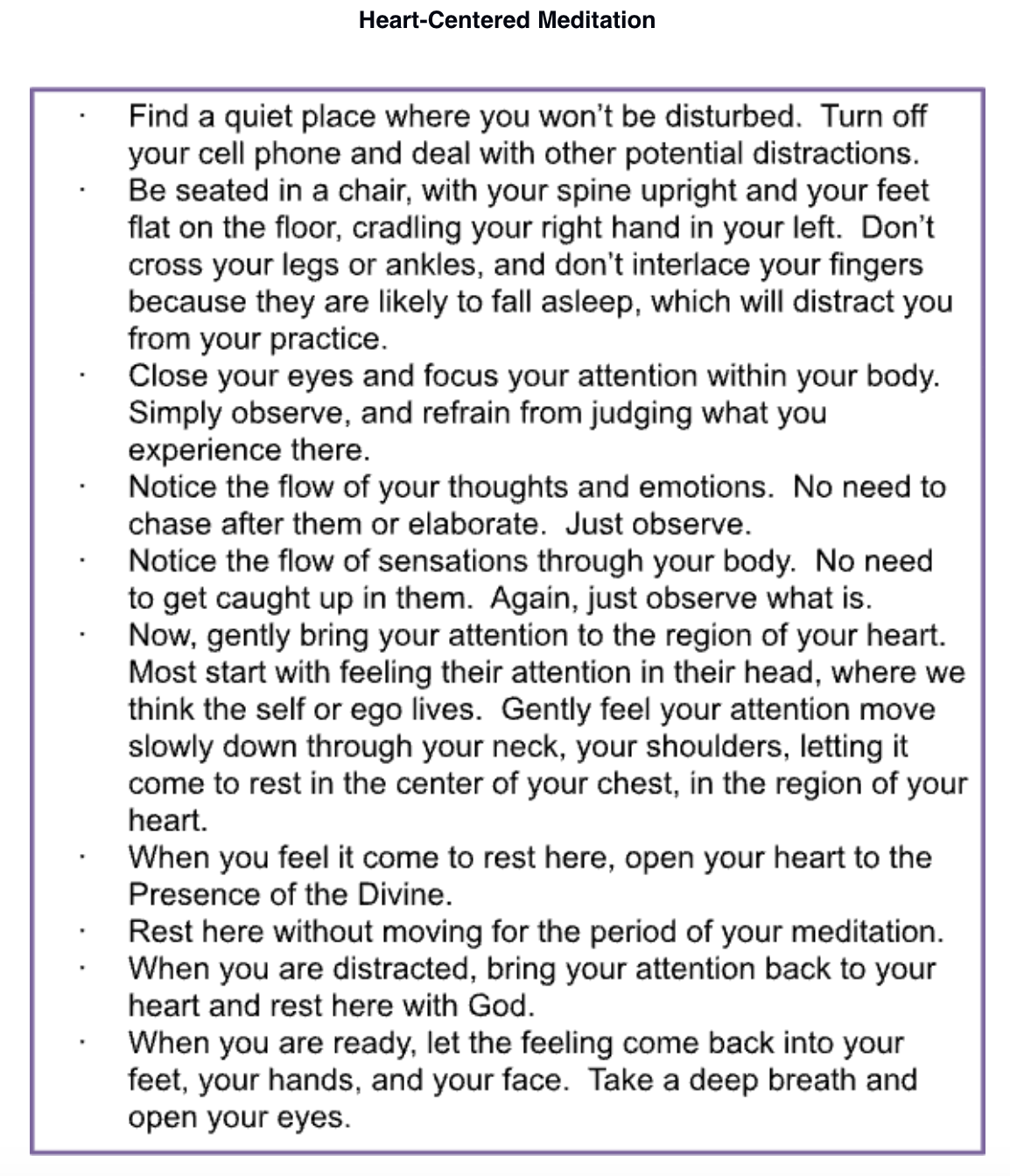
If you have difficulty moving your attention out of your head, first feel the sphere of energy around your head. Then imagine that sphere descending about an inch or so with every breath you take. When that sphere reaches the center of your chest, imagine reaching out from your heart to someone you love. Then reach out to another and another. This tends to anchor your attention in your spiritual heart center.
I have had people say they can’t move their attention out of their head because that is where it is supposed to be. That’s a common misperception. If you have ever stubbed your toe, barked your shin on something, or hit your fingers while hammering a nail, you know this is just not true. When you stub your toe, ALL of your attention is suddenly focused on the hurt toe. There isn’t even a particle of attention left to think about anything else. It’s just that we don’t pay much attention to what is actually going on inside of us. When you start noticing what is happening inside of yourself, you start to see some amazing things.
With practice, you will come to know your inner world. As you get more and more familiar with your heart center, your ability to focus without interruption will gradually increase. As you let go of your thoughts and emotions, you will experience a certain stillness in your inner world, a stillness that is free from your ego driving this thought and that one. This is not something you can force. You can’t say to yourself, ‘Stop chasing that thought,’ and expect to be successful. Why not? Well, stop and observe what part of you is doing the talking. It’s your ego that is attempting to exert power and direct your mental traffic here. And guess what – your ego is not likely to participate in its own demise.
This is the paradox of spiritual work. You have to find a way to go deeper inside to find the Divine dwelling within, but the tool you have always used to get things done – your ego – is not effective here. Remember what happens with seeds that are planted? The seed has to die in order for the new growth to occur. The same happens in the spiritual realm as well.
That’s all for this week, folks. Next week, we will start looking more deeply into the nature of the mind because the more you know about your inner world, the easier it is to negotiate your way home. Keep up with your daily practice. If you are new to this, try meditating multiple times a day for just five minutes or so. See you next week…
With deep affection,
P.S. Several of you have expressed the desire for an online meditation class. If there is enough interest, I will try to figure out how to hold a group class on the web. If you have an interest, please write me at ken123Kaisch@gmail.com.
Humility as a Tool → Letting go → Fear → Openness → Acceptance & Growth
If you are finding this newsletter course helpful, you may want to consider Dr. Kaisch's latest book, Inside the Invisible: The Universal Path to Spiritual Transcendence.👇
6: The Importance of Intention
Edition #6: Inside the Invisible
The goal of the spiritual life is union with the Divine. The early church had a term for this process – they called it theosis. This goal is summarized in the words of St. Athanasius, “God became man that man might become God.” Pretty wild, isn’t it? I will bet you never heard that in Sunday School!
As seekers of this spiritual union, we are involved in the process of changing our perceptions: our perceptions of ourselves, each other, and God. If you will, we are engaged in opening our eyes so that we can see all of Reality, not just a narrow slice of it. Instead of being satisfied with the partial loaf we have grown up with, we now want the whole enchilada. We will not achieve this by spiritual exercises alone.
This brings us to the importance of intention. At least half of the value of our first spiritual exercise lies in our intention to draw closer to the Divine. For the few minutes of your practice, your intention was fully concentrated on God. You didn’t know what to expect. You had no idea what would happen. Perhaps the skies would split open, trumpets would sound, and angels would appear. Who knows?
These expectations, however they manifest for you, are important. They are the result of your past conditioning. For example, if you are Christian, you may have expected Jesus; if you were of another faith, you expected something else. More than just old conditioning, your expectations are evidence of your desires, which are always driven by your ego.
Imagine your ego for a moment. Every ego has boundaries: you are okay with this, you are not okay with that, and those over there you don’t even see. These boundaries are invisible until you bump into them, and then they make themselves known. While boundaries are useful in negotiating our way through the world around us, they are the primary obstacle to our spiritual growth. These boundaries keep us from experiencing the living God.
Look what happened during your work with your spiritual exercise this past week. You sat down, closed your eyes, went inside, and then opened yourself to the Divine. This was driven by your intention to sit with your Lord.
You didn’t know what to expect, so you were wide open to receive whatever might happen. For a moment, you managed to step outside your ego boundaries. Then what happened? Your mind was still – at least for a moment or two – and you experienced some quiet. That quiet felt good, so you probably said something like, “I think I’m getting the hang of this,” which pulled you back inside your ego boundaries. Then it was off to the races, with your mind thinking this and that and everything under the sun.
When you noticed this, it was your intention that brought you back. You realized you had set out to open yourself to God, got sidetracked into your usual jumble of thoughts, and then did your best to pull out of that jumble. Your intention had been violated by you, yourself. That may have been a bit upsetting, so you came back to your practice.
Your intention to know and experience the Divine is what started you on this journey, and it constantly helps you keep on course. It is a precious gift from God, for without our intention, we would never start, and if by chance we started, we would immediately derail and fail.
So, cultivate your intention to realize God. Spend some time within focused on your intention. Nourish it. Cherish it, for without it, we are lost.
Questions and Answers
I received a bunch of questions this week that all asked the same thing: ‘Hey, Doc! What am I supposed to feel?’ so I am going to attempt to answer them all together. Here goes…
There is no ‘supposed to’ here. As you clear away your internal obstacles, you willexperience the Presence of your Lord. In fact, the Divine is within you right now – you just have not perceived that holy Presence. Now you get the joy of experiencing the obstacles that are in the way. These obstacles are revealed in your thoughts and emotions, and even in the itchy sensations you experienced.
Maybe your mind went to some pressing problem, and you began to think about that. Maybe you realized that you need to pick up some milk and bread from the store. Maybe you notice a kind of strange sensation on your skin somewhere. You tried to ignore it, but it grew and grew until you just had to scratch it to make it go away.
All of these results are simply ploys by the ego to get us to STOP. At a deep level, your ego understands your spiritual practice is a threat. As a result, it will throw at you whatever it needs to trip up your practice. In short, we all get suckered. We stop what we are doing – our spiritual practice – and follow the direction of our ego, the same old round of ceaseless thoughts that have always been there.
What is worse, this ego-driven process is insidious. As you develop your practice, you will find it happening again and again, to the point that many give up their spiritual work as a result. There is, of course, a remedy. It's kind of a clever remedy, actually, since it uses the force of the ego to thwart its drives. In that way, it is like ju-jitsu – using the opponent's own force to defeat him.
This remedy is most explicitly developed in the Buddhist practice of vipassana. When you have a thought, simply label it. Say “thought” and let it go. If you try to fight it, you have already lost the battle, and your ego has succeeded in derailing your intention. Likewise, if you feel an emotion, don’t pursue it, just say “emotion” and let it go. For physical sensations, say “sensation.” You can think of this as a ‘catch and release’ program.
The critical point here is not to wrestle with your ego because you will lose. Your ego is always in survival mode, and it is ferocious! Instead, step aside and let it pass through you.
That’s all for this week, folks. Next week we will refine your spiritual practice by showing you how to increase both the focus and the power of your meditation. So keep up with your daily practice. If you are new to this, try meditating multiple times a day for just five minutes or so, and we will meet again next week.
With deep affection,
P.S. Several of you have expressed the desire for an online meditation class. If there is enough interest, I will try to figure out how to hold a group class on the web. If you have an interest, please write me at ken123Kaisch@gmail.com.
Humility as a Tool → Letting go → Fear → Openness → Acceptance & Growth
If you are finding this newsletter course helpful, you may want to consider Dr. Kaisch's latest book, Inside the Invisible: The Universal Path to Spiritual Transcendence.👇
5: The Foundational Spiritual Exercise
Edition #5: Inside the Invisible
Consider with me the difficulty of pursuing spiritual goals with our selfish egos, always chanting ‘me-me-me.’ We want God’s embrace while holding on to the very thing that precludes that embrace – our tiny egos. There is such a clear irony here. Jesus says, in multiple places, that he is already here, with us. He has always been, and will always be here.
Let me give you some examples. In John’s gospel, Jesus says, “I am in my Father, just as you are in me and I am in you” (John 14.20). A chapter later, he says, “Abide in me as I abide in you” (John 15:4). How about in Matthew, when he says, just before ascending into heaven, “Know that I will be with you always, even to the end of time” (Matt 28.20). One of his names, Emanuel, actually means “God with us.” We just don’t notice. Worse, we don’t know how to notice.
So how do we open ourselves to that holy Presence? We conceptualize the issue as needing to do something different. That’s our ego talking. Often, our religious institutions echo our ego and exhort us to do all kinds of things: we need to behave better, to do this and not that, we need-need-need. Starts to sound like the ego talking, doesn’t it? Me-me-me all over again.
But let’s face it. We have followed the dictates of our ego in our pursuit of the Divine, and we have come up mostly empty. The ego gets us started, but it can’t take us very far down the path. Following the wonderful work of David Hawkins, it is not our doing that will bring us into God’s embrace; it is our letting go that is the ticket.
What!?! The ego starts screaming right about now. “Letting go diminishes us. Letting go makes us less. Letting go is scary!”
I am reminded of an old cartoon, in which a man falls off a cliff during the night but manages to grab hold of a bush growing out of the hillside on his way down. He calls out, ‘God, help me!’ A Voice answers, ‘Let go.’ ‘I can’t let go, I’ll fall to my death.’ ‘Let go,’ comes the reply. Finally, in desperate agony, because he can’t hold on anymore, the man lets go. And drops six inches to the ground. Pretty scary fall, isn’t it?
We are afraid to trust, because we have lived in a world with so much untruth. We have learned from repeated experiences not to trust. So, we hold on to what we think we know. Sadly, our holding on keeps us from opening to God’s embrace.
To find the Divine, we need to shift from relying on ourselves and our egos. The central core of spiritual work “is aligned with undoing and the unloading of the mind rather than its enrichment.” We need to change our programming from ‘getting’ to ‘allowing.’ In a word, we need to let go.
And this brings us to our first spiritual exercise. You can practice this anywhere, at any time, and it is always beneficial. You don’t need to adopt a particular posture, although I have found it helpful at the start to close your eyes and sit quietly in a quiet place. Then, simply open your awareness. This is not so much an action of getting as it is a letting go.It involves going inside of yourself: letting go so that you can move into your deepest being. There, Jesus promises us, we will find that we are already in union with Him.
This spiritual practice can be found under various names in all of the major religions. In Zen Buddhism, it is known as “just sitting.” In Daoism, it is known as “sitting in oblivion.” In Hinduism, it is embodied in the phrase, ‘Thou art That,’ meaning that you are that for which you seek. In Christianity, it is known as the Practice of the Presence of God, and Brother Lawrence, a 17th-century monk of the Carmelite order, is one of its foremost exponents. Regardless of the name, the practice involves abandoning the getting activity of the ego so that you can see what is actually there, inside of you, at your deepest levels.
Like all forms of meditation, you will probably find this practice a bit difficult. It is extremely simple – there is literally nothing to do. But your ego is not likely to enjoy the experience, so it will throw up all kinds of barriers. These will likely take the form of distractions and ‘forgetting’ to do the practice. It helps, therefore, to give yourself a minimum time for practice and specific times to engage in it.
I would suggest practicing this several times during your day. I like to open myself this way after my morning coffee. I often practice for thirty minutes or more, but in the beginning, I had a hard time even stretching it to five minutes. So, I would suggest you start with five-minute practices. In addition to morning practice, I typically take short breaks with this throughout my day, and then again as I lay in bed before sleep comes.
Because it is difficult to read this material and do what it suggests, I have included an audio clip of this exercise. Use it a time or two, if you find it helpful, to facilitate your initial practice. After a while, you will probably find it more of a hinderance, so then just discard it.
Opening to the Divine: The Foundational Spiritual Practice
Find a quiet place where you won’t be disturbed. Turn off your cell phone and deal with other potential distractions that might interrupt your spiritual practice.
Be seated in a chair, with your spine upright and your feet flat on the floor, cradling your right hand in your left. Don’t cross your legs or ankles, and don’t interlace your fingers because they are likely to fall asleep, which will distract you from your practice.
We entertain ourselves with cascades of thoughts, one after another. For the time of your practice, let go of chasing after them. Just sit, let go, and be open to that Presence which the scriptures of all faiths say is always with us at all times.
Sit without moving, so that the distraction of movement doesn’t take you away from your intention, which is to sit in the Presence and experience what is Real and True.
Close your eyes and turn your attention inward.
Open yourself to the presence of God right here with you, around you, and within you. Don’t push yourself to imagine something – that is just more doing and your ego-driven thinking.
Simply let go of everything. Let go of your thoughts, and observe your interior world.
Rest here for a time.
When you are distracted, bring your attention back and observe the play of your thoughts and emotions without chasing after them.
When you are ready, let the feeling come back into your feet, your hands, and your face. Take a deep breath and open your eyes.
With practice, you come to know your inner world. You will get more and more comfortable there, and the distractions will gradually cease. You will find yourself letting go more freely, thinking less, and going deeper and deeper. You will actually be able to feel the changes in yourself as you get more experienced here.
As you practice, you will find a deepening of peacefulness within yourself. This peacefulness arises because you are feeling more and more secure. Remember that security is the ego’s primary job, so as you relax into this practice, the ego has less and less to do. Your constant thinking will diminish, and your peace and joy will increase. What a bargain! LOL
If you have questions about your practice, please email them to me (Ken123Kaisch@Google.com) so that we can start a Q & A column.
Next week we will focus on the importance of intention to your spiritual practice. At first glance, your intention may not seem terribly important, but you will find that it is a crucial element in achieving the success you are looking for. Until then…
With deep affection,
P.S. Several of you have expressed the desire for an online meditation class. If there is enough interest, I will try to figure out how to hold a group class on the web. If you have an interest, please write me at ken123Kaisch@gmail.com.
Humility as a Tool → Letting go → Fear → Openness → Acceptance & Growth
If you are finding this newsletter course helpful, you may want to consider Dr. Kaisch's latest book, Inside the Invisible: The Universal Path to Spiritual Transcendence.👇
4: The Behavior Changes Needed for a Spiritual Life
Edition #4: Inside the Invisible
Hey ! Welcome to today’s message:
The six major world religions all agree that four specific behavioral changes are necessary for a truly spiritual life. The failure to implement these changes will negatively impact your prayer and meditation and will result in significant barriers that impede the process of theosis or divinization. These four changes include:
No lying
No stealing
No sexual improprieties
No violence.
While this looks like standard religious fare, let’s look deeper so that we can understand why these particular behaviors have the potential to impede or even stop your spiritual progress.
Let’s take stealing, for example. Imagine that someone points a gun at your chest and says, “Give me your money, or I will blow you away.” The thief is saying that, in effect, his needs are more important than yours. This is the essence of self-centeredness, isn’t it? “My needs are more important than you or your life.” Me – me – me!
In effect, the thief has drawn an impenetrable boundary around himself, and that boundary blocks him from uniting with God. How can you be on a spiritual path, which is God-centered, while refusing to center your life on the Divine? Clearly, the me–me–me part in all of us gets in the way and blocks our spiritual progress.
The same holds for the other behavioral changes that are necessary for a truly spiritual life. When we lie, we do so for self-centered reasons. Once again, our self-centeredness blocks our spiritual movement. Furthermore, since the Divine is often referred to as the Truth, it seems obvious that telling untruths is harmful to us spiritually.
As for sexual improprieties, you might ask yourself, “What exactly are they?” The clearest answer is that they are what you think they are. We each have an inner knowingness about what is right and wrong, proper and improper. We need to listen to that inner knowingness and make our decisions accordingly. What is sexually improper for a twenty-something is quite different than what is improper for an older person committed to celibacy. What is important in this spiritual discipline is that you constantly ask yourself, “Am I doing this for selfish and egocentric reasons, or am I motivated by selflessness and love?”
Let’s see if I can make things clearer by using a couple of examples. Let’s start with something like affairs. If one of the partners in the affair is in a committed relationship, and the affair is hidden from the other partner, then clearly, this is a sexual impropriety. It is driven by selfishness, and selfishness blocks our spiritual progress. Even if the affair is not hidden and has the consent of the other partner, it is still driven by selfishness.
Now let’s look at something that may not be so clear, for example, masturbation. In my view, masturbation is normal and ordinary. It is either a means to relieve tension or a way to have a sexual fantasy. In both cases, it is ego-driven and self-centered. That being said, it is unlikely to cause as much damage as a secret affair. Again, the watershed question to ask is always, “Is this behavior driven by my selfish desires?” If you answer in the affirmative, then that behavior needs to be altered so that you can be more fully open to the embrace of Divine Love.
Let’s look at the last behavior that always inhibits our spiritual growth – violence. Violence comes in many forms, from rape and murder of another human being to swatting flies. In every case, violence comes from our egocentric and selfish needs. As such, violence impedes our spiritual progress.
But what about a righteous war, you might ask, like that against Hitler? Are you saying that’s bad? Yes, I would say that even a righteous war is bad, but I would also say that they are sometimes necessary. I also believe that the men and women who committed violence in those wars were all spiritually damaged by their experiences. That being said, I am extremely grateful for their sacrifices, and I believe their selflessness in service to others counteracts, to some considerable degree, the spiritual damage they sustained.
* * *
These are the four behaviors that need to be regulated for us to make spiritual progress. There are, of course, degrees in each of these behaviors. The critical part, in my view, is that at the beginning of your spiritual work, you are aware that these four behaviors can derail your progress. Being aware of these pitfalls, you can make your choices accordingly. Of note, the need for changing these behaviors is not negotiable. All six of the world’s great religions have agreed that these behaviors must be regulated for genuine spiritual progress.
So let’s take a look at what regulating these behaviors means. I’m not saying you have to change them now, at the start of your spiritual journey. I am saying that they need to be aware of them in order to make significant progress.
By regulation, I mean that these behaviors need to be brought under control. We need to be aware of the necessity of changing these behaviors, and we need to take steps to do so, starting now.
Let me give you a rather inconsequential example of this in my own life. Because I live in an agricultural area, we have a lot of flies in the summer. When I first moved here, I spent a lot of time swatting at them. After one particularly explosive incident, I realized I was engaging in violence and that this violence was undoubtedly impacting my spiritual life. As a result, I investigated other ways of controlling these pests. I found that if you plant certain varieties of salvia, a plant that has an odor that repels flies, you can keep those pesky critters out of your house. My next step in this ongoing process will be learning to ignore those few flies that still get into the house.
* * *
I hope you have found this helpful and that you are thinking about what you can start doing now to change these four behaviors in your own life. The direction of a truly spiritual life is one in which we identify and release our ego-driven, selfish desires. As we do so, we become more and more open to the love of God, which is always fully and deeply present to us.
I look forward to continuing next week with an exposition of our first spiritual practice. This practice is the foundation upon which you can open yourself fully to the Unseen. I hope you will invite your spiritual friends to join with us. Having others to meet with and talk about these things will accelerate your own transformation (and theirs).
P.S. If you are finding this newsletter course helpful, you may want to consider Dr. Kaisch's latest book, Inside the Invisible: The Universal Path to Spiritual Transcendence. 👇
Inside the Invisible: The Universal Path to Spiritual Transcendence by Dr. Ken Kaisch
3: Conventional Religion & The Inner Way
Edition #3: Inside the Invisible
Hey ! Welcome to today’s message:
In this newsletter, we will explore the differences between the approaches of conventional religion and what I call the Inner Way, which is also known as the mystical way, non-duality, and the unitive way. After some thought, I decided the simplest approach would be to present the data in a table format. All of the major world religions have an external, conventional side and a mystical, non-dualistic side.
The conventional approach, which is all that most people have experienced, doesn’t, in my view, take you very far. It has to do with outward observances, and the inner changes necessary for a truly spiritual life are rarely talked about. As you have no doubt surmised, I am interested in exploring the Inner Way with you.
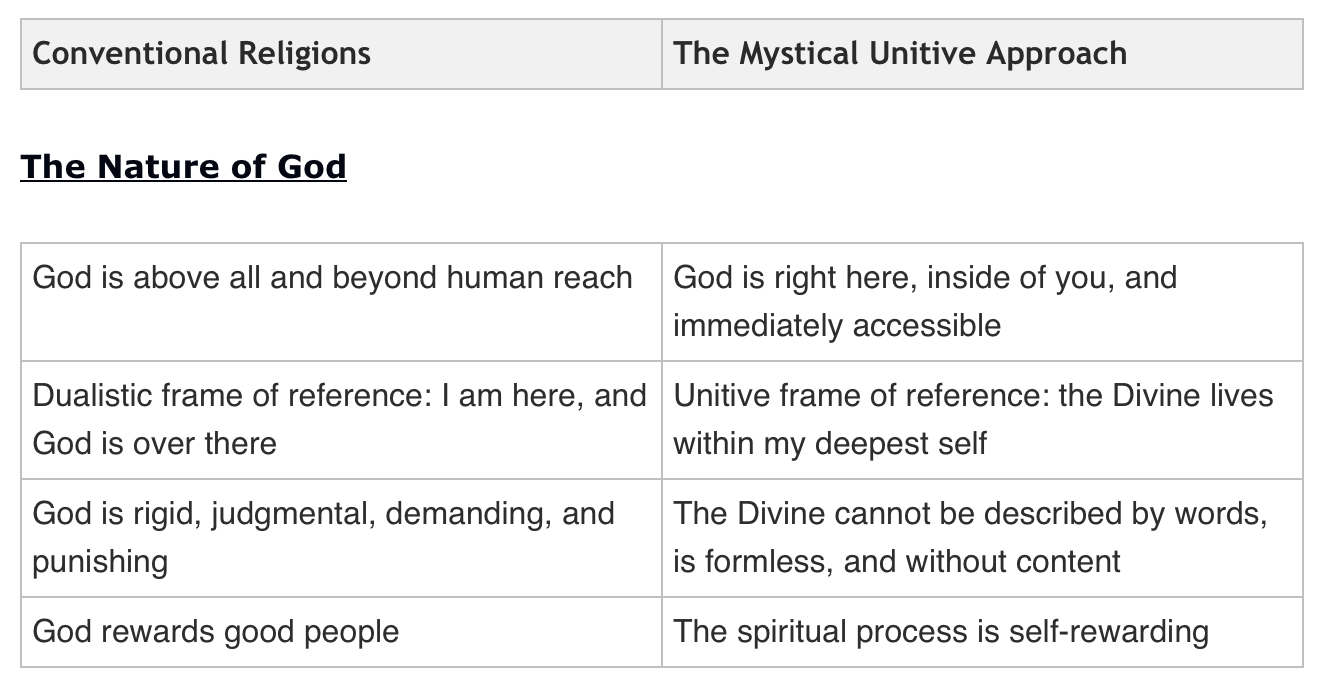
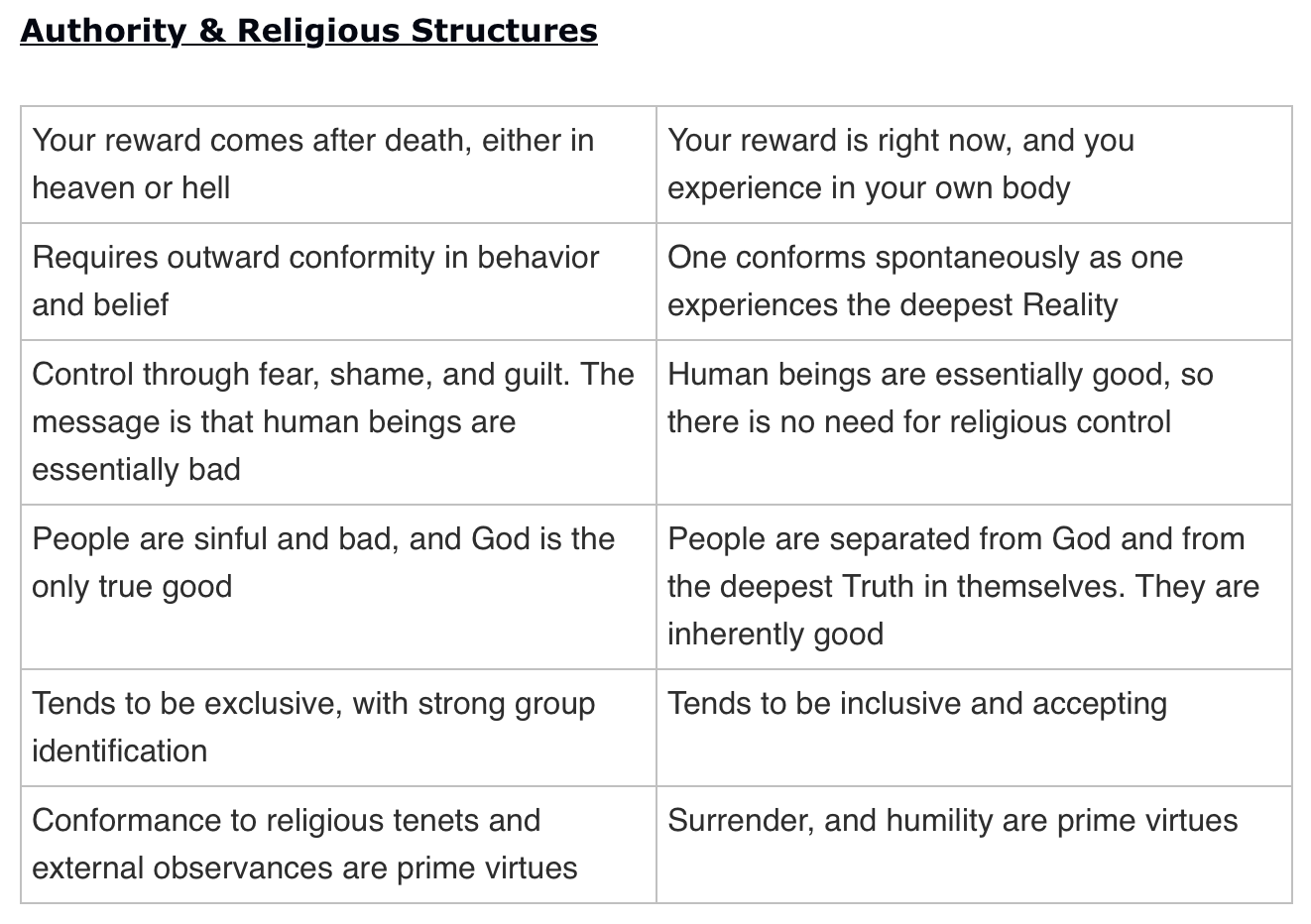
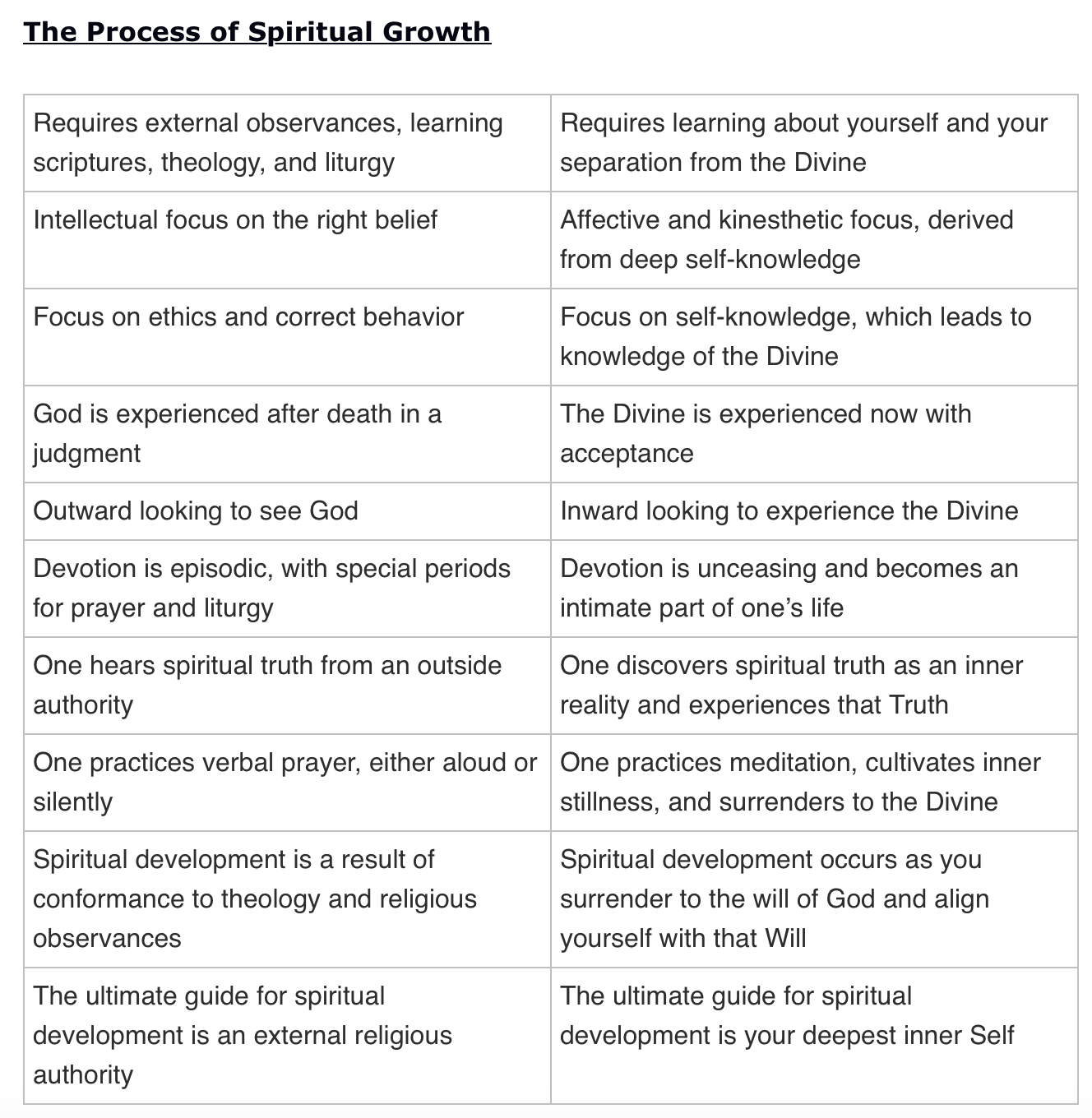
If you are exploring these data for the first time, it may seem a bit overwhelming. We have all been schooled in the conventional type of religion. Because no other form of spiritual observance was ever described, we either accepted or rejected the conventional view. When you are first exposed to the richness of the unitive way, it may surprise you, it may intrigue you, and it may simply seem like too much to deal with.
But the fact that you are receiving this newsletter rather strongly suggests that you are ready to go deeper in your spiritual journey. So, for this week I would encourage you to simply sit with the information in this table and just think about it. Notice where you feel a repulsion – the feeling that comes when you know intuitively that something is off.
Notice also where you feel an attraction – that feeling you get when you find yourself resonating with a statement, that knowingness that comes when you experience something that is true and real. You might realistically say that the mystical way begins with self-exploration and using the power of your inner knowingness to discern Reality. A discernment that is often subtle and hard to detect at the beginning, but one which grows stronger as you learn to use and rely on it.
Next week, we will explore the four spiritual disciplines necessary for further growth. (Yeah, I know no one likes to hear the word discipline, but these disciplines actually make a lot of sense!) The following week, we will introduce our first spiritual practice. This practice is foundational, and will serve as the basis for our further growth in the mystical way. So please invite your spiritual friends and fellow-travelers to come join us in this deep inner work.
P.S. If you are finding this newsletter course helpful, you may want to consider Dr. Kaisch's latest book, Inside the Invisible: The Universal Path to Spiritual Transcendence. 👇
Inside the Invisible: The Universal Path to Spiritual Transcendence by Dr. Ken Kaisch
2: The Goal of a Spiritual Life
Edition #2: Inside the Invisible
Hey ! Welcome to today’s message:
For most, the goal of the spiritual life is, at best, unclear. Many would say that the goal is to be a good person and to lead a moral life. Some translate this as an imperative to work for social justice. Others try to improve their personal lives, but many who do so are rather vague about what is necessary. All of these approaches remind me of the story of Jacob and his brother, Esau. Esau ‘sold’ his patrimony as the firstborn son for a bowl of gruel.
Our spiritual destiny has to do with behavior change – yes – but this kind of thinking is way too small. Do you really think that your Creator wants you to be ‘nice’? Do you really think that’s important?
What God wants from us is far more radical, so if you are standing, please sit down and hold onto something solid. Here it is, short and simple: The goal of the spiritual life is that you become God!
After you get over your shock, I hope you will give me a chance to explain. Let me start with examples from the holy writings of my own faith, Christianity. In the gospel of John, Jesus says, “I am in my Father, and you in me, and I in you” (John 14.20). Take a moment and let the meaning of these words resonate in your chest. God is in you. The Divine has always been in you and with you. The purpose of Christ’s Incarnation, and the purpose of all the great spiritual teachers, is to show us that God is right here, with us, every single moment of our existence, and to invite us to step into that holiness, into the Divine. In case you don’t believe St. John, let me refer you to 2 Peter 1.4 where the author states we should become “partakers of the Divine nature.”
The technical ‘church’ term for this is Theosis, and it is best summarized by St. Athanasius of Alexandria, who lived from 296-373 CE. He said, “(Jesus) was made man that we might be made God.” Again, let these words resonate in your heart: the reason Jesus took on his mortal body was for you, yourself, to let go of your felt limitations and realize that you are called to the fullness of Christ.
In the early Christian communities, this notion was clear and widespread. We hear it in the New Testament scriptures, in the early Church Fathers, beginning with St. Irenaeus of Lyon in the early 2nd century, and beyond. We hear it in mystics like John of the Cross and Teresa of Avila, and in the Eastern Orthodox theologians like Vladimir Lossky.
And this notion is not limited to Christianity alone; it is clearly present in the Eastern religions as well. Ramana Maharishi of Hinduism said, “The Self [the Source or God] is not reached. You are the Self. You are already That. The fact is that you are ignorant of your blissful state.” We find it in Buddhism as well, in the words of those Zen masters who say that we are all enlightened, we just don’t recognize it. In Islam, we hear the great mystic al-Hallaj, who said, "I have seen my Lord with the eye of my heart, and I said: 'Who are You?' He said: 'You.'" (Of note, al-Hallaj was executed for blasphemy, just like Jesus, for saying “I am the Truth.”)
The deepest truth of all the great religions is this: the spiritual quest is one of recognizing we are already one with the Divine. Thus, there is no journey per se. Rather, there is a series of awakenings or realizations about the nature of Reality and the nature of Truth.
As you can well surmise, this is a mystical journey – a journey that takes you deeply into the nature of yourself, and thus into the nature of God. Think of the journey like an onion, with concentric layers. This journey is about moving through the layers until we reach the center. There, the great spiritual masters say we will find the Divine. Depending on your faith, you might describe it as the Kingdom of Heaven, Enlightenment, self-realization, or Fruition Consciousness. But who really cares what we call it! What is important is following the course of that Inward Way and realizing the fullness of the Unseen Presence.
While all of this might be interesting, it hides something even more important. Something I would say is of crucial importance. From our human perspective, we think we are trying to move towards God. We think we are the ones doing the work. What most of us do not yet realize is that God is the one doing the heavy lifting. God is working constantly in every moment of our lives to draw us closer and closer. What we call ‘our journey’ is simply a response to the Divine initiative.
As the great German theologian Karl Rahner once said, “In the days ahead, you will either be a mystic (one who has experienced God) or nothing at all."
* * *
Thank you for joining me today. Next week, you can expect a discussion of the mystical path and how it differs from more conventional understandings of religion. And coming in a few more weeks, we will explore our first spiritual practice, which will be the foundation of our work together.
P.S. If you are finding this newsletter course helpful, you may want to consider Dr. Kaisch's latest book, Inside the Invisible: The Universal Path to Spiritual Transcendence. 👇
Inside the Invisible: The Universal Path to Spiritual Transcendence by Dr. Ken Kaisch
1: Have you noticed our world seems to be coming apart?
Edition #1: Inside the Invisible
Hey ! Welcome to today’s message:
Have you noticed that our world seems to be coming apart?
Natural disasters like the LA fires… the looming threat of WW III… rampant crime… a hot war in Europe. It’s a mess, isn’t it?
And what kind of resources do you have to fall back on? Who do you trust when the going gets tough? Our politicians – they line their pockets while letting our cities burn and handcuffing the police. We have a media that sensationalizes everything and omits the truth. Social media? A million different lines of nonsense. The truth is, life is pretty shallow right now, and most of us don’t know where to turn.
So maybe you turn to God for help. But let’s be honest, what do you really know about God? Everyone seems to have an opinion about God: God is Jesus – God is Krishna – God is this – God is that – God doesn’t exist! – yes, She does! It’s a hot mess, isn’t it?
Everyone assumes their idea about God is the correct one. But what if it isn’t? How would you know? Do you know the truth about God just because somebody says, “This is the Truth?” We know that people lie all the time. They have hidden agendas and axes to grind, and sometimes, they just lie for the heck of it. And the wretched truth is, almost everything YOU know about God is something that someone else told you. How do you know if you got the right stuff or were sold a bill of goods? How can you sort through this mess to separate truth from somebody else’s fiction? How can you get to something you can RELY on?
Our newsletter, Inside the Invisible, cuts through the fluff and nonsense that clutter our perceptions to bring you clarity that you can count on. The clarity we have found comes from applying scientific research methods to the writings of the spiritual masters from all of the major world religions – mystics who have actually experienced the Divine and whose lives have been transformed by their experiences. We want to bring these insights to your computer on a weekly basis. And the best part – you get this valuable information for FREE.
So who am I that I would make you such an offer? I have spent my life trying to discern fact from fiction. I am an ordained Episcopal priest and a clinical psychologist. At 76, I am now retired and can devote my remaining years to what I believe is our most important mission in this life – to learn about the Divine from our own personal experiences and to share the results with others. After all, if the scriptures of the world’s great religions are correct, our efforts here on this earth will determine our outcome for eternity.

A bit about my own spiritual journey. I attended seminary in the early 1970s, spending three years taking graduate courses in theology, church history, Old and New Testament studies (including learning New Testament Greek so that I could read our scriptures in their original language), liturgical worship, church music, and the like. For these efforts, I was awarded a Master of Divinity degree. To this day, I am not sure what that means. I was no more divine upon graduation than I was before I entered seminary.
Mind you, I am not complaining about what I learned there – it was valuable and shaped my spiritual life in many ways. But the one thing they did NOT teach was how to connect with the Divine. Curious, isn’t it? They taught everything they could about the Christian religion except how to forge a living connection with Christ.
I then served parishes in the Episcopal Diocese of Utah for nine years. My last parish, St. John’s in Logan, Utah, was comprised mostly of college professors, their families, and their students. I once asked this very bright and articulate group what, for them, constituted a spiritual experience. The resulting silence was deafening, and the obvious discomfort in the room quickly became intolerable.
After the initial awkward silence, there were a few tentative answers. It was almost as if they were afraid of saying the wrong thing. And when they finally responded, all of their answers had to do with church-related activities like ‘feeling something when I receive communion.’ I was greatly surprised.
Nobody talked about their experiences in prayer and meditation. Why not? Didn’t they feel connected to God, then? And even though my congregation was composed of avid outdoors types, nobody talked about their experiences in nature – a beautiful sunset, the glorious snow-covered mountains. Just this awkward silence.
Later, when prompted, they began to describe the spiritual feelings that arose from their nature-based experiences. They talked about great feelings of awe at the overpowering majesty of a glorious sunset. They talked about feeling their hearts opening somehow in response to these experiences. And then, with some prodding, they began to describe their experiences of loving – seeing their babies being born, their children so innocent in their sleep, their love for their partners, their friends. It was as if a whole new world opened up as they considered these very personal experiences as spiritual ones. But even as the discussion deepened, no one risked talking about God, and Jesus was nowhere near the conversation.
The great news here was a kind of group heart-opening, as people looked outside of what is conventionally called ‘spiritual’ and realized they were actually having spiritual experiences frequently in their daily lives. Not only that, these experiences were enormous for them; they weren’t something trivial or inconsequential. The other side of the coin, however, also revealed itself. These good Christian people had no idea how to cultivate their lives so they could have more of these experiences. And the Church was not doing a very good job showing them how they could open to more of them!
While I pastored at St. John’s, I pursued graduate degrees in clinical psychology. I thought I was going to school to learn psychotherapy, and I did indeed learn those skills. Ironically, the courses I hated – statistics and research methods – turned out to be some of the most important ones for my spiritual formation. I realized later in life that these research skills could be applied to religion and spirituality. As I pursued this, I found amazing truths about the spiritual dimension of our being.
Perhaps the single most important concept of my graduate studies at Utah State was the idea that if your theory does not account for every single bit of data, then your theory is wrong. When I applied this concept to religion, I was appalled. Buddhism is a religion, and while it recognizes that gods exist, it doesn’t ascribe any significance to this. Hinduism, on the other hand, has a multiplicity of gods. Christianity has only one God but in three persons. Are these three religions talking about the same thing? How could they all possibly be true? Are other understandings of the spiritual life false because they don’t believe like I do? This was an important turning point for me: how do you distinguish between spiritual truth and falsehoods? How do you learn to see Reality?
God then moved me to Southern California, ostensibly to do my clinical internship at Patton State Hospital. On reflection, I think the real purpose was to connect me with Dr. Ron Jue, president of the Association for Transpersonal Psychology. I apprenticed under Ron, and through him, met many wonderful spiritual teachers from other traditions. I began to see, with my own eyes, that the followers of other spiritual traditions had access to the same spiritual experiences that were available in my own tradition.
In 1988, I chaired a panel discussion at an ATP conference that included a Hindu nun, Srimata Gayatri Devi, the Buddhist teacher, Jack Engler, and Father Tom Keating, who were instrumental in my deeper spiritual formation. The next year, Ron, I, and many others put on the Contemplative Congress, where we invited contemplative teachers from most of the major religions. It was here that I met Joseph Goldstein, Susan Saltzburg, Rabbi Zalman Schacter-Shalomi, Maezumi Roshi, Rabbi Jonathan Omer-Man, and Nur al-Jerrahi, among others. We were fortunate that the Dalai Lama was our keynote speaker, but unfortunate in that he was announced as the winner of the Nobel Peace Prize that Saturday morning and was whisked away by the press.
These experiences moved me to create a weekly group that taught the Christian forms of meditation and contemplative prayer. At our peak, we had twelve chapters throughout Southern California and we put on three international conferences that taught Christian meditative disciplines. I was also introduced to Bishop Kallistos Ware, a great soul from Orthodox Christianity who took my practice of the Jesus Prayer much deeper.
Each of these teachers showed me the validity of their tradition, both by means of their teachings and by their personal presence, as transformed souls. The richness that I have experienced with them is what I plan to share with you in these newsletters.
* * *
Here is what you can expect in future newsletters. First, we will describe the goals of spiritual practice because if you don’t have the clarity of a defined target, you are unlikely to make real progress. Second, we will describe the inner attitudes necessary to make quick progress. Third, we will introduce you to spiritual practices, taken from all the great religions, that will facilitate your inner transformation. To this, unlike many others, we will add the insights that can be gained from science, in particular, the discipline of psychology. Psychology is, after all, the science of behavior change, and we will apply the information developed here to the spiritual quest.
* * *
Tune in next week as we describe the ultimate goal of the spiritual journey and explore the differences between the established religions and the inner spiritual work that you must do if you wish to deepen your spiritual life.
I hope you will share this free weekly newsletter with your family and friends. Thank you for joining in this transformative journey!
P.S. If you are finding this newsletter course helpful, you may want to consider Dr. Kaisch's latest book, Inside the Invisible: The Universal Path to Spiritual Transcendence. 👇
Inside the Invisible: The Universal Path to Spiritual Transcendence by Dr. Ken Kaisch