


Using the tools of science and psychology to deepen your spiritual growth.
Please Note: These newsletters are meant to be read in order.
59: Who’s in Charge?
Edition #59: Inside the Invisible
I have two requests. First, please send a donation help cover the expense of setting up a new website using the link:
Donations
Second, please send us the email addresses for one of your friends who might enjoy our newsletter to: ken123kaisch@gmail.com
Today, I would like to explore who is in charge of this God business we have been discussing. This topic can be boiled down to a single word – authority. Who has the authority to call the shots? And on what basis do they have this authority? And over what do they have authority? These are critical issues that have bedeviled the early church and bedevil us to this day.
* * *
Fundamentalist Christians assert that God is in charge. They further claim that the Bible is the inerrant word of God and the means by which God’s authority is exercised in the world. Apparently, they haven’t read their Bibles very well, because they haven’t addressed or explained the many places where Scripture appears to contradict itself.
Essentially, this is a lazy answer to the question of authority. Rather than wrestle with the genuine questions of authority, their answer is to simply “believe.” This response has led to a dependence on the transcendent view of God and typically denies the loving-kindness of the imminent God.
Of course, fundamentalists are not alone in adhering to the transcendent view. Christians of all stripes – the Orthodox, the Roman Catholics, various Protestant denominations, and the evangelicals – emphasize, at times exclusively, this transcendent view. This is a profound theological error with a host of negative consequences!
Can you have “up” without “down?” Can you have “left” without “right?” To play with words a little, can you have “right” without “wrong?” Of course not! Within the phenomenal, dualistic world, things come to us in pairs. We cannot accurately speak of one half of the equation without considering the other. And this is what the Church has done since its inception. It has only looked at half of the truth.
It is correct to say that God is in charge. The error arises when the only view of God is that of the transcendent God. In this view, God created the world and humanity and left us to our own devices. We will be judged by this God after we die, and, depending on the number of brownie points we have accumulated, this will determine where we will spend eternity.
* * *
The Gospel of Thomas and, to a lesser extent, the Gospel of John, present a very different view of authority. Here God is not separated into transcendent and immanent parts. Instead of the dualism inherent in the phenomenal world, these gospels assert that Reality is whole; that humanity is a constituent part of the larger Reality and cannot be fundamentally separated from it.
In this view, our ignorance is the fundamental problem. We are ignorant of the Divine within us, and we are ignorant of the divine context in which we live and move. We don’t realize that our essential being is part of the Divine Being.
Take a moment and reflect on that last sentence. It means that God dwells within you and within each one of us. Once we realize this, all external forms of authority simply collapse. The ultimate authority already exists within us, so there is no need for any external authority. That said, we are sadly ignorant of this Truth within ourselves.
From this perspective, our task as spiritual beings is to overcome our ignorance. There is no Original Sin that condemns us. Our God does not condemn us. Jesus, Krishna, and the Buddha do not condemn us. Instead, they invite us to learn from them; they invite us to overcome our ignorant beliefs; and they invite us to experience the fullness of our being, which just so happens to be the fullness of the Divine.
Once you understand and experience this fullness, no external authority has power over you. No external authority can rightly tell you what to do. No external authority can tell you what is ethical and what is not. In this view, inner transformation precedes ethics.
Please note that this does not mean that ethics and morality are unimportant or unnecessary. Countless millennia of human experience tell us that our morality is very important. Without it, our social order collapses. But the question to ask is, “For whom is morality important?” Once again, let’s turn to the person of Jesus and the record of his actions.
Let’s look at Jesus’s actions with the man born blind, described in John 9.1-41. Here, Jesus restores the sight of a man born blind, but the Pharisees excoriate him for doing so on the Sabbath. Because healing is considered to be work, and work, according to Jewish law, is forbidden on the Sabbath, clearly Jesus was in error and could not be a prophet of God. (The viciousness of this application of the law never ceases to astound me! Can you imagine denying the healing of a blind man because it happened on the wrong day?)
Jesus here is acting from the deepest morality – the morality of love and the recognition that we are all connected, that we are all part of one another and God. Having experienced this inner transformation – that his being is an intimate part of the Father’s being – Jesus knew that there was a deeper morality than that expressed in the Jewish law. His inner transformation resulted in a profound deepening in his moral behavior.
Incidents of this nature are recorded again and again in the Gospels. Jesus touches lepers, consorts with tax collectors, and allows a bleeding woman to touch him. He allows his disciples to pick and eat grain on the Sabbath. Over and over again, he is reprioritizing the Law, stating that human need triumphs over ritual restrictions. Again and again, he prioritizes loving one another over everything else.
This is both the most profound morality and the most difficult to implement. But remember, it is only difficult for those of us who still walk in ignorance. For those who have learned their true nature as part of the Divine, this is just normal behavior. It is unremarkable.
* * *
So, let’s go back to the institutions of the Church, the ones that tell us what we should do and what we should not do. For one who has realized her true nature, there is no need for an institutional authority. Authority flows naturally from within because you are already aware of the mind of God. You know what God wants from you. You are fully prepared to act in accordance with the will of God.
For a person such as this, the Church's authority is both unnecessary and superfluous.
So how might the exercise of this kind of authority look in the world in which we live? I had breakfast this morning with a priest friend, Father Mark. He described to me how the Ethiopian Orthodox Church chooses their bishops. All the bishops get together and discuss who would be the best candidate, that is, who best exemplifies the spiritual teachings of Jesus. These discussions continue until a consensus of the three best candidates is reached. Each name is written on a slip of paper, placed in a chalice, and prayed over. Then the youngest bishop blindly chooses one of the three slips of paper and reveals the name of the man who will be consecrated.
Contrast this with how the bishops in my own church, the Episcopal Church, are chosen. Or contrast it with the selection of a new pope. In both cases, political factions within these churches put forward their own candidates and agendas, and battle back and forth. After considerable political wrangling, a new primate is chosen. It is rare for a candidate to be chosen for their spiritual depth. Almost universally, the choice is a political one based on considerations that often have little to do with spiritual development or God.
The contrast between these two methods is stunning, isn’t it? In the case of the Ethiopian church, the focus is on spiritual qualifications, and the blind drawing provides an opportunity for the Holy Spirit to make the actual choice. In the case of the two Western churches, the focus is on political alliances and agendas. With the Ethiopian church, there is room for the Holy Spirit to guide the choice. With the Western churches, it is the political Pooh-Bahs rather than God who do the choosing.
The contrast couldn’t be clearer. So ask yourself this: who would you prefer to have calling the shots? A bunch of political hacks or the Holy Spirit?
* * *
Well, I suspect I have said enough in this newsletter to get an angry letter from my bishop and possible charges levied against me for heresy. Oh well, maybe Jesus will love me anyway.
In the meantime, please remember that the Kingdom of Heaven is within you. Take some time to let go of your thinking, to let go of all the busyness in your life, and just BE. The promise is this: when we find our own being, we enter into the Being of God, and, in the process, we realize that the Kingdom is truly within us.
Rest in the loving embrace of our Lord! Let his loving-kindness bring you to your deepest fulfillment!
P.S. Several of you have expressed the desire for an online meditation class. If there is enough interest, I will try to figure out how to hold a group class on the web. If you have an interest, please write me atken123Kaisch@gmail.com.
P.P.S. Several of you have expressed the desire for an online meditation class. If there is enough interest, I will try to figure out how to hold a group class on the web. If you have an interest, please write me at ken123Kaisch@gmail.com.
Humility as a Tool → Letting go → Fear → Openness → Acceptance & Growth
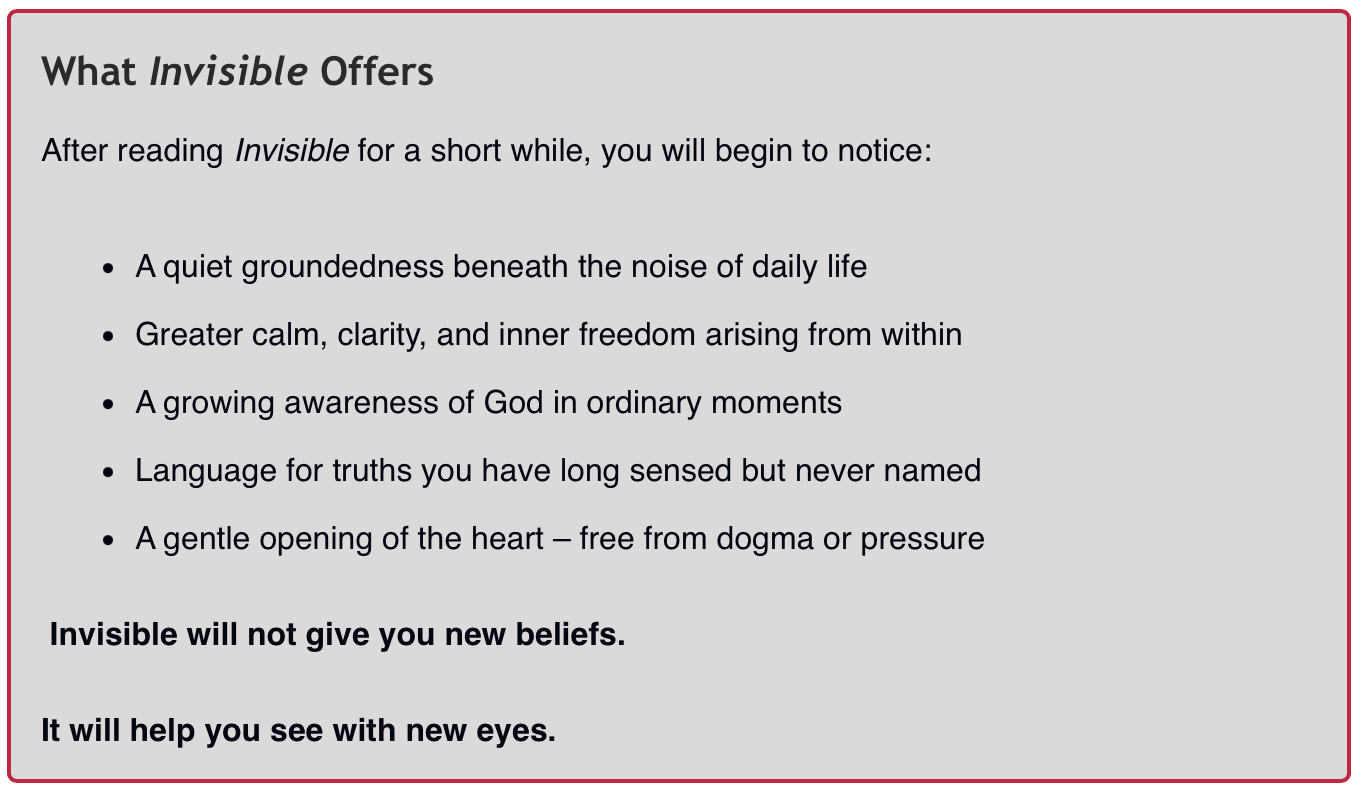
If you are finding this newsletter course helpful, you may want to consider Dr. Kaisch's latest book, Inside the Invisible: The Universal Path to Spiritual Transcendence.👇
58: The Nature of God
Edition #58: Inside the Invisible
I have two requests. First, please send a donation help cover the expense of setting up a new website using the link:
Donations
Second, please send us the email addresses for one of your friends who might enjoy our newsletter to: ken123kaisch@gmail.com
Most people think about theology, if they think about it at all, as the study of God. This is simply a mistake. Theology is not just about God; it’s about how our finite minds construct and encounter claims about the Infinite. There are two streams of thought in this regard, and we will explore each in turn.
The stream of theological thought called cataphatic theology seeks to understand the Divine through concepts and words. In this approach, God is described by using analogies: “God is good, wise, just, etc.” It is a theology of affirmation, but this approach has a serious drawback. The problem is that it easily reduces God to a series of concepts, and this verges on idolatry. It takes us away from the actual experience of the Divine, and we get lost in concepts instead.
Apophatic theology takes the opposite approach. Instead of describing what God is, an apophatic theologian will describe what God is not. This approach begins with the understanding that God is beyond all our knowing and, consequently, it is better to say nothing. The problem with this approach is that it easily slides into vagueness or nihilism.
What both traditions have in common is the assumption that God exceeds the capabilities of our ordinary means of understanding. Both approaches understand the limits of language, and both aim at transformation, not just information. Both agree that God is beyond language. Where they disagree is what to do about it.
* * *
With this conceptual framework, let me share my understanding of the Divine. I am not trying to convince you to see things my way; instead, I want you to understand the bias I’m coming from.
Every approach that uses words to describe the Divine is, in my view, ultimately erroneous. That is not to say that we shouldn’t try, but rather to understand the limitations inherent in our language. The problem is simple: all language is based on dualistic thinking. There is an “I” over here that perceives an “object” over there. Language begins by splitting the deep unity of our experience, and because most of our experience is mediated by language, this split usually occurs outside our awareness, in the unconscious mind.
Before language gives us duality, there is an undivided state – a unitive awareness. In this non-dual awareness, there is simply a “beingness.” We typically experience this non-dual awareness at least twice a day. The first time is just after we wake up from sleep. There is a space between waking and being conscious of one’s self as a separate entity.
The second time we typically experience non-duality is as we drift off to sleep. There is a moment where we let go of our “self.” In this moment, the too-narrow constraints of self dissolve, and one’s being extends into eternity and into Infinity. (You will notice, I hope, that while I prefer the apophatic way of speaking, I am forced to use language and analogy to point at the actual experience of God. Both approaches are necessary, and they both fall far short of an adequate description.)
You’ll notice that I haven’t yet talked about Jesus, about the Trinity, about Krishna or Buddha, or any of the usual terms that are employed when talking about God. In my experience, these labels follow after the direct experience of the Divine. The usual labels are language-based and thus fall within the dualistic realm. As such, they can never accurately describe the non-dual experience.
You will also notice that I typically use the term “non-dual” rather than “unitive.” On the surface, it appears that these two terms are referring to the same thing, but there is a subtle distortion in the term “unitive.” The term gives lie to itself because it implies that a separate “thing” exists, a unitive thing. Once again, we have fallen into the dualistic trap entailed by languaging.
So, what is this non-dual Reality that I keep referring to? Perhaps the most basic description is to label it, “All-That-Is.” This Reality is sentient and loving. It is not just connected with all that is; it actually is All-That-Is. It has been an intimate part of our lives since the very beginning. It holds you and me and all parts of Itself in equal esteem. It offers guidance to Itself and seems to be steering humanity towards a particular end.
Divinity is impartial, non-judgmental, and goes beyond our limited ideas of good and evil, right and wrong. It grants each of its parts the freedom to act or not, as that part chooses, and it holds everyone in the embrace of unconditional Love. This Love is an inclusive field that rejects no one. One experiences Its presence as an exquisite, all-encompassing reality. It is deeply gentle yet infinitely powerful.
Because the Divine is All-That-Is, it sees all and knows all and radiates an infinite field of power. Everything naturally aligns with this power. It exists both within and outside of time and space, and when we experience this Presence, it is unmistakable. We recognize its Presence by virtue of experiencing that same Presence within ourselves. That is to say, at our deepest level, we are one with that Presence.
Having said this, we stand in the midst of several wild paradoxes. First, despite our longing and our many attempts, we cannot comprehend the Infinite by means of our finite cognition. Further, we cannot use language without distorting the Reality language is attempting to describe. Further still, we cannot conceptualize the Divine without reducing that Reality to a point where it becomes unrecognizable. In other words, we cannot contain God with our ideas.
And that brings us to the question: how can we move forward from this place?
* * *
The short answer is this: we move forward when our primary data source shifts from inherited concepts to direct, structured experience. That is, when we “feel it in our bones.” Right about then, we are experiencing the Divine directly. Once you've had an experience of this nature, it is unmistakable!
It’s not about feeling something intense. It’s not about rejecting doctrine and all the concepts about the Divine and the spiritual life we have inherited. It’s not about using “mystical” language. It’s an experience far deeper.
As I see it, there are three criteria that must be met simultaneously for us to experience the Divine directly. First, there is an epistemic shift. Knowledge is no longer about God; it becomes immediate, direct awareness. Instead of representational concepts like “God is good,” we realize that words cease to have any power to explain. The meaning of the experience resides within the experience itself. Sadly, most spiritual seekers stop here. They are still trapped in a dualistic framework and have not yet broken through to the direct and immediate experience of the Divine.
The second criterion is that this experience is stable. Instead of being a feeling that comes and goes, or something that varies, this experience is always present. You may choose not to notice it; you may choose to lose yourself in some other experience. But every time you direct your awareness to the depths within, it becomes present to you in a way that is instantly recognizable.
Third, the experience arises prior to interpretation, and is not borrowed from prior concepts such as Scripture or tradition. Prior concepts necessarily distort our experience. For example, if you feel stillness during a meditation, the tendency is to label it as “God’s presence,” because that’s what we’ve been trained to do. You haven’t yet entered into direct experience; your ideas and concepts still stand between you and it.
There is an interesting twist in this kind of experience. Many genuine mystics have authentic spiritual experiences, but they still describe them using inherited theological frameworks. For example, one might say, “This feels like union.” While the experience may be genuine, the language distorts it significantly and impedes the seeker's progress.
Genuine mystical experience is not constructed out of prior knowledge. It is not recognized through analogy. It is not confirmed by memory. It doesn’t arrive as: “This matches X teaching.”
Instead, the knowing appears before thought. It precedes languaging and concepts. It has a self-validating, independent authority. It doesn’t require validation from Scripture, from teachers, or from any prior beliefs. They are simply irrelevant to the actual experience.
Finally, these experiences don’t point to something else. They are self-evident and self-validating.
Many, perhaps most, spiritual seekers think that they’re having direct insight. In actual fact, they are simply matching a pattern they have experienced against an internalized theology. This does not lead to enlightenment; it is simply high-speed interpretation.
* * *
Looking back on all the words I’ve written, I find myself giggling. For a guy who prefers not to talk about these things and the guy who distrusts his own words, I certainly have scribbled out a lot of them today. And here I thought I was going to talk about the Trinity. So much for my mighty plans!
Again, thank you for your patience and for working through this material with me. I deeply appreciate your willingness to travel these roads with me. As I write, I have a very clear sense of your presence out there, just beyond the limits of my perception. Your presence sustains me in ways you might not fully realize, and I am deeply grateful.
Please remember to set aside time every day for at least five minutes (or more!) of meditation and quiet reflection. Ultimately, our willingness to travel into our own depths will determine how close we come to the everlasting Truth.
May you rest in God’s love every moment of this week!
P.S. Several of you have expressed the desire for an online meditation class. If there is enough interest, I will try to figure out how to hold a group class on the web. If you have an interest, please write me atken123Kaisch@gmail.com.
P.P.S. Several of you have expressed the desire for an online meditation class. If there is enough interest, I will try to figure out how to hold a group class on the web. If you have an interest, please write me at ken123Kaisch@gmail.com.
Humility as a Tool → Letting go → Fear → Openness → Acceptance & Growth
If you are finding this newsletter course helpful, you may want to consider Dr. Kaisch's latest book, Inside the Invisible: The Universal Path to Spiritual Transcendence.👇
57: The Two Faces of God
Edition #57: Inside the Invisible
I have two requests. First, please send a donation help cover the expense of setting up a new website using the link:
Donations
Second, please send us the email addresses for one of your friends who might enjoy our newsletter to: ken123kaisch@gmail.com
Today, I would like to take a break from our focus on church history and look at some of the consequences that flow from our examination. In particular, I would like to focus on the two major ways we experience God: as the transcendent Creator who stands above and apart from all things, and as the imminent Lover of souls, who stands with us in every moment. I have briefly explored this in my third newsletter, but now that we have a more substantial background together, we can go much deeper.
The Transcendent God
First, let’s explore the transcendent dimension of the Divine, because this is probably the God that you are most familiar with. It is the God typically proclaimed in most Christian churches, and while it is accurate as far as it goes, it is partial and incomplete. Because it describes only a part of the Divine nature, it must be considered erroneous unless it includes a description of the imminent dimension of God.
The transcendent God is understood to have created all that Is. This is the God who, in the book of Genesis, said, “‘Let there be light,’ and there was light.” After creation, the transcendent God appears to have left its creation, and believers are promised that they will meet this God again after their death.
Of note, this aspect of God is understood to be both judgmental and punitive. The various religions of the world – both in Christendom and beyond – have catalogued quite a list of transgressions and have described, often in gory detail, the punishments that go with each transgression.
Within Christianity, these transgressions are labeled as sin. The Western Churches have declared that the fundamental truth about humanity is the universality of our sin. This was enshrined in Christian doctrine by St. Augustine, who was the first to clearly formulate the doctrine of Original Sin.
In this view, all humanity is condemned because of the sin of Adam. Because Adam was disobedient to God, he was condemned to leave the idyllic Garden of Eden forever. He is also condemned to work hard all of his life, and his partner, Eve, was condemned to the pain of childbirth. For both, sexual intercourse is seen as sinful and the vehicle through which their original error is passed on to future generations.
Because of this notion of Original Sin, we in the Western churches have concluded that we ourselves are bad; that we are inherently defective. From this, it follows that only God can heal us from our terrible sin and from our inherently rotten human nature.
This account of the relation between God and humanity carries a striking and little-noticed parallel. After creation, the transcendent God appears to separate from his creation, not to be seen again until after we die. In a similar way, humanity appears to be separated from God because of this Original Sin. (So, in effect, human beings are just copying God’s separation from humanity! LOL) We have the mistaken idea that a vast abyss separates us from God because of our inherent defectiveness. In this view, only God can heal us and repair the separation that divides us. Further, our inherent separation from both God and Creation can only be repaired for those who are obedient children of the Divine.
And who decides what obedience looks like? Why, the authorities of the church, of course! And this is where the church's authoritarian structure has corrupted itself. I’m reminded of that wretched quotation from Lord Acton, who said, “Power corrupts, and absolute power corrupts absolutely.”
Just as power corrupts in the political sphere, it also corrupts in the religious sphere as well. The flagrant instances of religious corruption are apparent to us all. Pastor Jimmy Swaggart, with his hellfire and damnation sermons and his repeated dalliance with prostitutes. Jim and Tammy Faye Baker and their wild and fraudulent timeshare schemes. Joel Olstein and his many imitators preaching the gospel of prosperity. Yeah, it’s prosperous all right. It’s prosperous for Joel, who tells folks to send him their money, but it’s not so prosperous for everyone else.
And so, we have, in a shameless display, the corruption that dogs even the highest-minded religious pursuits! It’s enough to make you barf. And when innocents who are stirred by God to begin the spiritual quest see these scandalous goings-on, what are they likely to conclude? Yeah…
The Imminent God
Unlike the transcendent view of God, God's immanence is beautifully illustrated through the person of Jesus. This aspect of the Divine feels close and personal. It is the God who stands with us during our trials and struggles. This is the God who understands how hard it is to be human – how tough it is to have one desire pulling you in one direction and another pulling you in the opposite direction.
This is the God who loves us, understands us, and walks with us through “the valley of the shadow of death.” This is the God who never leaves our side, constantly whispering encouragement and guidance.
There is never a word of condemnation here. This is the God who describes Himself in the story of the Prodigal Son. The selfish son demands his inheritance and then squanders it. Finally, realizing that even his father’s servants are better off than he is, he decides to go home and ask his father to accept him as a servant. When the father sees his son returning, he throws a big homecoming celebration because the child who was lost is now found, and the one who has died has come back to life.
So, you might ask, how does this imminent God handle sin? How does he address our daily feeling that we are somehow broken or flawed?
When thinking about the notion of sin, it’s instructive to look at Jesus's actual words. He doesn’t ignore our wrongdoings or mistakes. The word Jesus used, translated as ‘sin,’ is hamartia. Hamartia is a military term that describes the distance between the center of the bull’s-eye and where your arrow or spear lands. Hamartia was translated from Greek, the language in which the New Testament was written, into Latin as ‘sin.’ Like many English words, the word ‘sin’ was simply borrowed from Latin and plopped down into English. Over time, the meaning of our English word ‘sin’ has drifted far from its original military meaning.
The best one-word translation of hamartia/sin is ‘separation.’ Separation is the English word that best describes the distance between the bull’s-eye and where your projectile landed. Thus, when Jesus refers to people as ‘sinners,’ he means that they are separated: separated from their neighbor, separated from their own innermost self, and always, separated from God.
Notice the vast difference here between the doctrine of Original Sin, which condemns all humanity for someone else’s wrongdoing, and the notion of sin as expressed by Jesus, the imminent dimension of God. One is condemning and punitive; the other is gentle and suggests, by its very nature, the remedy.
And what is the remedy for separation? Using the metaphor described in the Prodigal Son, the remedy is to return home. The remedy is for us to turn away from the self-centered behaviors that have separated us from our Father. There is no condemnation here, or threat of punishment if we don’t return. There is, however, an acknowledgment of the error.
There is a clear recognition that our selfish actions have caused our disastrous separation from the Divine. By following our own desires, we have hidden the essential unity that connects us all. And the essence of that unity? The essence—universally desired by all humankind—is love and acceptance. This is the splendor of the imminence of God – that, no matter what we do or how deeply separated we are, the love God has for us is never diminished!
Given the glorious and universally-desired nature of love, you have to ask yourself, how did we get separated in the first place? What happened that we turned our backs on God, on our neighbor, and on our own deepest desires to be loved and cherished?
Let’s go back to the Prodigal Son for the answer. Why did the younger son ask for his inheritance and leave his father? He did so because he wanted to live the ‘high life.’ He aimed to be the Jeff Bezos of his time; the Elon Musk of the ancient world. He believed that being a big spender would earn him the love and acceptance he craved. The problem with this idea is that people don’t love the big spender for who he is; they love him for his money. And like all finite resources, money eventually runs out.
From this example, we can conclude that separation is essentially due to ignorance. The prodigal son believed he could buy love. He lacked the experience to understand that true love can never be bought with money.
We can push this line of thinking even further. If our ‘sin’ results from ignorance, then our salvation depends on understanding the implicit unity that connects all creation. In this perspective, salvation cannot be achieved through good behavior or deeds. It can only be realized as we come to see the unity that links God to Creation.
For most of you who are reading this, this is a radically different notion from everything you have been taught. While ethics and morality are important in the imminent view of God, they are not the central feature. There is no earning ‘brownie points’ for being a good person or for doing good deeds. You do the good deeds as a reflection of the unity you feel with God and creation. The more you understand this, the more imperative your moral behavior becomes.
Another crucial difference centers around the importance of belief. In the transcendent view of God, belief is all-important. In this view, your belief about the nature of God and the proper role of humanity constitute the guardrails that can keep you on the ‘straight and narrow.’ This leads to the mistaken notion that believing in the right way leads to salvation.
In my view, this is a remarkable mistake! It’s remarkable because, on the face of it, it is simply ridiculous. I can believe all I want that I have a million dollars, but my belief doesn’t make it so. I can believe that I am the most handsome and charming man in the known universe, but my belief doesn’t make it so. In fact, in this latter case, we have all met people who have believed they are very special and above everyone else. We typically view these people as sad specimens of the human race. The only place they are special is in their own mistaken minds.
From the imminent view of God, we are saved as we recognize our unity with the Divine. This recognition is not dependent on a church or any kind of external structure. It is not dependent on external authorities. Instead, salvation depends on us: 1) on our seeing and understanding the nature of our separation, 2) on our learning about our essential unity with God, and, as a result, 3) on our experiencing the essential and underlying unity that binds us to the Divine.
As you might imagine, learning all of this is far easier said than done. Ultimately, it involves a deep dive into non-duality, the actual experience of oneness with All-That-Is. To address this, my team and I are hard at work designing a website to facilitate this deep dive. I’ll keep you updated on the details as we get closer to the release date.
For now, it’s enough to notice that the imminent view of God has not been very well described by most of the theologies that arose following Christ’s execution. Of the four original schools of thought, this view of God is best embodied by the Gospel of Thomas. And, as you will recall, Thomas was universally suppressed by the Church, to the point where only one copy of his gospel has ever been found, and that didn’t happen until 1945.
* * *
Well, my apologies for being a bit long-winded today. Thank you for suffering through all of this. I’m doing my best to approach the spiritual journey with clear eyes and a commitment to discerning the truth. My hope for us all is that we will open our eyes so that we can experience the marvelous love in which God holds us. That we come to understand that we are not defective or broken. A little slow… yeah. A little hard of hearing… sure enough. A little ignorant… yup! But loved and cherished and always held close by the God who created us.
In the everlasting love of our Lord,
P.S. Several of you have expressed the desire for an online meditation class. If there is enough interest, I will try to figure out how to hold a group class on the web. If you have an interest, please write me atken123Kaisch@gmail.com.
P.P.S. Several of you have expressed the desire for an online meditation class. If there is enough interest, I will try to figure out how to hold a group class on the web. If you have an interest, please write me at ken123Kaisch@gmail.com.
Humility as a Tool → Letting go → Fear → Openness → Acceptance & Growth
If you are finding this newsletter course helpful, you may want to consider Dr. Kaisch's latest book, Inside the Invisible: The Universal Path to Spiritual Transcendence.👇
56: The Christian World After Nicaea
Edition #56: Inside the Invisible
I have two requests. First, please send a donation help cover the expense of setting up a new website using the link:
Donations
Second, please send us the email addresses for one of your friends who might enjoy our newsletter to: ken123kaisch@gmail.com
One would hope – after a big shindig like the Council of Nicaea, with the Emperor Constantine and all the important bishops meeting, debating, and deciding – that the fog surrounding Christian theology would lift, everyone would see Truth, and we would all live happily ever after! Despite each one of us having a lifetime of experience watching one conflict transform into another, and then into still another, we cling to our false hopes. Oh well, onward and upward…
* * *
Despite the apparent agreement at Nicaea on the two natures of Christ, major controversies persisted, not to mention a host of other theological disputes. Instead of a unified church after Nicaea, Christianity was divided among several rival groups, each tied to a particular political bloc, language, culture, and a different theology about the nature of God. By 600 A.D., the Christian world had broken into four major parts:
Byzantium, centered in Constantinople, held that Christ had two natures – both fully human and fully divine. This was the seat of imperial rule and control, and it sought to exert its control over the other three divisions.
The Miaphysites, centered in Egypt and Syria, believed Christ possessed one united nature, in which the human and divine natures were fused together. They bristled at the notion implied by previous councils that there were two Christs. These churches existed under Byzantine rule but opposed the Imperial theology.
Persian Christianity, centered in present-day Iran, held that Christ has two distinct natures. They distinguished between the Divine Logos and the human Jesus. These were the Nestorians, who considered both the divine and human natures of Christ to be fully real and complete, and not fused into a single entity. Of note, this church built one of the most remarkable missionary networks in history. By the seventh century, they had Christian communities in Persia, Central Asia, India, and China. A stele in Xi’an from 781 A.D. records this expansion.
Latin Christianity, located in the former Western Roman Empire and centered in Rome. This church emphasized a strong institutional hierarchy with bishops, priests, and deacons, and a growing papal authority. This branch of Christianity was the smallest, both geographically and in population.
Thus, the Eastern part of the Empire had three competing Christian doctrines, each of which regarded the others as heretical. Into this divided Christian world, a new revelation was proclaimed and a new religion born – Islam.
Islam spread with ferocious intensity. In 632 A.D., the prophet Mohammed died. And by 636, the Byzantine army was defeated at Yarmouk. By 640, Egypt had been conquered, and in 651 the Persian Empire collapsed. Thus, within 20 years, the entire Near East changed hands. Prior to Islam, the Middle East was the most Christian region on earth. After Islam, it gradually became Muslim – a process that occurred over centuries.
The Muslim political and military conquests did not destroy a unified Christian civilization. Rather, it entered a world where Christianity was already fragmented into rival theological cultures, and this helped make the Arab conquests possible. On a side note, the taxes imposed on non-Muslims, the jizya tax, were often lighter than Byzantium’s imperial taxation. In effect, for many, the new rulers were less burdensome than the Byzantine rulers.
* * *
So let’s look briefly at some of the other theological controversies of the time.
There was the Pneumatomachian controversy, which explored the nature of the Holy Spirit. Basically, the Church wondered about the nature of the Holy Spirit, whether the Spirit was divine or some subordinate power. While the bishops concluded that the Holy Spirit was a constituent and co-equal part of God, they didn’t spend much ink on the matter. They declared that the Holy Spirit was “Lord and giver of life, and who proceeds from the Father and the Son.” Parenthetically, this seems to contradict the opening of John’s gospel, which states that all things came into being through the Logos, not through the Spirit. In any case, this controversy resulted in the doctrine of the Trinity as we now know.
The Apollinairian controversy revolved around the mind of Christ. While it was clear that Jesus had a human body, Apollinarus wondered whether Jesus' mind was the divine Logos rather than a rational human soul. In effect, he thought Jesus had a human body, but with a divine mind. This was settled at the Council of Constantinople in 381, which established the principle that Christ is fully human and fully divine.
The Nestorian controversy revolved around the nature of Christ. It explored the notion that Christ’s two natures – human and divine – might actually indicate two separate persons. The Council of Ephesus in 431 determined that Christ was one person, not two.
The Monophysite crisis taught that Christ’s humanity was absorbed into the divine nature after Jesus was incarnate. The Council of Chalcedon in 451 pronounced that Christ exists in two natures, without confusion, division, or separation.
While most people who explore these matters grasp the theological nature of these controversies, they often miss the political dimension of these battles. These conflicts also concerned control of the five major patriarchates of the time: Rome, Alexandria, Antioch, Constantinople, and Jerusalem. Each doctrinal dispute was often aligned with regional political rivalries.
By the end of the Council of Chalcedon in 451, Christianity had defined four major elements. It had decided upon a fixed Trinitarian doctrine, a defined Christology, and a hierarchical episcopal structure. It had also solidified its alliance with imperial authority. These four elements would dominate institutional Christianity for the next thousand years.
* * *
I think it’s easy for us to take these controversies lightly because we have only known their result – the institutional Church and its monolithic structure. We have never lived in an era that questioned these doctrines; we have never entertained opposing positions regarding these matters. Most of us have never thought about religion as something existential, as a life-or-death affair. As a result, these controversies seem unimportant, even trivial. After all, what difference does any of this make?
Yet, if you take religion and the spiritual life seriously, these are matters of absolute importance. Come to think of it, you can make a pretty good case that what you do spiritually will affect your outcome for all eternity, right?
Several years ago, I had breakfast with two Muslim friends, one a Muslim cleric and the other a physician. In our discussion, they commented on the Christian doctrine of the Trinity. They were quite puzzled by this formulation of God, coming as they did from a strict monotheism. They understood the concept of God as Father, and from that, the notion of God as Son followed quite naturally. What they couldn’t understand was the notion of the Holy Spirit; it just didn’t make sense to them. They speculated that perhaps the idea of this third part of the Trinity was simply a mistake – perhaps a mistranslation of some key word in the distant past or something like that.
I was stunned into silence by their conclusion. I had never questioned this element of our Christian theology before. Their discussion brought to mind the larger and unstated issue: how do we determine what is real and true in spiritual matters?
Certainly, when you have an avatar like Jesus, you can trust what he has to say. The impact of someone with his extraordinary spiritual powers will always impress his listeners as the Truth. But the truth that we hide from ourselves is that we ourselves have not heard from Jesus directly. We assume that reading Scripture is the same as having a conversation with Jesus. It’s not!
We have heard reports of what Jesus said: reports from Matthew, Mark, Luke, and John, and reports from Thomas, Mary Magdalene, and others. We don’t know how their biases have distorted Jesus’s actual teaching. We also know that these teachings have been filtered through the 2000 years of Christianity’s existence. During most of these intervening years, spiritual matters were repeatedly confused with political expediency. As a result, there are multiple levels where spiritual matters have been compromised and distorted by the various political processes that have contaminated the truth of Jesus’s teachings.
All of this leaves the Church in a most difficult place today. We are pretty confident that Jesus spoke the truth. After all, he was the person who said that he himself was “the way, the truth, and the life.” It seems unlikely that a liar would make such a claim. But beyond that, it’s hard to know where to turn for the truth about spiritual matters.
Thankfully, we have a chain of Christian mystics who have dedicated their lives to following Jesus, who have done their best to embody his holy teachings. Not only that, but the teachings of these Christians are mostly congruent with the teachings of mystics from other religious traditions. As a result, I believe we can proceed with confidence, trusting them. More on this in future newsletters.
* * *
We have taken quite the excursion into ancient church history these past several weeks. I hope I haven’t bored you or lost too many of you in the process. Now, with this as our basis, we can turn to what all of this means for us today. In a word, we will start looking for the nuggets of theological truth hidden amid all this talk of church history. We will begin next week with an in-depth exploration of the very strange notion of Original Sin. I hope you will join me because the next few newsletters will focus on sorting out theological truths from the political BS.
In the meantime, please remember that the Kingdom of Heaven is within you. Take some time to let go of your thinking, to let go of all the busyness in your life, and just BE. The promise is this: when we find our own being, we enter into the Being of God, and in the process, we realize that the Kingdom is truly within us.
Rest in the loving embrace of our Lord! Let his loving-kindness bring you to your deepest fulfillment!
P.S. Several of you have expressed the desire for an online meditation class. If there is enough interest, I will try to figure out how to hold a group class on the web. If you have an interest, please write me atken123Kaisch@gmail.com.
P.P.S. Several of you have expressed the desire for an online meditation class. If there is enough interest, I will try to figure out how to hold a group class on the web. If you have an interest, please write me at ken123Kaisch@gmail.com.
Humility as a Tool → Letting go → Fear → Openness → Acceptance & Growth
If you are finding this newsletter course helpful, you may want to consider Dr. Kaisch's latest book, Inside the Invisible: The Universal Path to Spiritual Transcendence.👇
55: The Politics of Nicaea
Edition #55: Inside the Invisible
I have two requests. First, please send a donation help cover the expense of setting up a new website using the link:
Donations
Second, please send us the email addresses for one of your friends who might enjoy our newsletter to: ken123kaisch@gmail.com
When I was a little boy in the 1950s, the prevailing opinion among the adults in charge of such things was that the Church knew all the answers, and the job of the person in the pew was to accept those answers at face value. When I went to seminary in the 70s, cracks were beginning to appear in this monolithic edifice.
Today, with the Christian Church in retreat, we have begun to realize that the Church has never been a monolithic structure, that there have always been profound divisions.
Practically speaking, this means there are no easy or universal answers. We must each sift through what is known about God on our own. We must each find our own answers. I’m hopeful that these essays on church history will help you find yours.
* * *
The answers the Church claims are universal and God–given are actually responses to specific problems that arose at particular times and in particular places.
And this brings us, in our present narrative, to the politics that drove the theological narrative arising from the Council of Nicaea – the politics the Church deliberately overlooks.
As an Episcopal priest with a graduate degree in these matters, I was taught to believe that Nicaea was about finally understanding the truth of Jesus’s nature: was Jesus human, Divine, or some combination of the two? But by focusing on the Christological issue, which is a theological concern, the Church has completely overlooked what actually happened.
The Council of Nicaea was about politics! Any concern about religion and spiritual matters was a distant second. The Council of Nicaea was not called into being by the Church itself. No. It was the Emperor, Constantine, who called for the Council and presided over its opening. What’s more, only one major issue was solved; most of the other theological issues remained without clear solutions. And the one issue that was addressed was handled with vague language to avoid offending or excluding the major political factions of the time. So, what we really have is a political compromise, which was then presented to the people as the Truth.
Here, for me, lies the strangeness, the utter weirdness of this Council. I had always understood this as a gathering of the bishops of the major churches around the Mediterranean to resolve the various heresies of the Church. As you know, there was no clear authority regarding spiritual matters in the church in its first 300 years. As a result, all sorts of strange aberrations about the nature and life of Jesus arose. (To give you an idea of how strange, consider the “gospel” that described Jesus’s boyhood as one of creating toy soldiers out of mud, breathing life into them, and watching them battle it out for his own entertainment.)
So, some sort of gathering was necessary to figure out the boundaries of this new religion. What does Christianity actually believe? What was the true nature of Jesus – was he fully human, fully divine, or something else again? The resolution of these questions was critical. You can’t just have someone going around – kind of like we have today – saying that Jesus is from another planet, or that the holy Eucharist is some kind of magical potion. (Strangely, we seem to be replicating the chaos of the early Church in our own time, with all sorts of strange claims by folks who claim authority in the Christian world, but who are making claims that cannot be verified!)
* * *
So, back to Emperor Constantine and the Council of Nicaea. After decades of civil war, Constantine had recently unified the Roman Empire through military means. By 325 A.D., the Empire was a patchwork of territories (most of them conquered and occupied by Roman armies), ethnic groups, and religions. In addition, the Empire was divided socially into Roman citizens (who had all the rights and privileges), noncitizens, and slaves. Constantine’s problem was finding some way to unite these different factions into a coherent whole. As you might imagine, governance would be impossible without a single frame of reference that was more or less acceptable to everyone.
Constantine looked to the Christian church as the potential ideological glue for his empire. As he looked into the matter, however, he found, instead of unity, a series of bitter doctrinal conflicts, especially in Egypt and the eastern provinces. The central controversy was called the Arian dispute.
Arius argued that the Son was created by the Father, and therefore was not eternal. He had a clever slogan, “There was when he was not.” As you will remember, the theology of John stated the opposite in the opening words of his gospel: “In the beginning was the Word, and the Word was with God and the Word was God. He was in the beginning with God.” This was clearly a statement aimed directly against Arius and his teachings. This dispute spread rapidly across the eastern empire, creating considerable chaos.
Poor Constantine. He thought he had picked a winner with this new religion, Christianity, but apparently, he didn’t check that horse’s mouth very carefully. For Constantine, this theological dispute was perceived as a threat to Imperial unity, and he could not let it stand. As a result, he imposed a Council on the Christian bishops to force a settlement.
This Council took place over several years, and between 200 and 300 bishops attended, mostly from the Greek-speaking Eastern Empire. Very few Western bishops were present, so this was not a representative assembly like we know today. Constantine himself opened the Council, which is a clear indication of how important it was to him. The central theological issue debated by the bishops was: “Is Christ fully divine?”
Of note, Arius’s position – that the Father is eternal and the Son is created and is therefore subordinate – actually preserved a strict monotheism. This position, however, lost the political battle. Arius’s opponents, led by Athanasius and Alexander, held that the Son is eternal and shares the same divine nature as the Father. Specifically, they said that the Son was of the same substance as the Father. This became the foundation of the Nicene Creed.
So much for the theological controversy. Now let’s get to the heart of the matter and look at the politics. This theological debate did not occur in a vacuum. Constantine exerted direct pressure on this gathering of bishops. Remember, in the Roman world, the Emperor held the power of life and death over his subjects, and he had a substantial military to enforce his will. He expected an agreement, and the bishops knew that if they did not agree, they would be exiled, or worse. And that is what happened to Arius and his followers: the dissenters were branded as heretics and punished with exile.
* * *
Let’s step back from these historical events for a moment and look at the implications of these developments. At the very beginning of the Christian church, we have the ruling political leader, Emperor Constantine, dictating the Church’s spiritual beliefs. While the Emperor let the bishops debate among themselves about what was true spiritually, he made the final call. As a result, we cannot be sure that these claims about the nature of Jesus are true, because they come from a political rather than a spiritual authority. We do know with certainty that Constantine had the final say in this matter, and we do know that his central aim was to create a unifying ideology acceptable to all the people he governed.
A second compromising factor lies in the way the bishops arrived at spiritual truth: they debated with each other, and in the end, they voted. To make this matter clear, this means that the bishops, in their many conversations, also determined spiritual truth by politicalmeans. While they did not have the power to impose their will as Constantine did, they used a similar political process.
To make matters even worse, the final wording adopted at Nicaea was rather slippery. “Constantine’s one overriding motive was to secure the greatest possible agreement” to bring as many as possible under his rule. To secure this end, the Council was willing to use rather vague language in its final formulations. This language allowed for the widest possible measure of agreement, thus satisfying Constantine’s overriding concern.
* * *
So, where does that leave us today? In my mind, and after looking at these data, it seems like the Church has both feet firmly planted on solid air! While we have thought that the major tenets of the Christian faith have been based on revelation from God, it turns out that many of these same tenets are the result of political compromises. While they may state truth, we seem to have little spiritual basis for these assertions. Ironically, I am reminded of the rationale many young people give when they are caught doing something illegal or immoral: “Well, it seemed like a good idea at the time.”
Since we turn to God and to our religion for certainty and truth, this conclusion is rather frightening. And yet, if you sit with these ideas, it becomes clear that we are being called to look deeper. To look much deeper. I believe we are each called to look within and to discover the living Christ who dwells in our hearts. To discover and experience in our own flesh the “Kingdom of Heaven” that lies within us.
There is a problem with this view, of course. It means that ultimately each of us is our own authority. And here we come face-to-face with the central problem of the early church: who is in charge? Who has the final authority to determine spiritual truth from falsehood? So let’s continue with our explorations.
* * *
Returning to our central narrative, Nicaea created an Imperial Church. It did not immediately end the Arian controversy – that continued for several hundred more years. It did not address most of the other early heretical movements, such as the Gnostics, the Marcionites, or the Ebionites, either. That said, the alliance of the Church and the Empire marginalized and eventually suppressed these movements. In effect, the Imperial Church gained the power to define orthodoxy.
The key feature of this alliance between church and state was that the state enforced doctrinal authority. The Spanish Inquisition is a vivid example of this kind of alliance. It also meant that bishops functioned as arms of the state, within the Imperial administration. Finally, it meant that theological disputes were treated as issues of public order and, therefore, subject to Imperial rule. This fusion shaped Christianity for the next 1500 years.
The real significance of Nicaea is not the creed that bears its name. The real significance is that Christian doctrine became a matter of Imperial governance. After 325 A.D., theology was no longer just a religious debate. It became a political question about the stability of the Roman Empire.
The Nicene Council did not produce unity. It produced an enforceable orthodoxy, and these two are not the same thing. The Empire gained a uniform ideology, but theological conflict within Christianity intensified over the next two centuries. We will look at this intensification in our next newsletter.
* * *
Again, thank you for your patience and for continuing to plow through this material. I myself am fascinated by the parallels between the early church and our own time. Understanding the historical antecedents allows us to draw more sensible conclusions about our faith. I have always felt that finding the truth about something is both important and valuable. I appreciate your willingness to travel down these roads with me. Thank you.
Please remember to set aside time every day for at least five minutes of meditation and quiet reflection. Ultimately, our willingness to travel into our own depths will determine how close we can come to the everlasting Truth.
May you rest in God’s love every moment of this week!
P.S. Several of you have expressed the desire for an online meditation class. If there is enough interest, I will try to figure out how to hold a group class on the web. If you have an interest, please write me atken123Kaisch@gmail.com.
P.P.S. Several of you have expressed the desire for an online meditation class. If there is enough interest, I will try to figure out how to hold a group class on the web. If you have an interest, please write me at ken123Kaisch@gmail.com.
Humility as a Tool → Letting go → Fear → Openness → Acceptance & Growth
If you are finding this newsletter course helpful, you may want to consider Dr. Kaisch's latest book, Inside the Invisible: The Universal Path to Spiritual Transcendence.👇
54: The Theology of St. Paul and Beyond
Edition #54: Inside the Invisible
I have two requests. First, please send a donation help cover the expense of setting up a new website using the link:
Donations
Second, please send us the email addresses for one of your friends who might enjoy our newsletter to: ken123kaisch@gmail.com
Over the past month, we have explored the original Torah–based Christianity that was centered in Jerusalem and around the person of James the Just, the brother of Jesus. We then went on to explore the theology in the Gospel of Thomas, and the Johannine theology. These last two perspectives are almost polar opposites: Thomas focuses on the humanity of Jesus, while John focuses on the cosmic Christ. Now we turn our gaze to the theology we are most familiar with, that of Paul.
* * *
Paul’s story is a curious one. He begins his spiritual journey as a Jewish Pharisee. As such, he was not just opposed to Jesus and his teachings, he was an active persecutor. A passage in Acts states that he was “ravaging the church by entering house after house, (and,) dragging off both men and women, he committed them to prison.” (8.3)
On his way to Damascus to arrest more of Jesus’s followers, Paul had a mystical experience – a vision of Jesus – who said to him, “Saul, Saul, why do you persecute me?” This experience left him blinded, and three days later, a devout follower of Jesus, Ananias, laid hands on him and Paul’s sight was restored. From that moment, Saul became a follower of Jesus and changed his name to Paul.
Can you imagine the consternation among the apostles and the followers of Jesus? This vicious cop, who rages through the Christian community and drags whole families off to prison, has a conversion experience? Claims to have had a vision of Jesus? Claims now to be an apostle, equal to the 11 remaining disciples? What you do with this? Do you take him at his word or do you throw him and his so-called conversion out into the street?
Paul and his claims posed a serious problem for the early followers of Jesus. Remember the difficulty of their situation. Their leader has been arrested, tortured, and executed as a common criminal. The Jewish establishment – the Pharisees and the scribes – were out for blood. And this guy, Saul, has Christian blood on his hands. But now he’s claims to be a new man, with a new name, and he’s suddenly saying that he’s on your side. Does this really sound credible?
The problem facing the disciples was one of authority: there was no central authority that could pass judgment on the genuineness of Paul’s conversion. He was certainly regarded with great suspicion, but there was no clear way to get rid of him. As a result, he was rather grudgingly accepted.
So, that’s how Paul’s Christian journey started. What is even more amazing is how it ended. Paul’s understanding of Jesus and his teaching – that is,his understanding of the man whom he never heard, who he never met – becomes the predominant understanding of the Christian church! Paul’s theology was the winner in the “Christian Theological Sweepstakes,” and it is his understanding of Jesus that most Christians accept as “gospel” today. What a stunning turnaround!
* * *
So let’s trace, as best as we can, how Paul’s theology developed. His earliest letter, the first letter to the church in Thessalonica, is apocalyptic in nature. He proclaims Jesus as the risen Lord and encourages the church there to prepare for his imminent coming and the last days. You can see how this would follow from his vision. That’s exactly what he experienced – the risen Christ is coming and is coming right now!
Of course, as we now know, the world was not destroyed in an apocalyptic cataclysm, so Paul’s thinking gradually changes in response. He is surrounded by most of the original disciples who adhere to a Torah–driven theology, with an emphasis on following the Law. Paul, on the other hand, is a Roman citizen and has a more cosmopolitan perspective. He wants to carry his understanding of the message of Jesus to the wider community of Gentiles. For him, “Jewishness” is no longer at the core of Christian identity.
Paul’s theology, however, is not systematic. He doesn’t sit down and write a treatise about Jesus, God, the Holy Spirit, and humanity. Rather, his theology develops in response to various crises in the Christian communities throughout the Mediterranean. He addresses factionalism within the church, and the charismatic disorder in Corinth. In Galatians, he addresses the Torah crisis and the identity boundary of circumcision and following the Jewish law. In later letters he explores the differences between justification by faith versus justification by works, and he breaks with the Torah–boundary logic.
Then, in his most mature work, the letter to the Romans, Paul connects Adam and Christ as part of a master narrative. Here he states that sin came into the world through the disobedience of Adam. Conversely, Jesus’s actions – his obedience to the will of the Father – have redeemed humanity. In effect, Paul has taken the Jewish issue of who to include as a Christian and reframed the problem. Now it is no longer an issue of following the Law. Now the issue is a universal one – one that tries to address both our sense of human wrongdoing and the intervention of God’s grace through the person of Jesus.
By adopting Paul’s understanding, the Church frames the problem as a problem common to all humanity. This positions the Church as an institution that solves our universal problems and as an institution that is open to everyone.
* * *
Now, you might wonder, like I did, how Paul came to link Adam with Jesus. It turns out that there was an already-existing stream of thought in Judaism that connected Adam’s transgression with death. In the Torah, in Genesis 3.19, God confronts Adam after the apple and condemns him to death: “You are dust, and to dust you shall return.” Notice that only Adam is condemned to death here; there is no universal condemnation of humanity at all. In the Jewish line of thinking, Adam’s disobedience resulted in a corruption of the natural Edenic human condition. This is far different from the Christian notion of an indelible and universal stain.
This was not yet a doctrine of Original Sin. That would come later, in the fourth century, with St. Augustine. At this point, there was no fully worked out theory of inherited guilt transmitted by procreation. There was no defined account of infant guilt. And there was not even a clear concept of an “original” sin. In fact, the Jews of that era had no concept of Original Sin.
Let this fact settle in for a moment. The people who gave us the story of Adam and Eve did not give us the doctrine of Original Sin. To this day, Jews do not believe in Original Sin. The truth is, this doctrine was made up some 400+ years after the death of Jesus by Augustine of Hippo.
While early Christian writers discuss Adam, death, corruption, and the human propensity to sin, the notion of an inherited guilt was not a settled doctrine in the first and second centuries. The notion of Original Sin is developed by Augustine in the fourth and fifth centuries – much later.
Augustine argued that humanity is radically dependent on grace, and he argued for the notion of inherited guilt. This concept has been widely spread throughout Western Christendom and is a central dogma in most Western denominations to this day. Of note, Eastern Christendom, while accepting the notion of an inherited mortality as a result of Adam’s disobedience, did not accept the notion of an inherited guilt.
If you will, Paul supplies the raw materials necessary for the doctrine of Original Sin. Augustine then builds the Western theology of hereditary guilt and salvation through Christ’s actions out of the raw materials which Paul supplied. Paul was trying to make Israel’s God acceptable to the Gentiles at scale. To do this, you need a universal anthropology – a doctrine of wrongdoing leading to death that applies to all humanity – to justify a universal remedy, namely Christ. This new doctrine obliterates the Torah boundary markers and opens the Christian faith to everyone.
* * *
In my understanding, the notion of Original Sin is simply wrong. It’s based on a misunderstanding between our current understanding of sin and the sin that Jesus spoke of. He didn't speak to condemn sinners. He doesn't speak to condemn you or me. His admonitions, if you can even call them that, are to return to our relationship with God, our connection with the Divine. He calls us with the deepest love to remember our true nature – to remember that Christ, the son of God, lives within us. To remember that we, too, are his children. His beloved children!
* * *
Well, I suspect I have given you more than enough to wrap your head around for this week. When we sift through the early Christian writings, we can clearly see how our forebearers had to create the Church as they went along. Without this historical perspective, we simply assume that the Church has a set of coherent and well-thought-out answers that can solve all of our problems. In actual fact, nothing could be farther from the truth.
The answers that we accept as dogma today were actually responses to specific problems at specific times and places. They are not universal answers, suitable at all times for all believers. Thus, in my view, it is up to each follower to examine the data and to determine for themselves what is true.
It is abundantly clear that the Church has made many errors throughout its history. There are so many and they are so obvious that there is no need to attempt an accounting here. It is sufficient to say that God did not make that bump on the top of our necks just to attract the opposite sex. He created us with minds to think and with a desire to understand the truth. To do any less means that we turn our back on the Truth. To do any less means that we turn our backs on God.
Thank you for your perseverance in reading through these essays. Please remember to spend some time every day going within yourself and meditating. As Jesus says, “The kingdom of God is within you.” It is by looking within that you will find your greatest freedom. It is by looking within that you will find the everlasting Love of God!
In the peace of God which passes all understanding,
P.S. Several of you have expressed the desire for an online meditation class. If there is enough interest, I will try to figure out how to hold a group class on the web. If you have an interest, please write me atken123Kaisch@gmail.com.
P.P.S. Several of you have expressed the desire for an online meditation class. If there is enough interest, I will try to figure out how to hold a group class on the web. If you have an interest, please write me at ken123Kaisch@gmail.com.
Humility as a Tool → Letting go → Fear → Openness → Acceptance & Growth
If you are finding this newsletter course helpful, you may want to consider Dr. Kaisch's latest book, Inside the Invisible: The Universal Path to Spiritual Transcendence.👇
53: The Christianity of St. John
Edition #53: Inside the Invisible
I have two requests. First, please send a donation help cover the expense of setting up a new website using the link:
Donations
Second, please send us the email addresses for one of your friends who might enjoy our newsletter to: ken123kaisch@gmail.com
Over the past two weeks, we have been examining the different schools of Christian thought that developed after Jesus’s death. First, we looked at those followers of Jesus who kept their Jewish identity: those who followed Jewish laws and worshiped at the Temple. Last week, we studied the Gospel of Thomas and the very different theology promoted by the Thomasine school. Today, we focus on the Johannine school – a school of thought that developed in the late first century, between 80 and 100 A.D., and seemed to revolve around the city of Ephesus.
Johannine theology was much more successful than the theology of Thomas. For one, this school of theology left behind four texts: the Gospel of John and the three letters of John, all found in the New Testament canon. This strand of Christ-centered teaching appears to have centered in Asia Minor and remained as a separate and identifiable theological strand until the Council of Nicaea in 325 A.D.
Johannine theology served as the bridge between Jewish monotheism and the Nicene Trinitarianism. It has a very high concept of the nature of Christ, and in this way, it is very different from the other theological schools that emerged after Jesus’s death. For John, Jesus stands outside the created order and existed prior to it. This pre-existing Logos then incarnates, as stated in the Gospel of John: “The Word became flesh.” This Word maintains a constant unity with the Father: “The Father and I are one.”
As a result, Jesus is clearly seen as the Son of God. Jesus's role, then, is to reveal the Father to humanity. In addition, Jesus is understood as the Son of Man, but in this role, he functions more as a cosmic apocalyptic figure rather than just a human being.
Like the Gospel of Thomas, John emphasizes that eternal life is available now, and the resurrected life is already present. In essence, he internalizes the apocalypse. Eternal life is available right now, and judgment is occurring in the present moment. Resurrected life is already present and available.
In contrast with Thomas, though, John has an explicitly dualistic theology. He sharply contrasts between light and darkness, between above and below, between truth and falsehood, and between the children of God and the children of the devil.
For John, Jesus is not simply the Messiah. He is the self-revelation of God.
The God of John is radically transcendent, for no one has seen God – he is above and beyond all human knowledge. At the same time, God is fundamentally imminent— an inward Presence that manifests through the power of the Spirit. Here, we see that John’s concept of the Holy Spirit is central to his teachings. For John, the Spirit provides the believer with ongoing revelation and serves as both an internal teacher and a continual source of authority.
Of note, John’s understanding of the Holy Spirit differs significantly from that held by fundamentalist groups today. While the Holy Spirit is both teacher and a source of authority, there is no speaking in tongues, prophecy, healing, or the other manifestations attributed to the Holy Spirit today. Charismatic phenomena were not central to Johannine self-understanding. For this school, the Spirit’s primary function was revelatory and ontological, not performative. Authority rested in truth and relational participation, not spectacle.
Johannine theology differed in other respects as well. For example, there are several key female figures in John, including the Samaritan woman, who is the first to question Jesus about theological matters; Mary of Bethany, who is cast as the model disciple; and Mary Magdalene, the first witness of the resurrection. All of this suggests, in contrast to the widespread patriarchal frame of that time, that women were seen by this group as having theological agency. This further suggests a less rigid ecclesiastical hierarchy. The epistles of John, however, reflect a tightening of these boundaries over time.
The Johannine school derives its authority from three sources. The first is from eyewitness testimony. John frequently uses the phrase, “we have seen,” and this grounding in the visible and in personal experience of Jesus constitutes the initial basis for authority. In addition, John refers to the ongoing teaching of the Holy Spirit as a further basis for authority. Finally, John roots his authority in what he believes to be the correct cosmic Christology.
Over time, authority increasingly shifted towards episcopal structures. As Ignatius of Antioch and other bishops of the era asserted their primacy and authority, the Johannine communities appear to have gradually adopted this view.
* * *
There were several serious conflicts, both within the Johannine community and with other communities that existed at the time. John’s letters clearly reflect a split within his community. They describe a group that has “gone out from us” (1 John 2.19). This group appears to have held the belief that Jesus only appeared to be human; that he did not truly possess a physical body, and thus, he did not actually suffer. This view was competing with John’s understanding of Jesus’s Incarnation, and it created in a significant disruption of communal authority as a result.
There were also major conflicts with the broader Jewish community. The Johannine school seems to have originated within the community of Jewish Christians, led by James the Just. As Johannine theology developed, both the Jewish Christians and the larger Jewish community came to regard these followers of Jesus as heretics. Consequently, they were expelled from the synagogue. In effect, they were pushed out of their own religious environment.
This conflict produced a theological radicalization within the Johannine community. Their sense of Jesus as the Messiah escalates to Jesus as the pre-existent Logos, who is eternally one with the Father. The more Jesus is rejected by the Jews, the more cosmic he becomes for this Christian community. One of the consequences of this was an increasingly sharp dualism, with binaries such as light versus darkness, truth versus falsehood, and tellingly, the children of God versus the children of the devil. These binaries are conflict language, and they function to preserve group identity after expulsion.
This conflict reshapes the Johannine understanding of Jesus. Since they can no longer worship in the Temple, the Temple is vilified, described as a “marketplace,” and becomes the abode of the moneychangers. Jesus then speaks of himself as the new temple, which God will raise up in three days. In effect, the Johannine school, being expelled from the synagogue, relocates sacred space into Christ.
You can see the traumatic effects of this expulsion here. Jesus, the disciples, and the Johannine community were all Jews. This means that the Gospel of John is rightly understood as describing a family feud. The vilification of the Jews in John’s Gospel has nothing to do with the anti-Semitism of later Christians.
It is important to understand that the harsh language (“children of the devil”) found in John is trauma language. John is writing from a sense of profound loss. For John’s community, it must’ve felt as if they were pushed out of their spiritual home by the people they were regarded as brothers and sisters.
The third and final conflict experienced by the Johannine community occurred in the second century. During this century, spiritual authority began to coalesce around the person of the bishop of the in these early Christian communities scattered around the Mediterranean. You can see how this conflict might arise. The followers of John believed that the Holy Spirit is present in the hearts of the followers of Jesus, and this Spirit, coming from the Father and Jesus, is the ultimate authority. The bishops of the various churches, especially Clement of Rome and Ireneus, vigorously contested this.
This development did not just come out of nowhere. It was the bishops’ response to the plethora of competing ideas about Jesus that arose during this time. Remember, this development takes place before there was any recognizable authority. There was no list of authoritative scriptures to rely on. There was no set of Christian beliefs by which you could judge a theology. There was no central Christian leader who would determine whether a theological statement was true or false.
As you might suspect, this chaotic matrix gave rise to all kinds of wild speculations about the nature of Jesus, the nature of God, and the nature of humanity. The bishops were faced with the problem of sorting through this unholy mess. As a result, the bishops of Rome, Antioch, and Alexandria began asserting their primacy and their authority.
They were guided by several principles. First, they asked if the doctrine was rooted in the apostles of Jesus. Given that these men (and women) had actual direct experience with Jesus, their doctrines were likely to be closer to the truth than those who had no such direct experience. Second, an orthodoxy, based on writings attributed to the apostles, was beginning to emerge in Christian thinking. Did the doctrine conform with this emerging orthodoxy or was it in opposition? These criteria, promulgated by the bishops, came to define early Christian thinking and doctrine.
Of note, Johannine theology was flexible enough to be claimed by multiple factions in these early years. It’s theology was absorbed into the emerging catholic (here meaning “universal”) orthodoxy. Thus, the Gospel of John is fully canonical and Johannine theology has become mainstream. The independent school, however, did not survive.
* * *
The outcome was this. The cosmic Christology of John becomes the foundation of Nicene theology. Spiritual authority, on the other hand, is subordinated to the episcopal structure. Female agency is reduced in this later catholic consolidation. The pronounced dualism of John is moderated, and the independent Johannine communities are absorbed into the catholic institutional church.
Here is the strange conclusion. The Johannine school was theologically radical, mystically inclined, and centered around a cosmic Christ and an indwelling Holy Spirit. In effect, it’s theology triumphed over him most of the competing theologies of the time. That said, by 300 A.D. the school as a movement had vanished. What a paradoxical outcome!
* * *
Well, that’s enough for today. Next week I will try to close this series by looking at the grand winner in the “Christian Doctrinal Sweepstakes,” the strange theology of St. Paul. I hope you are finding these essays interesting, and they are helping you to understand how our apparently monolithic faith came to be. When you start to take it apart and examine the pieces, you begin to see why the Christian faith has so many conflicting and contradictory elements. The difficulty, in my view, is that spiritual truth is often forsaken in the process.
As a result, many have been (and are currently being) misled. As a result, instead of the spiritual freedom promised by Jesus and all of the great avatars, sincere seekers are misdirected away from the Truth. They find themselves locked in belief structures that loop upon themselves, creating a kind of mental jail. From long observation, I have concluded that mental jails are much more difficult to escape from than the ones built from concrete and steel.
Please remember to take time every day to go within yourself. Your freedom lies there, and is waiting for you to come and take the key and step into the fullness that God has created for you.
God bless you!
P.S. Several of you have expressed the desire for an online meditation class. If there is enough interest, I will try to figure out how to hold a group class on the web. If you have an interest, please write me atken123Kaisch@gmail.com.
P.P.S. Several of you have expressed the desire for an online meditation class. If there is enough interest, I will try to figure out how to hold a group class on the web. If you have an interest, please write me at ken123Kaisch@gmail.com.
Humility as a Tool → Letting go → Fear → Openness → Acceptance & Growth
If you are finding this newsletter course helpful, you may want to consider Dr. Kaisch's latest book, Inside the Invisible: The Universal Path to Spiritual Transcendence.👇
52: The Gospel of Thomas and the Thomasine School
Edition #52: Inside the Invisible
I have two requests. First, please send a donation help cover the expense of setting up a new website using the link:
Donations
Second, please send us the email addresses for one of your friends who might enjoy our newsletter to: ken123kaisch@gmail.com
Last week, we began looking at how the church came into being in the aftermath of Jesus’s execution. We explored how James the Just, the brother of Jesus, was the initial leader of this proto-Christian movement. Centered in Jerusalem, this school of thought focused on tailoring the life and message of Jesus to fulfill the messianic hopes of the Jews. They created communities that focused on the Torah and keeping the many laws prescribed by Judaism.
As we continue our archaeological dig, the next earliest development hinges on an almost forgotten gospel, the Gospel of Thomas. This is a fascinating development because it shows very clearly the power struggles among those early groups who were attempting to follow Jesus's teachings.
The only known copy of the Gospel of Thomas was found buried in the sands of the Egyptian desert in 1945. It was found along with many other books from the early Christian era that were suppressed after the Council of Nicaea in 325 A.D. Some of these books are fragmentary, while others, such as the Gospel of Thomas, appear to be complete.
Biblical scholars initially dismissed the importance of these books and simply labeled them as gnostic texts. This put them in the category of “interesting collateral information,” but not really very important. As later scholars examined these texts, however, they drew very different conclusions. They began to see a plethora of viewpoints in the early Church that had been unknown until then.
What emerges from this finding is a dawning understanding of what happened to these followers of Jesus as they dispersed after his death. Instead of a single, monolithic faith, the first 200 years after Jesus' death appear to have been a time of great spiritual exploration. Remember, in the chaos that followed Jesus’s execution, there was no creed or statement of faith. There was no Scripture to refer to for answers. There was no authority to settle questions of belief. There was no way to separate the truth about Jesus and his teachings from what was false. The situation was chaotic.
Imagine, for a moment, what you might do if you found yourself in this situation. It seems reasonable that you would collect the stories that you and your friends remembered about Jesus. Then, depending on your biases, you would begin exploring what the stories meant. In other words, you would begin to theologize and make meaning from these stories.
It’s important to note that you would not be working in isolation. There would be other groups of Jesus followers scattered throughout the Mediterranean, and other points of view about his teachings. As a result, it seems natural that very different theologies would arise.
Let me give you some examples. We know that Paul thought that women should be seen but not heard in a church setting. While he had a number of female helpers, Thecla and Phoebe come to mind, he clearly reflected the patriarchal culture of his Jewish heritage. Other Christian writers from this era had very different ideas about the proper role of women.
In the same cache of documents as the Gospel of Thomas, we find fragments from the Gospel of Mary. Authorship of this book is attributed to Mary Magdalene, and it clearly indicates her role as an equal to the Apostles. In this gospel and in other texts, there is no mention of the alleged prostitution that was later associated with Mary Magdalene. Other texts support this very different understanding of a woman’s role, and indicate a much more robust role for women than Paul was comfortable with.
Even more astonishing, we find fragments from a book titled “The Thunder, Perfect Mind.” This text, delivered by a female in the first-person voice, is filled with passages like the following:
“I am the first and the last.
I am the honored one and the scorned one.
I am the whore and the holy one.
I am the wife and the virgin.
I am the mother and the daughter,” and so on.
What do you make of the book filled with these wild contradictions? These strange paradoxes? Among other things, we can certainly conclude that there were serious differences, and even contradictions among the different proto-Christian communities scattered around the Mediterranean.
As we will show later, the political needs of the Roman Empire led to the suppression of all these points of view, save one – that of Paul and his doctrine of sin and salvation by faith. As I reflect on this, I am deeply saddened. This suppression, while politically expedient at the time, deeply damaged our understanding of the person of Jesus and damaged our understanding of his teachings.
* * *
So let’s go back to where we began today – looking at the Gospel of Thomas.
This gospel is very different from the four canonical Gospels found in the New Testament. It has nothing about Jesus' birth and nothing about his death and resurrection. Instead, it comprises 114 sayings attributed to Jesus. While versions of some of these sayings are familiar, others are strikingly different.
I’m going to assume that most of my readers are not familiar with the Gospel of Thomas. Thomas's ideas are radically different from those in the New Testament. This does not mean they are “wrong.” Rather, it underscores the point that there were many different interpretations of Jesus’s life and teaching, as well as serious power struggles between competing proto–Christian communities. You might think of it as parallel to our present situation, where Orthodox, Catholic, liberal Protestant, Evangelical, and Fundamentalist theologies all compete with one another.
Here is a timeline that we can reconstruct from the available evidence. For the first 20 years after Jesus’s execution, sayings and narratives about his life were collected, but there were no authority structures. Between about 50-70 A.D., several groupings of Jesus’ sayings began to be compiled, one by Thomas and the other by Mark. Between 70 and 90 A.D., the synoptic Gospels were consolidated. From about 90-110 A.D., the Johannine understanding of Christ emerges as a cosmic and mystical interpretation of Jesus, an interpretation that was quite different from the portrait described in the synoptic Gospels. Finally, around 110–130 A.D., a bishop–centered authority emerges, driven by Ignatius, the Bishop of Lyons, among others.
The Gospel of Thomas stands in clear opposition to what came to be known as the institutional Church. Rather than describing humanity as sinful and broken, as Paul did, Thomas asserts that Reality is whole and that our ignorance of what is real is the core problem. This ignorance is overcome through insight and seeing Reality. Christ Jesus does not stand as a mediator in this account; in fact, no mediator is necessary because Reality is available for anyone with “eyes to see.”
This version of Christianity repudiates the control structures of the emerging Christian orthodoxy. It was implicitly anti-Imperial. There was no glorification of Rome, no legitimization of violence, and no cosmic endorsement of Empire.
It was also explicitly against ecclesiastical authority. It denied the notion of apostolic succession or any external authority. It denied that belief alone could result in salvation. Instead, the Thomasine school asserted that Truth is immediately accessible to all who are willing to open their eyes and see it. Every follower of Jesus was invited to verify his teachings through their own experience.
As you can see, this was a direct threat to the emerging power of the bishops.
Pauline theology is based on fear and control. In Paul’s view, human beings are stained by the sin, ‘the badness,’ of Adam. Their only hope is the salvation offered by Jesus’s sacrifice of his life. This entails submitting to the authority of the Church, receiving the Church's sacraments, and, if everything works out, perhaps you will find yourself in heaven after you die.
* * *
The Thomasine school drew very different conclusions from these same data about the life and teaching of Jesus. Thomas asserted that the kingdom of God is already present. It’s not coming sometime in the future, it is not mediated by Jesus, and it is not some external event like ‘going to heaven.’ Instead, Thomas asserts that, “The Kingdom is (already) inside of you and outside of you.” (Emphasis mine.)
In this view, the fundamental human problem is not sin, but ignorance. Thus, the idea of salvation is significantly altered. It is not forgiveness. It is not the substitution of Jesus’s purity in place of our sinfulness. Instead, it is recognition that we are already in the presence of God.
Jesus’s life, then, is transformed by this understanding. He is no longer the “Redeemer,” he is the Revealer. Thus, there is no sacrificial theology and no exalted and cosmic Christ. Instead, Jesus functions to point out the Way. He is a provocateur, using paradox to shake up our conventional view of ourselves and the world.
The Gospel of Thomas was written for anyone who seeks. As such, everyone has equal standing, and there is no such thing as a clerical class. It is not an evangelical theology. It doesn’t want growth in numbers; instead, it wants growth in depth of understanding. This is not an intellectual understanding, but rather an experiential one – a direct perception of Reality.
Thomas states that the Divine is not to be found elsewhere. The Divine is right here in our midst and inside each one of us. The unity that connects us – a form of non-duality we have explored in previous newsletters – is obscured, but it is not broken. The problem is our failure to recognize what already is.
Thus, we are not saved by the intercession of another, nor are we repaired from the outside, nor are we redeemed by substitution. Instead, our task is to understand experientially what we already are. In this view, Jesus does not possess divinity on his own – he is not the only son of God. Rather, Jesus exemplifies what each of us already is, and he invites us to awaken to our own deepest inner Reality.
* * *
As you can see, Thomas makes the institutional church impossible. He systematically undercuts the fear-based methods of control used in the institutional church. He ignores the clergy and the sacraments. He sees all people as inherently equal – an understanding that resonates in our contemporary world.
The Thomasine stream of understanding did not disappear because it lost the battle for “hearts and minds.” The Thomasine school was suppressed because it could not be weaponized by bishops or emperors. In my view, we owe a great debt of gratitude to the unknown Christians who refused to burn the Gospel of Thomas, but instead hid it in a clay jar and buried it outside a cemetery in the deserts of Egypt. Their courage and devotion to the Truth have enabled us to draw back the curtains of history and peer into the actual circumstances of the early Church.
The Gospel of Thomas is not a missionary tract or a catechism for new believers. The author of this gospel wrote for committed insiders seeking direct experiential insight. Thomas wrote for those who were already followers of Jesus, for those already disillusioned with authority, ritual, and the notion of a delayed salvation. He wrote for those capable of a sustained contemplative reflection, and I suspect this includes many, if not most, of my readers.
For Thomas, the focus is on the direct perception of the spiritual reality which underlies our phenomenal world. He is interested in changing our understanding of Being – our own being and the being we attribute to God. In his view, awakening is not the adoption of a particular set of beliefs, nor is it a moral achievement. Instead, awakening is a structural change in how Reality is experienced. Instead of our egocentric, Me–Me–Me, the true Christian awakens to a direct perception of the Divine. This, in his view, is the stuff of salvation.
* * *
I think I will bring this to a close for now. I am hopeful that this essay disrupts your understanding of the Church. I do not believe the Church would exist today without the structure provided by the institution. That said, I am deeply saddened that the understandings presented in the Gospel of Thomas have been suppressed so completely.
While I am grateful for the institutional Church and all of its trappings, and bells and whistles, I am deeply saddened that the understandings presented in Gospel of Thomas have been suppressed so completely.
May you find your true home in the arms of our Lord!
God bless you, now and always,
P.S. Several of you have expressed the desire for an online meditation class. If there is enough interest, I will try to figure out how to hold a group class on the web. If you have an interest, please write me atken123Kaisch@gmail.com.
P.P.S. Several of you have expressed the desire for an online meditation class. If there is enough interest, I will try to figure out how to hold a group class on the web. If you have an interest, please write me at ken123Kaisch@gmail.com.
Humility as a Tool → Letting go → Fear → Openness → Acceptance & Growth
If you are finding this newsletter course helpful, you may want to consider Dr. Kaisch's latest book, Inside the Invisible: The Universal Path to Spiritual Transcendence.👇
51: Excavating the History of the Church
Edition #51: Inside the Invisible
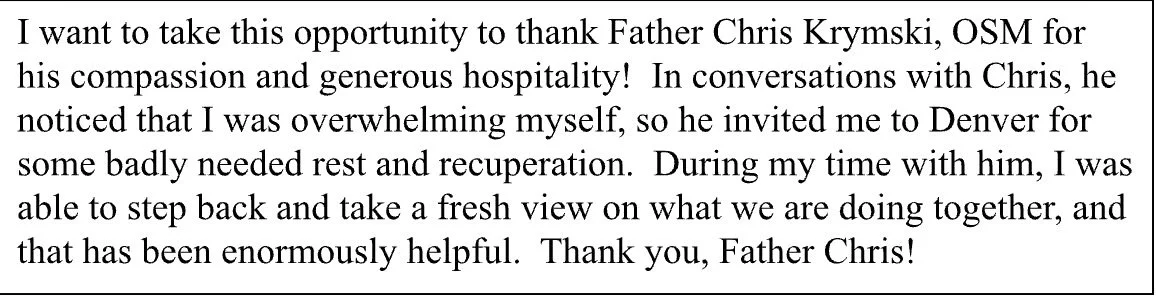
I hope you are a fan of archaeology like I am. I am fascinated by how our ancestors lived and how our present world has been shaped by their efforts in the past. I have been captivated most recently by church history, of all things!
Here’s what piqued my interest. When I was a child, the ‘Church’ I received was a massive and monolithic structure. All the important questions had been answered, and your job as a good Christian was to believe, Period! Questions were allowed, but only if they were asked humbly and with great respect.
Since retiring a couple of years ago, I have been able to catch up on recent research exploring the very beginnings of the Christian faith. As I have delved into these materials, I have found that the early church was anything but the monolithic structure I received as a child. In fact, there were very different understandings about what Jesus taught, radically different understandings of who Jesus was, and wild differences in how people responded to all of this.
For example, Jesus is often referred to as ‘Rabbi,’ which means teacher. That’s a pretty easy concept for all of us to grasp, since we have all had many different kinds of teachers. We know from our own experience what teachers are like. But in other places in the Bible, Jesus is the cosmic Logos – that great Being through whom “all things came to be,” as described in the gospel of John. Here are two very different understandings of who Jesus was and what he was about. One is simple and humble, the other is grand and cosmic. Which one is accurate?
Another anomaly. We have all heard of ‘Jesus of Nazareth,’ but I have never heard the phrase, ‘Jesus of Bethlehem.’ Yet, it’s my understanding that during Biblical times, people were called by their birthplace – for example, Saul of Tarsus. Is this an indication that Jesus wasn’t born in Bethlehem? Does this mean the narratives surrounding his birth – such as the journey to Bethlehem, being born in a manger, the shepherds receiving word of his birth from the angels, the three wise men from the East, the slaughter of the innocents, and the flight into Egypt – are all made-up stories?
And speaking of his birth, why do only two of the four canonical Gospels record the birth narratives? The stories in Matthew and Luke are cosmic in their significance. If you are trying to ‘sell’ a new religion, you certainly would want to marshal these stories as evidence. So why did Mark and John omit the birth narratives? What’s going on here?
As these questions arose, I began to wonder how the monolithic church that I received as a child came to be. And what happened to the wide variety of understandings about the teaching and person of Jesus that existed in the first 200 years after his death? In an attempt to answer these questions, I have decided to dig a little and explore what we know about the early church and its many different perspectives.
* * *
Let’s start with the immediate aftermath of Jesus’s execution and the very natural reaction of his followers to run and hide. Imagine what it was like for his disciples – they begin the week with the crowds in Jerusalem cheering them on, waving palm branches and welcoming Jesus into their city with “Hosannas” and shouts of joy. The crowd probably had a mix of expectations. Some of them expected Jesus to be the Messiah and to lead a rebellion to throw off their Roman overlords. Others expected some kind of religious revival, where the religion of the Jews would be purified, and the Jewish people would regain their favored position in God’s eyes.
Seven days later, however, the expectations of the crowds and Jesus’s disciples are in ruins. Jesus has been executed by the state as a criminal, and his disciples have fled or are in hiding in Jerusalem. The Jesus movement is completely disorganized and trembling in fear. Their revered leader is not there to guide them. What should they do?
Despite following their Rabbi, their teacher, for three years or so, the disciples are running in fear for their lives. The crowds, once so fervent in their adoration, have turned.
You can imagine the crowd’s disappointment, too. They had expected some massive triumph, but instead they got the worst possible outcome. The catalyst for their supposed triumph was arrested, tortured, and publicly executed. The crowds felt betrayed. So their disappointment turns to rage, and they actively look for this ‘charlatan’s’ disciples so that they can vent their anger.
In this chaotic situation, something vitally important is missing! It is so simple that we take it for granted, and as a result, it is invisible to us. It is simply this: none of the institutional tools we take for granted existed yet. There was no creed – no clear understanding of what it meant to be a follower of Jesus. The term, Christian, hadn’t been invented yet, so there wasn’t even a label for their group identity.
There were no scriptures. There was no organization, no church structure. There was nothing authoritative to go on, so there was no guidance whatsoever. Basically, these early followers of Jesus had to make up a church as they went forward.
* * *
What these early followers of Jesus had were memories of his teaching and his actions. It seems likely that some of these followers took notes when Jesus was teaching. But since these early followers tended to come from the lower levels of Jewish society, it seems likely that most were illiterate. The frequent mention of scribes in the New Testament indicates that these literate members of society were few in number and had a special place on the social ladder.
So, what would you do if you found yourself in this situation? Your entire world – all of your hopes and expectations – has utterly collapsed. You are now being hunted, and the crowd wants your blood. You are terrorized, so you do what feels right – you run and hide. If confronted by someone who recognizes you, like Peter, you deny any knowledge of this Jesus fellow. You are in fear for your life!
Some, like Peter and Jesus’s brother, James the Just, stayed in Jerusalem. After the uproar died down, they emerged and developed a school of Christianity that focused on tailoring the life and message of Jesus so that it fulfilled the messianic hopes of the Jews. Adherents of this school identified primarily as Jews and remained Torah–observant. In actual fact, it was not a single, monolithic school, but rather a cluster of related movements that were initially centered in Jerusalem and later scattered across Syria and Transjordan.
James the Just, the brother of Jesus, was the principal leader of the Jerusalem church. They emphasized observance of the Torah, including circumcision, the Sabbath, Jewish dietary laws, and reverence for the temple, before its destruction in 70 A.D. They saw Jesus as the Davidic Messiah and emphasized his humanness. They stressed Jesus’s ethical teaching, especially his Sermon on the Mount. According to the book of Acts, they practiced communal sharing and lived in poverty and simplicity. Authority was located in the “brother of the Lord,” James the Just.
After James died in 62 A.D., and after the temple was destroyed in 70 A.D., the group scattered and was marginalized. Jews tended to see them as just another reform group, and eventually came to see them as too Christian for Judaism. The Gentile Christians, on the other hand, came to see them as heretical because of their emphasis on the Torah and their focus on the humanity of Jesus. For these Christians, they were too Jewish for the emerging Catholic Christianity.
So what can we make of all this? In my view, it is crucial to realize that this Jewish Christianity was the original matrix of the Jesus movement. As nearly as we can tell from a divide of some 2000 years, this flavor of Christianity was as close to Jesus’s actual teaching as we can determine. The Pauline theology of faith and salvation by grace eventually supplanted this initial Jewish Christianity. What is more, we can start to see that the Pauline theology, so familiar to us today, was only one of many schools that developed after Jesus’s execution.
* * *
I think this is probably enough for this week. I suspect that many of you are hearing about these many different strands of ancient Christianity for the first time. I know, when I first heard about this, I was kind of stunned and then amazed. The monolithic church that I received as a child turns out not to be a monolith at all, and it certainly didn’t start out that way. The monolithic appearance results from the “winners” of these theological battles writing the history. As a result, they get a chance to tout their own views and smear their opponents, sometimes even erasing them from the record. While this is not how I would have preferred things to develop, it is, sadly, our all-too-human propensity – both in religious and political history.
Next week, we will continue our exploration into the development of the early church. As I have explored in this area, I am continually amazed at the differences between what I thought was true and what is actually true. It is helping me understand that our faith is far more complex than I realized
Once again, I want to encourage you to practice your meditation daily. In our spiritual efforts, consistency matters greatly. I would rather see you meditate for five or 10 minutes every day rather than one big 30-minute session followed by nothing for the rest of the week.
That’s all for now. Remember that you are blessed in every way, today and always!
With deep affection,
P.S. Several of you have expressed the desire for an online meditation class. If there is enough interest, I will try to figure out how to hold a group class on the web. If you have an interest, please write me atken123Kaisch@gmail.com.
P.P.S. Several of you have expressed the desire for an online meditation class. If there is enough interest, I will try to figure out how to hold a group class on the web. If you have an interest, please write me at ken123Kaisch@gmail.com.
Humility as a Tool → Letting go → Fear → Openness → Acceptance & Growth
If you are finding this newsletter course helpful, you may want to consider Dr. Kaisch's latest book, Inside the Invisible: The Universal Path to Spiritual Transcendence.👇
38: Linearity and the Materialist Worldview
Edition #38: Inside the Invisible
One of the challenges that we believers face today is how to respond to a scientific worldview that posits that God does not exist. This worldview is pervasive; we find it everywhere we turn. The computer on which you are likely reading this newsletter is one of thousands of examples of the technology that has come from this worldview. Yet, this perspective denies the existence of God and denies anything that might be considered ‘spiritual.’ Prominent intellectuals have written best-selling books on the ‘foolishness’ of believing in God. How are we, who are believers, to respond to these challenges?
From my perspective, it seems best to meet these challenges head-on and examine the commonly held components that underpin our prevailing scientific worldview. To this end, I would like to explore some concepts that are likely unfamiliar to most of my readers. While the read below may be a bit difficult to follow, I think you will find it helpful as you deepen your spiritual journey.
Linearity
Earlier this week, I got to thinking about the difference between linearity and non-linearity. From our human perspective, most of the world appears to be linear; that is, one discrete object or experience is followed by the next, and then the next, in a linear fashion. Briefly, linearity is characterized by observable data from which we can abstract verifiable rules that guide behavior.
In this linear world, we are able to identify causation because we repeatedly observe one thing causing something else to happen. We have seen this from our infancy, over and over again, and there is very little that could make us believe in something else. There are so many examples of linearity in our daily lives. We use numbers in a linear fashion: 1… 2… 3… and so on. We believe that if you take one atom of oxygen and two of hydrogen, place them in the presence of a catalyst, they will form a molecule of water. The examples seem endless.
Sir Isaac Newton developed the mathematics to describe our everyday experiences, and since then, we have trusted our scientists and mathematicians to describe and clarify the reality we see around us. On balance, they have done a splendid job. To verify this, all you need to do is look around you. The car you drive, the dwelling you live in, your everyday experiences at work – they all support this linear perspective.
Linearity, for the most part, describes the world as we experience it. However, when you look more closely, you begin to find an increasing number of things that cannot be described from this perspective. When you leave the realm of our daily experiences and look at the macro-world, the cosmos, you find that linearity no longer works very well. In parallel, when you look at the micro-world, at the level of subatomic particles and beyond, you find that they cannot be described with our linear perspective. We have left the realm of our ‘normal’ and entered into a realm that appears fantastic, where all sorts of strange phenomena occur.
If you will, we appear to live in a three–part world. At the cosmic level – including stars, galaxies, and so on – the perspective is nonlinear. At the human level – our sensory experience of the day-to-day world around us – the rules of linearity appear to govern our experience. At the micro level – the world of subatomic particles and beyond – the perspective again becomes nonlinear. The subatomic particles just do not behave like we expect, given our linear frame of reference.
These data suggest that our linear perspective may be incorrect. Does it really make sense to have a three-part world like this? Doesn’t it seem more likely that the apparent linearity of our everyday world is actually nonlinear?
Scientific Materialism
Our prevailing scientific paradigm has been one of scientific materialism. This philosophy states that only matter and energy exist. In this view, every phenomenon we experience is caused by matter and energy interacting in its several forms. This perspective has been highly effective as a means for transforming our world. Most of our technological progress has been driven by this paradigm. The combination of linear thinking in the context of this materialist worldview has been responsible for pulling humanity from subsistence living to the relative luxury we enjoy today.
There are, however, phenomena that materialism cannot explain. Scientific materialism postulates a Big Bang that started our cosmos, but it cannot explain what existed before the Big Bang or why the Big Bang occurred in the first place. It cannot explain how the spectrum of vibrant life arose from nonliving elements. It cannot explain what is called ‘the hard problem of consciousness,’ which is how our consciousness came into being from nonliving elements.
As you might suspect, scientific materialism is adamantly opposed to the notion of God or anything that might be termed ‘spiritual.’ Thus, there are serious limits to the explanatory power of this philosophy. To date, it has been unable to explain many of our most important human experiences. Experiences like our conscious awareness. Experiences like love – that strange invisible force which binds us together and which allows us to endure unimaginable suffering, and can lift us to astounding heights.
Over the last 50 years, a large array of data has been collected which are inexplicable from the perspective of scientific materialism. With the advances in medical science – advances which were created out of the materialistic perspective – we now have records of thousands of ‘near-death experiences.’ These are experiences of individuals who have died on the operating table, remained lifeless for a period of time, and then been restored to life. Many individuals who have experienced this have reported that their conscious awareness left their body and observed what was happening while they were clinically dead. These experiences indicate that the physical body is not necessary for conscious awareness. How else can you explain a verifiably dead body and a person’s consciousness existing apart from that body?
Near-death experiences are not the only phenomena that give lie to the philosophy of materialism. How do you explain the spiritual experiences of the great mystics? They regularly describe seeing God, angels, and other spiritual beings. So-called ‘miracles’ seem to occur in their presence with some regularity. Because these phenomena cannot be ascribed to material causes, scientific materialists deny their existence. To my mind, it would seem more reasonable to question the validity of the materialist perspective. To simply deny the impact of the Divine seems like cheating. Instead of taking these phenomena seriously, the way scientists take every other experience, they simply deny that these phenomena exist. In my view, this is sloppy thinking.
God and the Nonlinear
The Divine, to our continued consternation, doesn’t seem bound by linearity. The Burning Bush that Moses experienced will never be understood by observable rules. The person of Jesus Christ, likewise, cannot be understood by observable rules. How do you account for all of his miracles? His coming to life again after being crucified? How can it be that an ignorant peasant from a conquered Roman province, some 2,000 years ago, is the most famous person in the world today? None of this makes sense from a linear perspective. Yet, the facts are there, and they are incontrovertible.
Of interest, we tend to expect God to act in a linear fashion. For example, many believers pray for healing, either for themselves or for others. In general, those who pray for healing seem to want God to respond in a very specific and linear way. Their prayers go something like this: “Please, Lord, heal Aunt Mary of her cancer and restore her to health.” In effect, they are asking God to respond in a linear fashion with a specific healing for a specific person, often within a specific timeframe. Of note, these prayers are rarely answered in this manner.
As a believer, this constantly challenges our beliefs. Why would the Divine not respond according to our petitions in the way we ask? Perhaps it’s not a matter of a nonresponsive God. Perhaps, instead, we are expecting a linear response – 1 leads to 2, which leads to 3, and so on – from a nonlinear Being.
And this brings us to yet another question. How can we – creatures living in a linear framework – come to know the Divine? It seems clear that approaching God with our linear expectations is likely to be problematic. How can we move beyond these apparent limitations? This, I think, is best left for another day and another newsletter.
~
Before we finish for the day, let’s look at the data we have compiled to see what conclusions we might draw:
1. While scientific materialism has contributed greatly to our material well-being, it does not answer many of our deepest and most serious questions.
2. While scientific materialism masquerades as objective truth, it is not. It is simply one philosophy among many. That being said, in a conversation with a friend of mine, a quantum chemist, he stated that “scientific materialism actually does a pretty good job of (discerning) objective truth within the bounds of the scientific method, which requires that physical explanations of phenomena must be supportable by reproducible observations.”
3. Many of the proponents of this materialist philosophy appear to be intellectually dishonest. Rather than face the serious questions raised by their philosophy, they dismiss them out of hand. These are questions like the hard problem of consciousness, what came before the Big Bang, and what precipitated the Big Bang, and many others.
~
Well, I think that this is enough for this week. If you brain doesn’t feel all twisted around and upside down – well, I guess it means that I haven’t done my job well enough. LOL! On a more serious note, I hope I have helped you sort through some of the conflicting information that we get on a daily basis about what is real and what is not. The bottom line – we are all trying to get to the truth. I believe that our ultimate truth will take us into a remarkable realization – that the Divine is within us and has never, ever been apart from us.
In the certainty that we are firmly held in God’s love,
With love,
P.S. Several of you have expressed the desire for an online meditation class. If there is enough interest, I will try to figure out how to hold a group class on the web. If you have an interest, please write me at ken123Kaisch@gmail.com.
P.P.S. Several of you have expressed the desire for an online meditation class. If there is enough interest, I will try to figure out how to hold a group class on the web. If you have an interest, please write me at ken123Kaisch@gmail.com.
Humility as a Tool → Letting go → Fear → Openness → Acceptance & Growth
If you are finding this newsletter course helpful, you may want to consider Dr. Kaisch's latest book, Inside the Invisible: The Universal Path to Spiritual Transcendence.👇
37: Our Mistaken Notions of Sin
Edition #37: Inside the Invisible
I would like to focus today on the notion of sin. I have found that many run for the doors when a priest starts talking about sin. Let’s face it, it's not the most appealing topic for many. Now, I expect if I decided to categorize our many sins and went into lascivious and graphic details, perhaps that would probably attract listeners. But I'm just not going to do that. Instead, I want to talk about this most important Christian doctrine.
I want to talk about sin because it is so misunderstood. Today, the only place we use the word "sin" is in a church setting. When you greet your friends, you don't say, "Hey there, you old sinner. How's it going today?" You don't go up to strangers and start talking about your own sins… or theirs. We don't use the word, and as a result, it's meaning has drifted far from Jesus' original meaning. What I mean is that our understanding of sin is radically different from that of our Lord.
Today, if you happen to be in a church where sin is being discussed, or if you tune into a church service being broadcast that talks about sin, the chances are the speaker will refer to sin as something morally repugnant, something disgusting, something that a good Christian wouldn't be caught dead doing. Especially in public!
I expect that many of you were exposed in your youth to the sermon of that great colonial preacher, Jonathan Edwards, who spoke of "Sinners in the Hands of an Angry God." In this sermon, Edwards describes our wayward behaviors from God's point of view. He talks about sinners being suspended over the fires of hell, held by a single strand of spider silk. Just imagine flames leaping up around the poor tormented sinner – dangling from God's hand over the fires of hell – literally a nanosecond from being released into the flames to a horrid death.
It makes for a great image, doesn't it? I guess this is what preachers had to do before movies and television – to make things so graphic and horrible that they captured everyone's attention. But this understanding of sin is as far removed from Christ's understanding of sin as the East is from the West.
* * *
The sad fact is that our understanding of sin has drifted away from its original meaning. Our present-day understanding of sin is radically different from Jesus's understanding. So, let's go back in history and find out what Jesus really meant, shall we?
To understand this passage, you need to go back a couple of thousand years. The term that was translated as sin is the Greek word, hamartia.Hamartia is a military term. It refers to the distance between the center of the bull's-eye and where your arrow or spear hit. So that distance was the hamartia. The best one-word translation for hamartia would be the English word, separation. But when the original Greek, which was the lingua franca of the day in the Mediterranean world, was translated into Latin, it came out as sin. In the early 1500s, the word sin was lifted straightaway and plopped down into English. So now we have sin as an English word.
What happened next is quite fascinating. The meaning of sin in English began to drift. A word keeps its original meaning when it's used in multiple contexts. But when it's only used in one context, that meaning can drift – and that's what happened to sin.
For example, the word chair is used in multiple contexts, so it’s meaning stays fairly constant. There is the dining room chair, the living room chair, the dentist’s chair, and so on. The idea of chair is pretty constant throughout. Even when we refer to the chair of a meeting, it refers back to the special chair that the chairperson is sitting in.
In contrast, because it is only used in church settings, the word sin has drifted from meaning separation to mean something morally reprehensible, even despicable. Contrast these two flavors in your own mind: separation versus something vile and despicable.
* * *
So, let's go to a gospel story and see if this understanding of sin holds up. Let’s use the story of the woman caught in adultery. The scribes and Pharisees bring her to the town square and get ready to stone her. Then they remember that the weirdo prophet Jesus is in town, so they send someone to fetch him. Jesus arrives, and there are all the men standing around the accused woman with big rocks in their hands. The Pharisees then say to Jesus, "Teacher, this woman was caught in the very act of committing adultery. Now, the law of Moses commanded us to stone such women. What do you say?"
Instead of responding immediately, Jesus bends down and begins writing with his finger on the ground. The scribes and Pharisees kept questioning, and finally, he straightens up and says, "Let the one among you without sin cast the first stone." When they heard this, the crowd slowly melts away, one by one, beginning with the elders. Jesus was left alone with the woman. He asks, "Woman, where are they? Has no one condemned you?" She replied, "No one, sir." And Jesus said, "Neither do I condemn you. Go and sin no more."
* * *
There are two important transitions here. The first is Jesus' comment to the scribes and Pharisees. You'll notice he doesn't accuse them of sin. He doesn't accuse them of being sexist creeps. He makes a simple declarative statement – "Let the one among you without sin cast the first stone." What a simple and elegant way to handle these judgmental and bloodthirsty guys.
The second important transition occurs when he speaks to the accused woman. He asks, "Is anyone here to accuse you? If not, then go your way and sin no more." Let's drop our new English translation into his comments: "If no one is here to accuse you, then go your own way and be separated no more."
I find his restraint here amazing! At the very least, I would have excoriated this woman – "Don't be stupid! This is a small town, and everybody knows everybody else's business!" I would have lectured and gone on and on… and Jesus doesn't do that. He didn't shame her. He didn't excoriate her. He simply said, "Go and sin no more."
Go, and don't be separated like this from your husband. Don't be separated from your community by violating the rules and standards because it hurts the community. It damages the fabric of agreement – that we act in these ways and not in those other ways. And ultimately, "Don't be separated from your Father in heaven. He constantly extends himself to you. He invites you to participate in the riches of the world around you and the riches within yourself – the riches involved in that profoundly deep connection you already have with the Divine."
You see the vast difference between our current understanding of sin and the sin that Jesus spoke of. He didn't speak to condemn sinners. He doesn't speak to condemn you or me. His admonitions, if you can even call them that, are to return to our relationship with God, our connection with the Divine. He calls us with the deepest love to remember our true nature – to remember that Christ, the son of God, lives within us. To remember that we, too, are his children. His beloved children!
* * *
Again, let's put a point on all of this. Take a moment and reflect on your own sense of separation. How do you find yourself separated from those closest to you? Let me give you an example from my own life. I'm married to a wonderful woman who, in my view, talks too much. Checking in with my male friends, I find this is a common problem for us guys. The women in our lives often chatter on and on and, "Frankly Scarlet, we just don't want to listen to all that!" – at least most of the time. I find my wife's constant chatter rather irritating. What I mean by this is that I complain to myself that she's all the time blah blah blah. Look at what I have done by means of my thoughts: I have literally separated myself from the woman who loves me most in all the world. Can you think of anything crazier than that? Anything stupider than that?
When I reflect for a moment, I catch myself in my own stupid, grumpy thoughts. And I remember, "She loves me more than anyone else in the world." And the irritation melts away. The separation that I have put up – evaporates.
* * *
We find ourselves separated from our neighbors. We find ourselves separated even from ourselves. How many times have you caught yourself saying, "Maybe I should do this, but on the other hand, maybe I should do that." That's separation, isn't it? So, we are separated not only from the people around us – we also separate ourselves from our very own selves.
And, of course, the most horrendous separation is our separation from God – our Father in heaven. We forget that we are God's children. We're like the Prodigal Son, wandering the world trying to find satisfaction and fulfillment – but no matter where we go, that fulfillment always seems to elude us.
* * *
Here's an example of how it works for me. I think I need to do something to please God, so I say to myself, "I need to be a better Ken. I need to be a better psychologist. I need to be a better writer. I need to be a better husband. I need to be more compassionate." You get the idea.
I'm forgetting that our Lord loves us just as we are. Instead, of being who God created us to be, we actively separate ourselves from ourselves. We literally tear ourselves apart trying to be acceptable.
And in the process, we forget that Jesus is already dwelling in our hearts. In the process, we forget that we are already home. And if we're already home – if you and I are already home – then there is nothing we need to do to return home, is there?
As Christ uses the word, sin is not a condemnation. He never says that we are despicable or awful or bad or any of the other things that we tell ourselves and each other. When he uses the word sin, it's an invitation to attend to the multiple ways we have separated ourselves.
It's an invitation to let loose of these separations and return home.
It is an invitation to open our hearts in love – love for our broken, torn-apart selves, love for each other, and love for our Father in heaven.
* * *
So, if I may be so bold to say, here at the end of our newsletter today, 'Go and sin no more.' And take a moment to remember that you are deeply and truly held in the love of Jesus Christ, our Lord!
With love,
P.S. Several of you have expressed the desire for an online meditation class. If there is enough interest, I will try to figure out how to hold a group class on the web. If you have an interest, please write me at ken123Kaisch@gmail.com.
Humility as a Tool → Letting go → Fear → Openness → Acceptance & Growth
If you are finding this newsletter course helpful, you may want to consider Dr. Kaisch's latest book, Inside the Invisible: The Universal Path to Spiritual Transcendence.👇
22: The Language of God Is Silence
Edition #22: Inside the Invisible
I had a great question from Marianne in Boston about our last two newsletters on the Jesus Prayer. She made a comment that all language seems to divide us, so how could the Jesus Prayer, which relies on words, bring us closer to God? For that matter, how could any meditation that uses words and language allow us to cross the apparent abyss that seems to separate us from the Divine? This is a very profound question, Marianne, and thank you for raising it.
We live in a world of apparent duality, and this duality is inherent in our use of language. In fact, duality appears to be the way we conceptualize most, if not all, of our experiences. Just think about it for a moment: there is up, and its opposite down. There is left, and its opposite right. Almost all of our experiences can be formulated in this dualistic manner. Indeed, this is how most of us conceptualize our relationship with the Divine. “I” am over here, and the Divine is somewhere else. This kind of understanding leaves us forever searching, and the object of our search always appears to be just out of reach. Hence, our constant feelings of restlessness – we are always searching and nothing seems to fill us for very long. Worse, our restlessness covers over our deep feelings of emptiness.
We commonly understand that language is a way of connecting with others. In fact, that’s how we're using language right now, as a way of connecting. There is, however, another and opposite aspect to language. Language also divides. It operates by invisibly separating everything we experience into subjects and objects.
Let’s use a simple example, one that describes what’s happening between us right now. I am over here, and you, my reader, are somewhere else. On the face of it, this appears to be a simple statement of fact: “I” am over here and “you” are over there. While this sentence captures part of our relationship, it misses the most important part. It misses the fact that we are somehow deeply connected. It misses the fact that we are both searching for something deeper in our lives. It misses the deep emptiness within each of us that drives our search. It overlooks the fact that we are deeply connected with one another and with the Divine.
So, what’s more important? The fact that we are in different places, or the deep interconnectedness that hides beneath the surface?
And this takes us directly into the heart of the problem – that our relationship with the Divine and with each otherhas no words that can adequately describe it. Whatever these relationships are, they are beyond the power of language to describe. You see, when you use words, you must employ a distinction between the subject and the object. That’s simply how language works; it channels our thinking into divisions, and thus it keeps us from perceiving the underlying unity. This simple fact has a profound implication for our search. Whenever you employ the subject/object distinction, you can only perceive the separateness, not the unity underlying the separateness.
The great Christian mystic, Thomas Merton, stated that “The language of God is silence – all else is a poor translation.” So how can our words take us into the heart of God?
* * *
The Jesus Prayer uses words. We call upon our Lord Jesus for mercy, for all of us, to one extent or another, are lost in this wilderness that we call the world. We find ourselves cut off from God, and estranged from each other, and even from our own deepest being. Worse, the way to overcome these profound separations is not clear.
We are trapped by our dualistic concepts in a dualistic world. It is as if we have hallucinated a world that, by the nature of the concepts we use, prevents us from discerning the underlying unitive reality in which we live. Not only that, our dualistic thinking profoundly inhibits us from seeing the world and ourselves as we actually are. (I will explore this topic of the nature of reality at length next week. For now, I ask that you trust me on this point.)
So, the question that confronts us, stated as clearly as possible, is how can we use our dualistic tools to escape this gigantic mousetrap that we and our forebearers have created?
The Jesus Prayer is a tool that was developed in the very early centuries of the Christian era. Over the last 2,000 years, it has been used by a wide variety of people from very different cultures, speaking very different languages, but having in common the dualistic perceptions that bedevil us today. This tool has been used because it has been found effective in generation after generation. It is a tool that begins within the common dualistic framework: we are here, and Jesus is somewhere else, a Being from whom we are seeking assistance.
When we employ the Jesus Prayer, we are enjoined to repeat the words of the prayer over and over again. The goal of this prayer is to “pray without ceasing,” as Paul described in his letter to the Thessalonians. When I first heard of the Jesus prayer, I thought this constant repetition was simply stupid. “Why say the same thing over and over again? If God didn’t hear me the first time, what makes me think he’ll hear me on the hundred and first time?”
At this early stage in my spiritual life, I was missing quite a few things about this extraordinary tool. I missed the fact that repetition bores me. My discursive mind was always looking for new and more exciting things to focus on, and the Jesus Prayer simply bored me to tears. So, what happens when my constantly seeking intellect gets bored like this? Ultimately, it gives up and shuts up!
That’s right, when I keep repeating the words of the prayer and force myself to focus here and here alone, my discursive intellect stops searching for new and more exciting things to focus on. If I stay with it long enough, it gives up. When it stops its striving, it stills and moves into silence. And this is the point of constantly repeating the words. We are not really exhorting God, because he heard our petition the first time. We are simply boring ourselves into silence.
So ask yourselves, why would the language of God be silence? Since our words divide, it is only in silence that we can enter into union with the Divine. It is only in the stillness that we are open to the deeper unitive states – the union that takes us out of our separateness and isolation, the union for which we all search.
* * *
“But wait, there’s more!” As our self-talk grows silent, we come into an awareness of a deeper energy buried deep within our hearts. It is here, in the depths of each heart, that the mystics from all the great religions have said that we meet God. As long as our intellects blather on, our dualistic concepts force us into a separation from that great Being which underlies all our apparent divisions. When the self-talk stills, however, we then begin to perceive that underlying unity. In this silence, the language of God becomes apparent.
Remember the first component of the Jesus Prayer, to open ourselves to the Presence of God? When we begin using this prayer, this opening is, for most of us, a kind of pro formaevent. We go through the motions at this point, but we don’t really understand what it means to be open to the Divine. As our discursive intellect quiets, as our divisive self-talk disappears, we then begin to experience what it feels like to be in God’s holy Presence. As long as we blather on, the inherent divisiveness of using subjects and objects keeps us from the actual experience of God. Literally, our languaging is keeping us from our heart's desire!
You may not believe me when I talk about the importance of this holy silence to our spiritual development. Our discursive intellect would have us believe that “real knowledge” can only be obtained by using words. This is hogwash, and your own experience proves it.
Think back to that magnificent sunset you saw, or the tenderness of a father holding his newborn baby. Think back to the moment you first realized that your partner truly loves you. In each of these moments, our intellect stops. There are no words that can adequately describe the experience we have in these moments. How could that be, if our discursive intellects have the last word? Clearly, the deepest and most important experiences we have are those we have in silence. There is a Reality which passes our human understanding. This is the Reality in which we all live. We just pretend it ain’t so…
The Jesus Prayer occupies a very special place for those who seek God. It is a tool that can take us from our ordinary, intellectually-based awareness and move us into stillness and quiet. In the ensuing silence, we will find ourselves open to God in ways that we cannot imagine from our divided and separated states of being.
* * *
Well, that’s it for this week. It has been a joy for me to share these words with you, however divisive they may be! Hopefully you will be able to translate my silly words into silence, and listen for yourself to that still quiet voice in your heart. Next week, we will explore a topic that will shock and amaze you. We will take a deep dive into the nature of reality, and I hope to show you that everything you learned in your high school science classes is wrong.
With that teaser, I hope you have a great week. I encourage you to set aside a regular time to practice the Jesus Prayer, for it can take you into the depths where, with your own eyes, you can see our Lord.
With love,
P.S. Several of you have expressed the desire for an online meditation class. If there is enough interest, I will try to figure out how to hold a group class on the web. If you have an interest, please write me at ken123Kaisch@gmail.com.
Humility as a Tool → Letting go → Fear → Openness → Acceptance & Growth
If you are finding this newsletter course helpful, you may want to consider Dr. Kaisch's latest book, Inside the Invisible: The Universal Path to Spiritual Transcendence.👇
16: What Is Salvation?
Edition #16: Inside the Invisible
I was asked a great question by John from Nebraska this past week: what is salvation? This is such an important question that I put aside the essay I had been working on so that I could answer it fully.
In our era, there is much confusion about the notion of salvation. Many Christians seem to delight in asking others, “Are you saved?” To some degree, this seems just a part of the general combativeness and aggression that we’re living in. But unless you know what salvation really is, you’re in no position to address this question. So, let’s look at this issue carefully.
To start such an examination into an old theological issue is always fraught. There are many established positions on the matter, and it is very easy to find yourself getting lost in minutiae. To circumvent this, I prefer to start by examining the term ‘salvation’ in more ordinary contexts. So let us begin.
There are two parties involved in every saving act. For example, if someone is saved from drowning, the two parties are the savior and the one who is saved. In the same way, there are two parties in the Christian notion of salvation. There is God, in the person of Jesus, who is saving the person in need.
This leads us to the next question: What is the person being saved from? The traditional theological answer is that we are saved from sin. Our Eastern Orthodox brethren even have a graphic depiction of this. Many of their crucifixes – both painted and sculpted – show the cross of Jesus being planted over a skull. This skull represents the skull of Adam, the vehicle through which sin entered into our consciousness. This graphic depiction is intended to show clearly that Christ died to redeem the sin of Adam.
So, what exactly was Adam’s sin? His sin was disobedience. At that very early point in humanity's development, there was only one rule: don’t eat the fruit of the Tree of the Knowledge of Good and Evil. Adam clearly disobeyed this and was cast out of the Garden of Eden, and as a result, became subject to pain, suffering, and death. In traditional Christian theology, Adam’s sin was seen as a kind of mass infection. Every person since Adam has been similarly infected with the consequences he bore: pain, suffering, and death.
In my view, this is a pretty good explanation of salvation, but when you look closely, it has a number of flaws. For one, it violates our current sense of fair play. Why, for example, do you have to suffer and die for something someone else did? A someone you don’t even know who lived thousands of years ago! Kind of hard to swallow, isn’t it? Looking at the matter more deeply, this is not consonant with the New Testament notion of a loving God. The God who would condemn the entire human race for one person’s mistake is cruel and sadistic, not loving.
Second, how does Jesus’ death make up for Adam’s mistake? I’ve heard a number of explanations over my lifetime, but none of them hold up in the face of scrutiny. Again, was Jesus’ torture and death really the action of a ‘loving’ God? It seems cruel, mean-spirited, and sadistic to me. And how, exactly, does torturing a man to death lead to the commutation of Adam’s mistake? I mean, all humanity is still subject to pain, suffering, and death, so what did Jesus’ sacrifice really accomplish?
The traditional theology that informs Jesus’ death is lacking on several fronts. It is based on the Old Testament’s version of the Divine – harsh, judgmental, and even cruel. It is clearly not the Christian understanding of God. Second, it misunderstands the true nature of the infection by not understanding the true nature of Adam’s mistake. And believe me, it was a massive mistake, although you could also argue that it was necessary for humanity's development. And finally, the traditional understanding omits a crucial part of the human psyche – our proclivity towards guilt and self-blame. On these grounds, I believe, we need to reformulate our understanding of salvation.
***
So let’s begin by looking at the crux of the issue – Adam’s mistake. God told Adam that he was not to eat the fruit from the Tree of the Knowledge of Good and Evil, which, along with the Tree of Life, was situated at the center of the Garden of Eden. Prior to eating the forbidden fruit, Adam appears to have been in a very primitive state of consciousness. Without the dualistic conception of good and evil, everything would appear to Adam as acceptable. Indeed, God told him that he could freely eat from every tree in the garden except that one. And after Eve appears in the narrative, they are both naked and without shame, again indicating a primitive state of consciousness with little or no differentiation between good and bad. This is in stark contrast with virtually every human culture since that time, with our massive taboos regarding sex and appropriate dress.
In a strange way, Adam's state of consciousness sounds like the consciousness present in my dog, Maggie. Maggie approaches each new object with curiosity and interest. If there is a sharp sound or a sudden movement, she will typically recoil. On the other hand, if there is an interesting smell, she typically moves towards it. There is no a priori judgment of good or evil; everything is evaluated on its own merits, after first experiencing it.
Prior to eating the forbidden fruit, Adam appears to have no ego. If he has a sense of self, it seems very primitive, at the level of an animal's consciousness. Maggie, for example, responds to her name and seems to have a kind of rudimentary sense of self. With both Maggie and Adam, there is a sense of timelessness here, with no urgency because they are living in each and every moment. There appears to be no sense of the future and no sense of the past. As a result, there can be no planning. This is a devastating handicap because virtually every human endeavor relies on planning. You cannot hunt or gather without planning to go where the food sources are. You cannot have a community of individuals who live together without extensive planning.
When this biblical story is examined with a critical eye, Adam's so-called mistake begins to seem necessary for human development. From a psychological perspective, Adam’s mistake marks the beginning of the development of an ego – a separate sense of one’s self. This ego could be described as the very beginning of humanity. Of interest, Adam’s ego developed in response to an outside influence, God’s demand that he not consume the forbidden fruit.
When humanity lived in an animal’s state of consciousness, we were simply another species: just one among many. But once we formulated an ego, we became radically different. This difference is clearly apparent if you take a moment and look around you. You live in an elaborately constructed house, with a varied and interesting diet of food sources that have been derived from many different countries and delivered to your local supermarket. You leave your house and get in your car, bus, or taxi, and are driven to your supermarket where you choose from a wide variety of tasty foods. What other species has created such amazing complexity? The answer, of course, is that none have.
***
With the appearance of an ego – due to the influence of an external force, in this case God, – duality has entered into human consciousness. Suddenly, there are an array of new conceptual tools: the notion of good and bad, of right and wrong, and many others. Along with these tools comes the notion of time, differentiating the present moment from past and future. Suddenly, humanity is able to plan by using past experiences to predict and prepare for the future. If you will, the appearance of the ego appears to have spread throughout all humanity as a kind of massive infection.
At first glance, these new tools confer astounding advantages to the human race, but on closer examination, we quickly discover a dark side. We begin to apply the notion of good and bad to ourselves, and in the process create the emotions of guilt and shame. We find that planning can also be used for destructive ends. Initially, human beings would fight person to person, but with the ability to plan, we became able to gather larger groups to fight battles and wars with horrific consequences.
This is the state in which we find ourselves today. We are each driven by our egos. This means that we live in a state of almost perpetual dualism, and we find ourselves constantly looking for ways to enter into unity. We long for the peace that Adam and Eve enjoyed before the Fall. We long to quiet the constant back-and-forth chattering in our own minds. We long for deeper connections with one another – connections made elusive by our constant judgments.
This is the state of humanity when Jesus appeared. We, who are so internally divided by our conflicting judgments and the demands placed on us by others, experience a vast abyss between ourselves and the Divine. Not only do we experience this abyss with God, we also experience it with each other. Perhaps even more debilitating, we experience it within our own minds, within our own sense of self. Thus, we are fragmented, both internally and externally.
Psychologically, we tend to blame ourselves for these vast chasms, which lead to our isolation and loneliness. This infection is passed from parent to child every time the child is praised or blamed for an action. This infection is passed through our social institutions, through churches and schools and governmental institutions in the same manner. On every side, the developing ego is bombarded with messages to “do this” or “do that” in order to gain somebody’s approval.
Spiritually, this has greatly stifled our development. Instead of being free to explore our own innermost nature, we avoid anything that smacks of deep reflection. This avoidance has hindered us spiritually. Jesus and all the great saints have consistently pointed to the Presence of God that is always within us and immediately accessible. Because of our guilt, however, we avoid exploring this most intimate of connections. And this is what Jesus came to save us from.
With the entrance of God’s Son into the world, we are assured that God’s condemnation of Adam has been lifted from humankind. As a result, there is no actual abyss between ourselves and the Divine. The only abyss that exists is the one in our own minds, the one we hang on to. This means that we are now free to plunge into unitive states or to hold back. To enter into God’s embrace, or to hold ourselves apart as separate egos. Free choice – God’s ultimate gift to humanity – is restored to us once again.
It’s important to note in all of this that the salvation given by Jesus is free. Nothing is required of us. We don’t have to believe in a certain way. We don’t have to perform propitiating rituals. As a result, that often–asked question, “Have you been saved?” turns out to be simply ridiculous. Of course, you have been saved! And it doesn’t require anything of you. It doesn’t even require that you adhere to the Christian faith. The Son of God, in his infinite generosity, has destroyed that felt sense of separation from God that we have. The hidden gift here is that we are now free to heal all of the other separations we experience – the separations from each other, and the separations within our own psyche. Now we are free – truly free – to enter into union.
With love,
P.S. Several of you have expressed the desire for an online meditation class. If there is enough interest, I will try to figure out how to hold a group class on the web. If you have an interest, please write me at ken123Kaisch@gmail.com.
Humility as a Tool → Letting go → Fear → Openness → Acceptance & Growth
If you are finding this newsletter course helpful, you may want to consider Dr. Kaisch's latest book, Inside the Invisible: The Universal Path to Spiritual Transcendence.👇
3: Conventional Religion & The Inner Way
Edition #3: Inside the Invisible
Hey ! Welcome to today’s message:
In this newsletter, we will explore the differences between the approaches of conventional religion and what I call the Inner Way, which is also known as the mystical way, non-duality, and the unitive way. After some thought, I decided the simplest approach would be to present the data in a table format. All of the major world religions have an external, conventional side and a mystical, non-dualistic side.
The conventional approach, which is all that most people have experienced, doesn’t, in my view, take you very far. It has to do with outward observances, and the inner changes necessary for a truly spiritual life are rarely talked about. As you have no doubt surmised, I am interested in exploring the Inner Way with you.
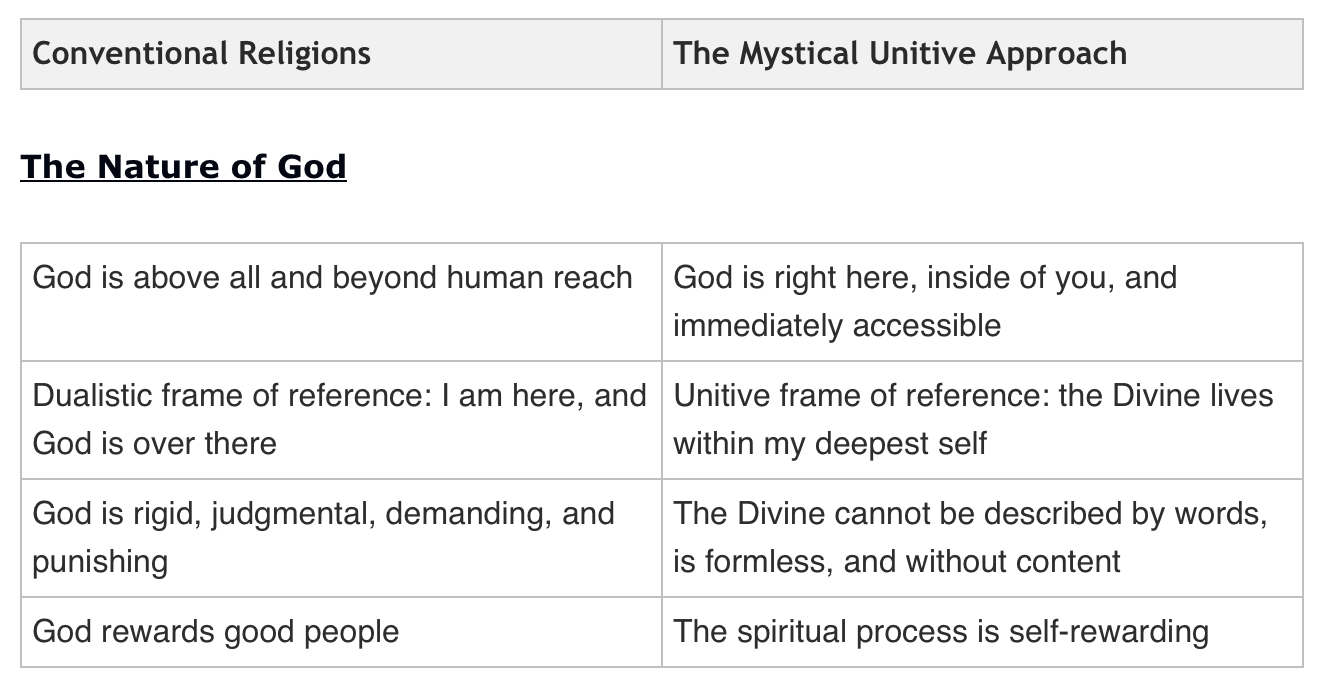
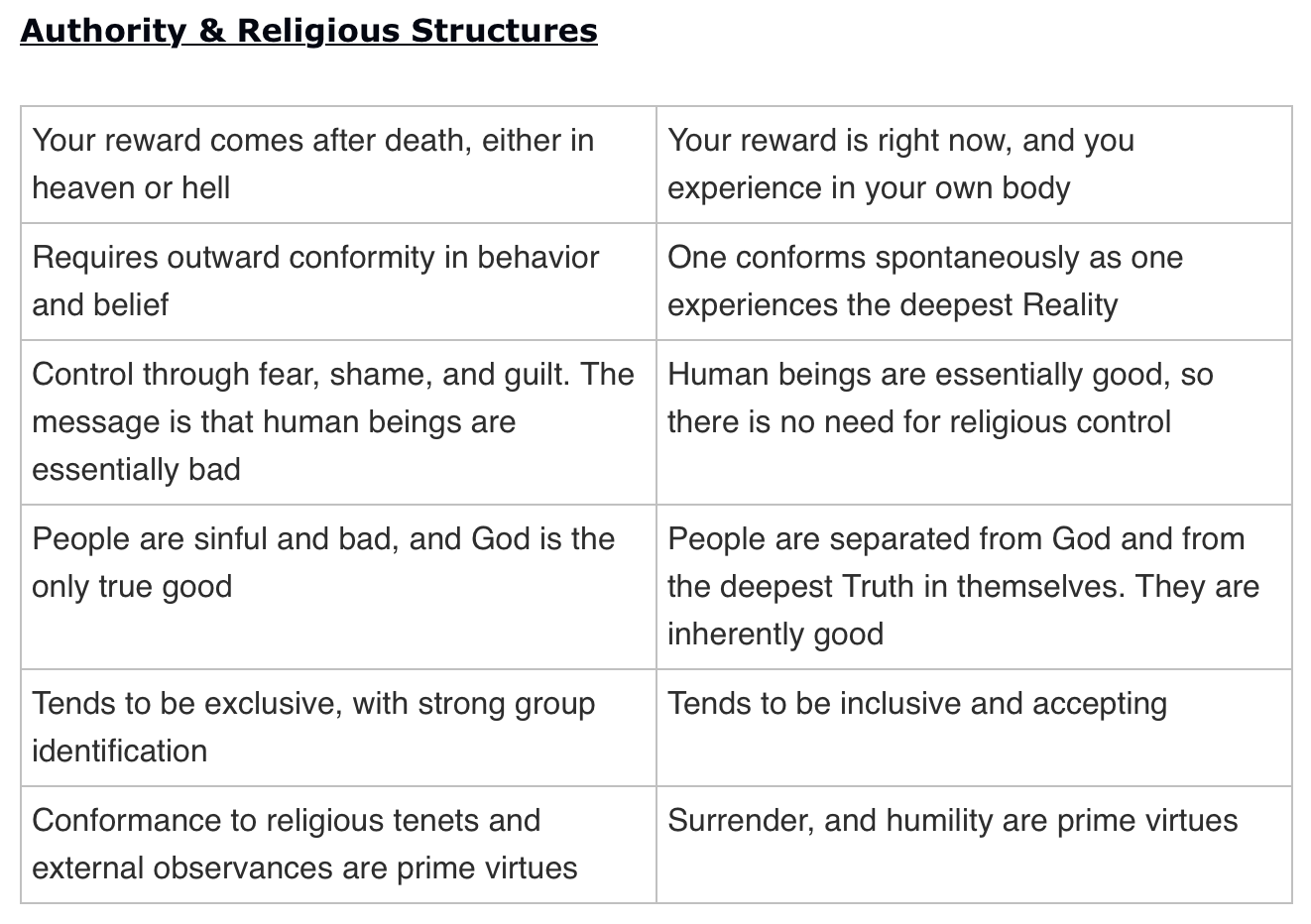
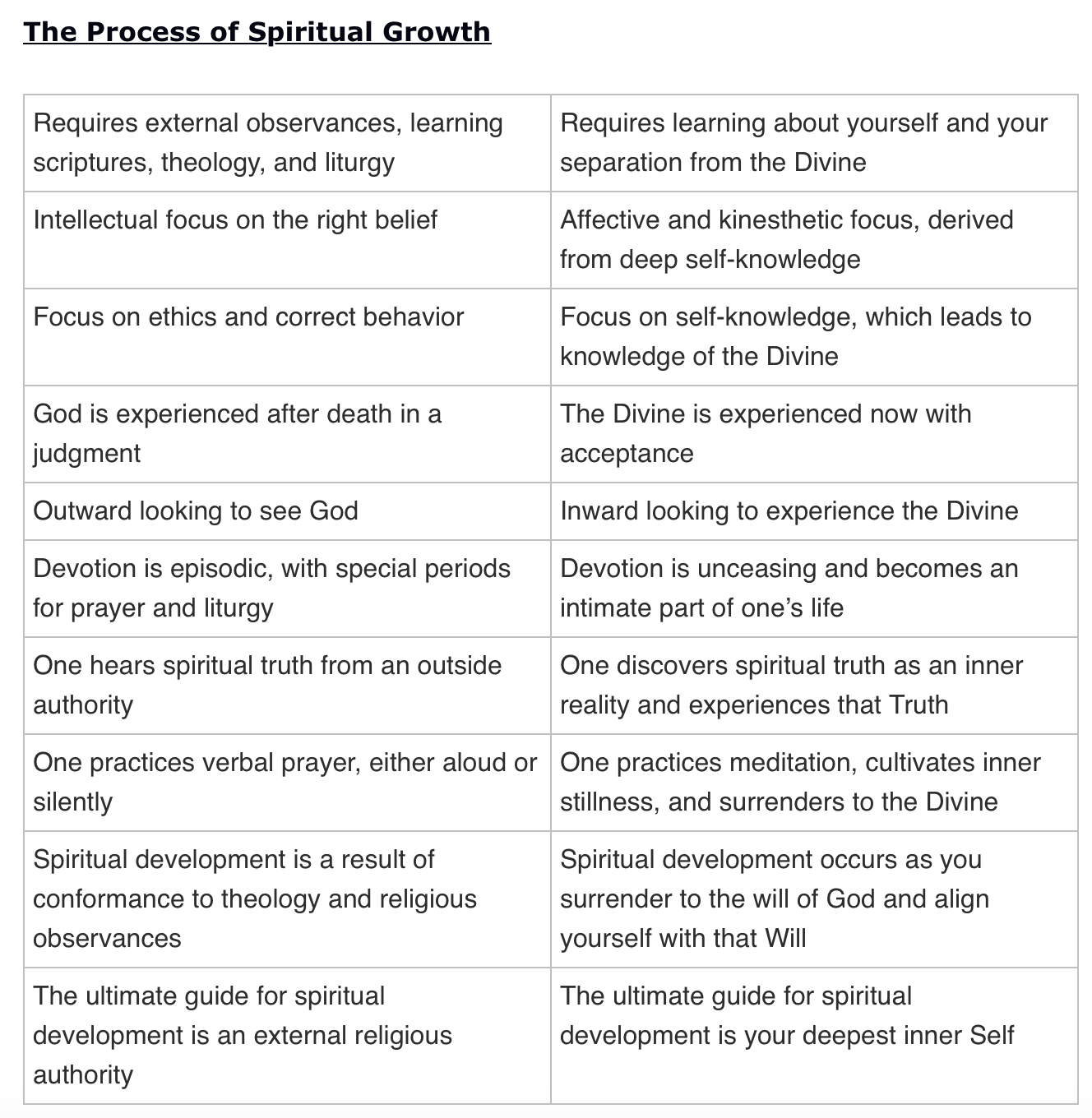
If you are exploring these data for the first time, it may seem a bit overwhelming. We have all been schooled in the conventional type of religion. Because no other form of spiritual observance was ever described, we either accepted or rejected the conventional view. When you are first exposed to the richness of the unitive way, it may surprise you, it may intrigue you, and it may simply seem like too much to deal with.
But the fact that you are receiving this newsletter rather strongly suggests that you are ready to go deeper in your spiritual journey. So, for this week I would encourage you to simply sit with the information in this table and just think about it. Notice where you feel a repulsion – the feeling that comes when you know intuitively that something is off.
Notice also where you feel an attraction – that feeling you get when you find yourself resonating with a statement, that knowingness that comes when you experience something that is true and real. You might realistically say that the mystical way begins with self-exploration and using the power of your inner knowingness to discern Reality. A discernment that is often subtle and hard to detect at the beginning, but one which grows stronger as you learn to use and rely on it.
Next week, we will explore the four spiritual disciplines necessary for further growth. (Yeah, I know no one likes to hear the word discipline, but these disciplines actually make a lot of sense!) The following week, we will introduce our first spiritual practice. This practice is foundational, and will serve as the basis for our further growth in the mystical way. So please invite your spiritual friends and fellow-travelers to come join us in this deep inner work.
P.S. If you are finding this newsletter course helpful, you may want to consider Dr. Kaisch's latest book, Inside the Invisible: The Universal Path to Spiritual Transcendence. 👇
Inside the Invisible: The Universal Path to Spiritual Transcendence by Dr. Ken Kaisch