


Using the tools of science and psychology to deepen your spiritual growth.
Please Note: These newsletters are meant to be read in order.
40: Bridging the Abyss: A Non-dual Meditation
Edition #40: Inside the Invisible
A number of years ago, I stumbled upon the insight that all language is inherently dualistic. What I mean by this is that our language splits the world into subjects and objects. Speaking with a friend from Lithuania, Zilvinas Svigaris, I learned that in the English language, this is especially pronounced. English structures virtually every noun into either a subject or an object. As a result, English speakers grow up with an invisible filter, the filter of dualism.
As a result, our language ends up distorting what we perceive. Let me give you an everyday example. I am eating a delicious avocado half, with the center filled with a great balsamic vinegar. My actual experience is composed of many discrete elements – the mouth-feel of the creamy avocado, the mild green taste of it, the bite of the balsamic, the tart smell of the vinegar, the feel of the metal spoon in my mouth, and so on. To language my experience, I have to break it down into its component parts. However, when I break it into small pieces like this, I distort the experience beyond recognition. The avocado-in-my-mouth does not feel anything like this verbal description. This is clearly a case where the whole is actually greater than the sum of its parts.
My actual experience is a unitive one. All of these constituent parts and more combine and explode in my mouth and nose. All and all, a most pleasant experience!
I believe that we have a great number of these unitive experiences on a daily basis. We don’t notice the unitive quality because we are so quick to divide the experience into subjects and objects. Let me give you another example – one which you have surely had multiple times.
You experience a gorgeous sunset or sunrise. The actual felt experience is, in itself, a unitive one. Your eyes take in the visual splendor, there’s an emotion that rises up in your chest, you feel yourself expanding from being your little, finite self to something enormously huge, even vast. You take in the entire visual space around you, and you feel yourself somehow ‘entering into’ the experience. ‘You’ kind of ‘disappear’ for a long moment as you participate in this glory. The experience, in its unitive form, is beyond breathtaking.
So, what do we do with this experience? You might speak to your companion, “Isn’t that sunset just glorious,” even though you know that your words barely scratch the surface of what you are experiencing. If you happen to have a camera, you probably snap a picture or two, thinking that you have captured the moment. But later, when we look at the snapshot, it is always wanting, somehow less than that glorious unitive experience we have just had.
If I were to ask you, “Which would you prefer – the actual experience of the sunset or a photograph of that same sunset?” I’m sure that you would say you want the actual experience. From some perspectives, this doesn’t make a lot of sense. The actual experience is ephemeral – now it’s here and then, proof it’s gone. The photograph, on the other hand, you can keep forever. It captures the visual experience perfectly, so why would you not prefer the photo? The answer is obvious, isn’t it? The photo captures only a single element of this complex unitive experience. And we, being greedy, want the whole thing!
~
We face a similar set of problems when attempting to deepen our relationship with the Divine through meditation. Our languaging separates us from God. In our minds, we place ourselves right here, but we place God somewhere else, somewhere ‘over there.’ You see the problem, don’t you? Our languaging creates an abyss for which there is no known bridge. What to do?
For years, I have searched for a way to overcome this apparent separation. On the one hand, our scriptures tell us, over and over again, that God is always with us, that the kingdom of heaven dwells inside of us. On the other hand, we rarely seem to experience that holy Presence. How can we address and resolve this apparent dilemma?
Trying to focus and be more precise in this matter, I asked myself, “What is there in the multiplicity of the many aspects of my existence that is already connected with God?” This led me to a question that I should have asked before this one, namely: “How do I know I’m connected with the Divine?” Or perhaps I should ask an even more basic question: “Am I connected with God?”
Considering these questions, a thought came unbidden to mind, one that I found hilarious. How do I know that I’m connected with God? Because (in a child’s singsong voice), “Jesus loves me, this I know, for the Bible tells me so!”
You might wonder what I found hilarious about this. Well, here I am, 77 years old, with four degrees, including an earned doctorate, in two different but complementary fields of study, and with many decades of devoting myself to exploring the spiritual life. With all of the weight of this accumulated knowledge, I go to a child’s faith statement instead of some fancy theological or psychological exposition. It makes me suspect that I may have taken a rather circuitous route to the Divine, rather than the direct one that I would prefer! LOL
When you probe deeper into this faith statement – this description of the connection between God and ourselves – you find something both basic and intrinsically fascinating. The bridge that connects us with the Divine is our awareness.
In fact, it is our awareness that connects us all with one another and with everything that is! But, because our awareness is invisible, we don’t notice it. While we use our awareness every waking moment, we take it for granted. Yet, this element, which exists unnoticed in the background, appears to be the connective tissue that unites all living things.
In addition, our awareness takes us beyond our ordinary human connections and serves as the connecting bridge to the Divine. The invisible part of me – the part that no one can ever see – is my awareness. That same awareness is the vehicle that takes me into that greater Awareness that we conventionally call God. In effect, the invisible part of me is actually the bridge to that invisible being we call the Divine!
Once you understand this, you realize that we have found a way to go beyond the inherent duality that posits me right here and God somewhere else. You realize that we have found a tool – an already existing bridge – that circumvents the illusion of separation.
I have been working with this tool for the last six months in meditation. I have experienced a series of what I call “deepenings.” (I will explore these in future newsletters.) What I would like to do today is to present my findings in the form of a meditation that is both accessible to all and practical.
To utilize this form of meditation, you will find it most helpful to be able to disengage from your thoughts and your thinking mind. This is a skill like any other skill, and it can be learned with sufficient practice. That being said, like many things, it is not particularly easy. Thus, while someone new to meditation may practice this form, it is probably not suitable for everyone, since beginners can experience significant difficulty in focusing on their awareness.
The problem arises, I think, because your awareness is not a static element – it can shift and change quite rapidly. A visual target, such as a simple cross, remains unchanged from one moment to the next. The same applies to an auditory sequence like a mantra. Your awareness, on the other hand, may shift from internal sensations, to a thought about your ‘to-do’ list, to an external sensation like an itch, and so on. It makes sense, then, to practice some of the more focused meditations so that you can learn to hold your focus on this constantly moving target.
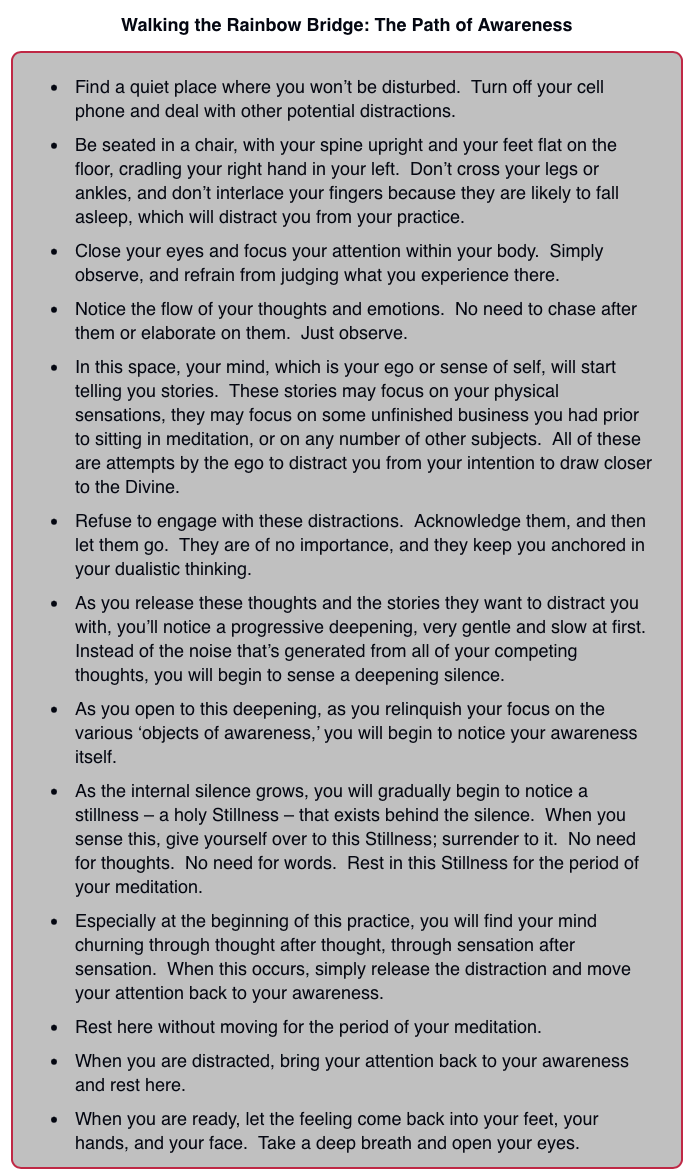
That’s enough for now, I think. I expect that you will find the meditation practice outlined in this newsletter to be very valuable on your inward journey. Please remember to practice daily, if your time permits.
Fundamentally, I believe that our intention to draw near to the Divine is the most important element in our lives. It is our intention that pushes us to meditate. It was your intention to draw closer to our Lord that pushed you to read this newsletter and to consider practicing meditation. I see this intention as one of the many gifts that our Lord so freely gives us. We can rejoice because, despite all apparent difficulties, our God is with us and in us!
Also, please remember that you are free to contact me if you have any questions about the practices I present or the experiences they yield. I will do my best to address your concerns as time permits. Just email me at ken123kaisch@google.com.
With love,
P.S. Several of you have expressed the desire for an online meditation class. If there is enough interest, I will try to figure out how to hold a group class on the web. If you have an interest, please write me at ken123Kaisch@gmail.com.
P.P.S. Several of you have expressed the desire for an online meditation class. If there is enough interest, I will try to figure out how to hold a group class on the web. If you have an interest, please write me at ken123Kaisch@gmail.com.
Humility as a Tool → Letting go → Fear → Openness → Acceptance & Growth
If you are finding this newsletter course helpful, you may want to consider Dr. Kaisch's latest book, Inside the Invisible: The Universal Path to Spiritual Transcendence.👇
39: The Problem of Non-dual Meditation
Edition #39: Inside the Invisible
Some months back, I promised you a new and exciting form of meditation. After making the promise, I realized that I didn’t really know enough about this new form of meditation to share it with confidence. So, I dithered and delayed.
My general rule of thumb is to share only those meditation practices that I know are effective. I typically rely on history and usage to determine this. If a meditation practice has been developed by our forebearers and used over a longish period of time, I tend to feel more confident in putting my trust in that practice. Then I realized, after promising this new form of meditation, that it didn’t have the historical antecedents that I usually use to guide my teaching. As a result, I held off from sharing this with you.
So let me begin by addressing a central issue in all forms of meditation. It is an invisible problem and a subtle one, one that is typically overlooked. It is a problem inherent in the use of language – the problem of subjects and objects. While the goal of meditation is union with the Divine, almost all meditation practices operate within the dualistic paradigm: that is, we are here and God is somewhere else, apart from us.
This leaves us with the paradox. We are seeking union, but we are using tools that reinforce the dualistic paradigm that rules our lives.
Let me try and put this in more concrete terms. You no doubt remember the story of getting the donkey to pull the cart by dangling a carrot in front of its nose – a carrot that it can never reach. In our case, however, by using dualism to try and overcome itself, it is more like you and me chasing an ice cream cone in the hot sun that is constantly three or four feet ahead of us. We run and run and run, but still the ice cream cone stays ahead of us. And should we ever manage to catch up with it, we will find that the ice cream has melted, leaving us a cone full of divine No – thing! (Sorry, but I have a weird sense of humor!)
Okay, maybe that wasn’t the very best example. But here is the dilemma: I am right here, and as I meditate, I postulate that God is somewhere over there, apart from myself. Either I have set up a dualistic framework for my meditation, or I have simply participated in the dualism that guides most of our waking hours.
At issue is how to overcome this too-familiar dualism. As long as we maintain this dualism, we will be unable to connect with the Divine. As long as we postulate that God is out there somewhere, we can think and talk about the Divine, but we will be unable to enter into union with the Divine.
Let me walk you through this for a moment:
When we pray the Lord’s Prayer, we pray to our Father in heaven – a Being who is in a place – heaven – far apart from us.
When we pray the Jesus Prayer, we ask Jesus, who we believe is apart from us, for mercy.
When we pray with Centering Prayer, we still find ourselves in that dualistic framework – we are here and the Divine is elsewhere.
The logic of this is terrifying! No matter what we try, we cannot draw closer to God. We cannot use language – either in thought, or in written or spoken word – because language is built on the subject/object duality. While this framework is quite handy for getting things done in our day-to-day life, it absolutely sabotages our attempts to draw closer to God.
This is a dilemma that haunts all forms of meditation and all forms of prayer. It’s not the exclusive province of Christianity or Buddhism, or any of the major world religions. It’s a dilemma that is faced by all.
~
When I was in college, I remember reading a science fiction story about a two-dimensional world. While I remember neither the title nor the author, I do remember being struck by the dilemma of trying to describe experience using only two dimensions rather than our customary three. This dilemma is very similar to the dilemma faced by all spiritual seekers. How do we overcome the perceptual limitations imposed by our frame of reference?
As always, when I face a dilemma like this, I turn to the spiritual literature. Our problem has been faced before, and with great success by a few. So, what do our great saints have to say about this? How did they resolve this problem?
Let’s start with the gospel of John. In chapter 14, Jesus says, “I am in my Father, and you in me, and I in you.” In effect, Jesus says, ‘I am in my father and my father is in me; just as I am in you and you are in me.’ When we stop and truly listen to this passage, we realize that there is no distance between the Divine and ourselves. Jesus already exists in us. There is no abyss to cross; no distance to cover.
We see from this that the dualism that besets us is just an artifact of our own minds. We project this mental artifact onto the world and ‘discover’ that the world is inherently dualistic. This is simply not true.
Other scriptural evidence suggests the same. In the gospel of Luke, in chapter 17, Jesus says, “The kingdom of God is within you.” In our dualistic thinking, we project that the Kingdom is outside of ourselves. We create a duality between the material and the spiritual worlds, but the creation of this duality traps us in the material. The gospel of Luke indicates, according to Jesus, that this is a profound error. The Kingdom is right here, within our deepest selves. We only need to wake up, i.e., to drop our dualistic thinking, in order to experience this profound and marvelous Unity.
Moving outside of the canonical books of Scripture, we have the gospel of Thomas. This book was found in 1945 near Nag Hammadi in Egypt, and it contains 114 sayings attributed to Jesus. The third saying in this collection states, “The kingdom is inside you and it is outside you. When you know yourself, then you will be known, and you will know that you are the child of the Living Father.”
Here, Thomas asserts there is no boundary between the inner and the outer. Drilling down into the meaning of this saying, Thomas states that the Divine has no boundaries. The Divine is found everywhere: in subjective experience and in objective experience. There is no place where God cannot be found.
Moving back into the canonical Scriptures, we have a passage from Paul’s letter to the Colossians. In chapter 3, Paul states, “Christ is all, and in all.” This may be the most explicit non-dual affirmation in the New Testament. There is nothing that can exist that is outside of Christ – “Christ is all.” Not only can nothing exist outside of Christ, but Christ is “in all.” In this passage, we hear echoes of Thomas, who stated that the kingdom is inside and outside of us.
So, what does this mean? It means that we are inextricably part of the Divine. Our pain comes from our failure to recognize our true nature – that Christ is within us and within all of Creation around us. That there is nothing that can separate us from the love of God!
There are many more passages in the New Testament that point to the non-dual nature of Reality. These passages are typically overlooked because they do not fit our typical frame of reference which is dualistic. There is a massive tragedy hidden in this oversight.
Most Christians and most believers of all sorts adhere to this dualistic framework. They have literally put connection with God out of reach. In some ways, it’s like the gold held in Fort Knox. We delude ourselves by saying that it belongs to all of us, but good luck trying to get your hands on a single bar of bullion!
~
In this edition of Invisible, I have tried to make clear the dangers of our commonly held dualistic frame of reference. I believe that our dualism literally prevents us from seeing and experiencing the Divine – the Divine that is all around us and deeply within us, in our innermost depths.
Our dualism even extends to our meditation practice and our efforts to experience God. In our next newsletter, I hope to introduce you to a meditation practice that transcends this pervasive dualism. Until then, please don’t stop your meditation practice. Even within the dualistic paradigm, meditation prepares us for the experience of God. It trains our minds to focus and to maintain that focus over extended periods of time. It calms our emotional turmoil, and it introduces us to that Great Silence in which we find our Lord.
With love,
P.S. Several of you have expressed the desire for an online meditation class. If there is enough interest, I will try to figure out how to hold a group class on the web. If you have an interest, please write me at ken123Kaisch@gmail.com.
P.P.S. Several of you have expressed the desire for an online meditation class. If there is enough interest, I will try to figure out how to hold a group class on the web. If you have an interest, please write me at ken123Kaisch@gmail.com.
Humility as a Tool → Letting go → Fear → Openness → Acceptance & Growth
If you are finding this newsletter course helpful, you may want to consider Dr. Kaisch's latest book, Inside the Invisible: The Universal Path to Spiritual Transcendence.👇
34: Interior Movement During Centering Prayer
Edition #34: Inside the Invisible
As you begin Centering Prayer, you may be disappointed as you become aware again of all the internal noise and distraction. The inner noise, however, is to be expected. You are loading the mind with less and less technique. As a result, your mind tends to wander more. Expect this, and gently bring the mind back to center with your sacred word.
After a time of practice, you will find your mind growing calmer and less distracted. The purpose of these deep forms of interior prayer is hesychia, or stillness. You may enter into a profound stillness during the time of your Centering Prayer. This is a place that has no words, thoughts, or images. When this occurs, rest here at the center and enter the Mind of God. What we are doing in our prayer is letting go of our mental constructs, letting go of our 'ideas' of ourselves and God, so that we can experience ourselves and our God directly. This is the difference between experiencing the map and experiencing the territory it covers. While the map is helpful in many respects, we can never truly know the territory from a map.
You will have noticed, as we progress in our description of different kinds of monologistic prayer, that Centering Prayer is a relatively advanced technique. As we have sequenced the preceding prayers, from the Jesus Prayer to the Cloud to Centering Prayer, there is less and less to occupy the mind. As you progress in your practice, you are able to hold your attention on the Divine with less and less loading.
People usually expect to encounter fewer problems with interior prayer as they progress to more advanced techniques. It rarely works out this way. Indeed, it sometimes seems like we are constantly starting over. In our subjective experience, it seems that the more we practice, the more aware we become of our wandering mind. When we notice this at an advanced level, there may be some despair about making any real progress.
We must understand this phenomenon of wandering mind in order to prevent despair. Father Keating likens this process to shining a light of progressively greater intensity on the surface of a carpet. Under dim light, the carpet looks clean. As we increase the intensity of the light, we begin to see big specks of dirt. When we put thousands of watts of light on a small patch of the same carpet, we see even the little tiny specks of dust.
It is the same with the mind and meditation. As we attempt to settle our wandering minds, at first, only gross interruptions interfere with our concentration. The neighbor's dog barks, we compulsively think about an upsetting event: these are the sorts of things that disturb us. As we gain strength in our practice, we find that we no longer notice these things. Instead, we notice a subtle flow of thought in the back of our minds. This often seems like the same kind of interruption, but it is not.
As you continue with your practice, you will find progressively finer flows of thought. Each of these has always existed in you, flowing in steady streams. However, due to your involvement with the larger, more significant events, you have just never noticed the more subtle streams. When we can disengage from our obsessive self-absorption, only then are we free to engage with the Divine.
* * *
The Results of Practice. Intensive practice of Centering Prayer serves as a kind of divine therapy, allowing the false self to surface and the compulsive, destructive patterns to resolve. While this process should never substitute for psychotherapy, it can have a remarkable impact in ways that are quite similar.
The power of this divine therapy is illustrated in the story of a colleague of mine. This woman, in her early forties, came from a dysfunctional family and was unable to affirm herself in any meaningful way. She found herself compulsively attending to the needs of others and sacrificing her own well-being in the process. Despite five years of psychotherapy with very skilled therapists, she was unable to resolve the false-self complexes that drove these behaviors in her. While she obtained some relief, there was no lasting behavior change, despite her best efforts and those of her therapists.
After learning meditation and practicing for some years, she went on a ten-day Centering Prayer Intensive under the direction of Father Keating. During this time, she had a series of transformative experiences. After four days of intensive Centering Prayer practice, this is what happened:
While chanting, I became aware that all I need to do is to say "yes" and God will be a part of my life forever. It was so simple. I said "yes" and was immediately flooded with an intense feeling of love and the gift of tears. There are no words to describe what the tears are; they are not tears of grief, sorrow, pity. Perhaps the best way to describe them would be to say that they are tears of coming home, similar to the tears one has when one has been away from home for a long time and returns to the bosom of his/her family. They are not necessarily tears of joy or happiness, more a sense of overwhelming grace.
Later, while sitting in meditation, I felt as though God were gazing into my very being, flooding me with love. I have never been so tenderly loved, so completely loved, so totally accepted.
I sat down one night, determined to ask God to make changes in my life. I expected to wait quite a while before I got a sense of response, but this came instantaneously. I was overcome by a spiritual vomiting. One thing after another from my past came up. I no sooner recognized it, then another thing came up. These things that I was vomiting were the experiences of my false self: my pride, my self-pity, my preconceptions, my ideas about myself and the world. This kept up for hours, until I was exhausted. I went to bed, fully expecting to sleep because I was so emotionally drained.
Instead, as I lay there, I became engaged in wrestling with God. I know now that I was wrestling with my true self, but then it felt as though I were wrestling God. I kept holding onto all those things that I had vomited up earlier. I would not let go of them. They were how I defined and knew myself and my world. I knew that if I let go of them, my 'I' would cease to be. It seemed as though there was a soft being with me, urging me gently to let go of my vomit. But I kept wrestling with that soft being, only I wasn't strong enough. I wrestled and fought, but still that being held on. I didn't sleep at all that night.
I was still wrestling as I walked to mass in the morning. Along the road, I was 'debating' with God. I was asking God what would happen if I let go of myself. (As I write these words, now, the answer seems obvious. But you must remember that I was totally engaged in this tremendous struggle for my very being.) What would be left? Then I had a waking 'vision.' I'm still not sure what to call it. I was aware of myself looking into a mirror and seeing no reflection. I was aware of myself holding the mirror, but no reflection or anything else was coming back at me. There was just nothing in the mirror.
This, for some reason that I still don't understand, was very reassuring to me. It was as though I was still there, but I was nothing. So I said "Okay" to God and let go of myself. The next sensation I had was the experience of free-floating. Then I just was, with no more sense of falling or floating. I did not know who I was. I did know where I was and what I was doing. But I had no sense of who I was. This continued for a while. It was not bothersome. In fact, it was quite intriguing. I knew I still existed, but I did not know who this 'I' was.
I spent the next few days exploring aspects of this 'I', which was my true self, which had been hidden deep inside, below all the garbage that I had accumulated. It was like listening to an inner voice, instead of my usual thinking about things. My perception of reality shifted slightly. I became aware of the unity of all people and all things in God. This has stayed with me until today (a time period of several years).
This woman returned from the ten-day intensive as a changed person. Not only has her perception of reality shifted, as she indicates above, but her behavior has undergone a radical change. She no longer feels compelled to take care of others and to sacrifice herself for their needs. Yet, paradoxically, she seems more effective in her interactions with others and is perceived as immensely compassionate. This woman even looks different. Her husband said that when he met her at the plane, he didn't recognize her at first.
The account of this modern-day pilgrim describes what these forms of deep prayer are about. They are transformative tools that enable us to discover our true nature as children of God. The practice of meditation and contemplative prayer helps us to see ourselves as God sees us. More importantly, these practices help us to be ourselves. In the process, we come to know ourselves as participating in God's holy Presence. Here is where we find our deepest, truest nature.
* * *
Centering Prayer is rooted in the apophatic mysticism of the Western Church and is based on the prayer described in The Cloud of Unknowing. Centering Prayer is rooted in a profoundly incarnational theology. It rests on the understanding that God is always with us, that the Divine is always accessible to us in our deepest center. In addition, with the work of Father Keating, there is an expansion of the Pauline doctrine of "putting on the armor of light." This theological expansion provides words for describing and understanding the transformations that occur in meditation and contemplative prayer. Thus, it enables greater precision in description and a deeper understanding of the process.
One of my concerns as a teacher and a psychologist is the applicability of different meditations for different people. For example, there is a clear developmental sequence in these meditations, which I have tried to illustrate in these newsletters. But are there certain meditations that would work better for one kind of person than another? Since we all learn in different ways, it is likely that some people will learn more effectively from one type of technique than another.
Over the years, I have found some confirming evidence for this, as we compare the Jesus Prayer with Centering Prayer. In my experience with these two techniques, I have found that their efficacy is related to personality styles. For introverts, Centering Prayer appears to be a more suitable option. Introverts work better when they don't have to 'talk', even when the talk is internal. Extroverts, on the other hand, seem to find the Jesus Prayer more compatible. The Jesus Prayer provides them with a way to go deeply into prayer, while still chatting away.
Centering Prayer is a vital technique for spiritual transformation. It is not, however, a tool for beginners. The focus of Centering Prayer is too diffuse for most beginners. They have difficulty concentrating their awareness on the inner center. Thus, Centering Prayer is for those who have developed some ability to focus attention and to rest it in God. The contemplative practices that we will describe later will further enhance our ability to focus attention.
* * *
That’s it for this week. Next week, I plan to delve deeply into the concept of karma. The concept of karma is pretty straightforward – we are each responsible for all our actions. This idea is found in all major religions, although each has developed its own terminology to describe the same phenomenon.
Please continue to meditate regularly. You now have an array of meditative practices to choose from. You will make the most progress if you pick one practice and stick with that for a time.
Humility as a Tool → Letting go → Fear → Openness → Acceptance & Growth
If you are finding this newsletter course helpful, you may want to consider Dr. Kaisch's latest book, Inside the Invisible: The Universal Path to Spiritual Transcendence.👇
33: The Practice of Centering Prayer
Edition #33: Inside the Invisible
Centering Prayer is a modification of the prayer described in The Cloud of Unknowing. In Centering Prayer, there is no creation of a cloud of unknowing above you or a cloud of forgetting below you. These are mental creations; ideas that are artificial and not wholly real. Instead, there is a resting of the attention in one's center, trusting that God is always present to us there. There is no attempt made to 'feel' God's Presence. Again, this would be just another 'mental' effort; something that ultimately distorts our approach to God rather than something that facilitates our approach.
Finally, there is a different use of the "sudden impulses toward God" which the author of The Cloud describes. The author of The Cloud invites us to use a one-syllable word to help focus our attention, by "fasten[ing] the word to your heart" and saying it over and over again. The authors of the Centering Prayer invite us to choose a word at the outset of our meditation, but to use it in a somewhat different way. Instead of repeating it constantly, like in the Jesus Prayer, we are to say it only when we become aware of distractions. We are to "touch distractions with the sacred word, like the light touch of a feather."
Father Keating sums up this use of the sacred word with "the four R's." These are:
1) Resist no thought.
2) Retain no thought.
3) React emotionally to no thought.
4) Return to your sacred word when you notice you are thinking about some other thought."
Centering Prayer revolves around the use of a "sacred word." Before we begin a period of practice, we must choose a word, a sound, or even a gesture. This will serve as a symbol for us, a tool to remind us of what we are doing – sitting in God's holy Presence. When distracted, we will use this word to bring us back to that central Reality.
It is important to note that the sacred word is not sacred because of any intrinsic quality of the word itself. It is sacred because it expresses our intention to be in God's Presence and to yield to His action. Your sacred word may be one of the words used to refer to God: Jesus, Lord, Kyrie (Greek for Lord), Abba, Amma (Aramaic for Father and Mother), etc. It may refer to a divine quality: Love, One, Still. It may be a gesture, made silently within yourself, such as raising the distracting thought up to the Divine. It may be totally devoid of intellectual content, such as the sound of a pure tone, or a sigh like, "Ahhh."
Whatever you choose for your sacred word, it should be simple, short, and non-reflective. That is, you shouldn't go off on a ten-minute remembrance of Jesus' Sermon on the Mount if you use the name "Jesus" as your sacred word. Furthermore, after you have chosen your sacred word, do not change it for the period of your meditation. Father Keating and the other leaders in the Centering Prayer movement recommend practicing this method for at least 20 minutes at a time. They also recommend practicing twice a day: early in the morning when you arise, and in the afternoon or evening.
Keating describes Centering Prayer as "a discipline designed to withdraw our attention from the ordinary flow of our thoughts. We tend to identify ourselves with that flow. There is, however, a deeper part of ourselves. This prayer opens our awareness to the spiritual level of our being....which is our participation in God's being."
Centering Prayer is based upon cultivating a receptive attitude. The entrance into deep quiet is a mark of the power of our developing receptivity. We are not praying to achieve a spiritual 'high,' to have no thoughts, or to do or have anything at all. Our purpose, in Centering Prayer as in all of the exercises presented here, is to be with the Lord, to be open to His Will, to be receptive to His movement in our hearts.
The reason this discipline is so crucial is simple. "The chief thing that separates us from God is the thought that we are separated from Him. We fail to believe that we are always with God and that He is part of every reality." The obstacle that prevents us from understanding this fundamental reality is our own thinking and worldview. "It needs to be exchanged for the mind of Christ, for His worldview." Centering Prayer, then, can be best understood as an open-hearted consent to God.
* * *
This seems like a good stopping place for this week. I would encourage you to practice Centering Prayer until we meet again. I have found that Centering Prayer seems more natural for introverts, whereas the Jesus prayer, with all of its words, seems more natural for extroverts. That being said, both of these forms of meditation will take you very deeply into the presence of God. It really doesn’t matter which method you choose; what matters is that you find a method that is comfortable for you and that you practice with it regularly.
Next week, we will examine the interior movement that occurs during Centering Prayer in more detail. I will be sharing the experiences of a colleague who went to a 10-day Centering Prayer Intensive Retreat. In this account, my colleague shares with us a series of internal changes that occurred as a result of her meditation. Her account is very moving, and it will give you a sense of what is possible as a result of practicing this prayer.
Humility as a Tool → Letting go → Fear → Openness → Acceptance & Growth
If you are finding this newsletter course helpful, you may want to consider Dr. Kaisch's latest book, Inside the Invisible: The Universal Path to Spiritual Transcendence.👇
32: Centering Prayer
Edition #32: Inside the Invisible
In past newsletters, we have explored a very special kind of prayer known as monologistic prayer. This is a family of meditative exercises that has been developed within Christianity over the course of its 2,000-year history. Then, in weeks 20 and 27, we explored the Jesus Prayer as one of the very first examples of this special way of connecting with God. With the Jesus Prayer, you open yourself to the presence of God, move your attention into the region of your heart, and from your heart say the words of the Jesus Prayer. This is a repetitive prayer and was developed as a way of following Paul’s injunction in 1 Thessalonians, to pray without ceasing.
Over the centuries, prayerful Christians have developed other forms of monologistic prayer – forms that seemed more in keeping with the tenor of their times. This is exactly how Centering Prayer came into being.
In the mid-1970s, monks at the Cistercian abbey of St. Joseph in Spencer, Massachusetts, began to talk together about the spiritual poverty of our times. They viewed with concern the exodus of sincere spiritual seekers within Christendom who were unable to connect with their own contemplative tradition. They wanted to find a way to make the riches of the contemplative life available to the lay person who could not spend a life in the monastery. The result of their conversations is Centering Prayer, a contemporary revision of an earlier monologistic prayer, a technique that was first presented in the fourteenth century, in The Cloud of Unknowing.
Because the development of Centering Prayer is contemporaneous, we have insight into how it was created and why. This takes away the aura of “specialness” that surrounds many of the earlier forms of monologistic prayer. We see, by talking with the originators of Centering Prayer, what they were trying to address and how the prayer seemed to develop stage by stage.
Responding to an invitation from Father Thomas Keating, abbot of the monastery in Spencer, Father William Meninger developed the initial form of Centering Prayer and taught it within the walls of the monastery. Father Basil Pennington then began to offer classes outside the monastery, altering the prayer to fit in this
new environment. In 1981, Father Keating 'retired' as abbot at St. Joseph's and began to teach Centering Prayer full time to the spiritually hungry. The practice was codified in 1984, with the publication of Open Mind, Open Heart.
Like the Jesus Prayer, this form of prayer is not for the discursive intellect, and is not meant to be a forum for the creation of visual imagery or other forms of 'thinking.' Rather, it is a technique that enables us to see what lies beneath the busyness of the modern mind. It rests on the notion that, deep in our hearts, God is always with us.
The Theological Basis for Centering Prayer
Centering Prayer rests on a much more developed and sophisticated theological and psychological base than does the technique of The Cloud. Centering Prayer focuses on the incarnation of God: that God is always and everywhere present to us. Father Keating has given us a thoroughly developed understanding of the Pauline teaching of "casting off the deeds of darkness and putting on the armor of light." He not only explains the theology, he also incorporates contemporary psychological understandings as well. As a result of these deeper understandings of the inner workings of the human mind, the authors of Centering Prayer revised several elements in the prayer technique.
The basic theological underpinning on which Centering Prayer rests is that God is always with us. We find this understanding in the Scriptures of both the Old and New Testaments. In the Old Testament, we hear in the book of First Kings that Elijah finds God in the "still small voice within." The stories of the prophets are filled with references to God being present, right in the midst of the people of Israel. This God, while being Wholly Other, is also the burning bush right in front of Moses. Not only is this God right here, He is named in the book of Isaiah, "Emmanuel", which means "God with us."
In the New Testament, the incarnate aspect of God finds its fulfillment in the person of Jesus, God's Son, sent to redeem His people. Jesus, himself, reaffirms this at crucial points in His ministry. In the gospel of John, Christ states "I am the good shepherd." The shepherd stands with his sheep; that is the nature of shepherding. A bit later in the gospel of John, our Lord says, "I am the vine, you are the branches." In case we didn't understand the inseparable nature of the shepherd with the sheep, Christ gives us an elaboration of this notion with His vine image. There is no place in the vine where you can clearly say that the vine stops and the branches begin. Not only is God with us, He is indistinguishable from us except in the most general of generalizations. And at the very end of His incarnate time, in the last words of the book of Matthew, Jesus says, "know that I will be with you always, even to the end of time."
The understanding which has come down to us through the Church, is that we are grafted onto Jesus by means of our baptism. Jesus, then, is always present in the soul of the one baptized. This theological understanding has been verified experientially by those who have devoted themselves to drawing closer to God. Generations of Christian contemplatives, those who have traveled the spiritual path before us, have indicated that Christ lives in the soul, and the soul is found in our hearts. Not the physical organ, but in our spiritual center which is located in the same general vicinity.
Perhaps the most dramatic example of this grafting and the transformation it can bring is found in the story of Saul of Tarsus, at the very beginning of the Christian era. Saul, the persecutor of Christians, the apostle who never knew Jesus in the flesh, was utterly transformed by his encounter with the risen Christ. Jesus even gave him a new name, Paul, to mark this transformation.
While much is made of his visionary experience on the road to Damascus, little attention is given to the quiet, yet more profound part of Paul's journey. Over the course of his remaining years, Paul changed and matured spiritually. As he gained knowledge of God's indwelling Presence, his connection with the Christ strengthened immeasurably. He was able to write from prison in Rome, just before his execution, "nothing can separate me from the love of God in Christ Jesus our Lord." He is writing here, not from faith. His is not a strong hope in Christ. He writes like a man who knows. He knows that nothing can separate him from the Lord because that has been his daily experience in prayer. Paul has 'seen' and 'felt' and 'listened to' the Christ who dwells in his heart.
This is the close connection with Christ that we all long for. The basic understanding, which forms the foundation of Centering Prayer, is that God is already present with us, in our center. We are already redeemed; we are already participating in the Divine. We are already one with God, our Savior. There is nothing we need to do to come to our Redeemer.
We don't feel like this, though. These assertions of closeness to God run counter to our felt experience. Our felt experience of separation, however, is fundamentally untrue. Our felt experience is a result of our dissociation – our disconnection from our true self. The authors of Centering Prayer reiterate the same message that all the deepest mystics of the Church have given us: there is no fundamental separation between God and her people. There is no abyss to cross, no journey that is necessary. What we hear from our spiritual Fathers and Mothers is something radically different. What they say is this: "God is closer to you than you are to your very self."
Our Felt Separation. Two thousand years ago, St. Paul struggled with the same profound sense of separation that we struggle with today. He complained, "I do the things that I don't want to do, and I don't do the things I want to do. What is wrong with me?"
Modern psychological investigators have addressed the same phenomena using different language. D.H. Winnecott uses the terms true self and false self to describe these experiences. Father Keating has adopted these terms to explain the apparent contradictions within the human psyche. From this perspective, each of us creates a false self – a socially adapted ego – in response to the pressures of growing up. We learn very early that some parts of ourselves are not acceptable. Boys learn that it is not acceptable to show emotions, such as crying. Girls learn that it is not acceptable to be rowdy and loud. As our egos develop, we often cut off these parts of ourselves because they are not socially acceptable.
The false self is our response to social pressure. None of us develops 'naturally.' That is, none of us is ever allowed to be just as we are. Rather, the human infant undergoes a constant process of shaping and conditioning, during which we learn to be acceptable to others. This socialization process is crucial for us if we are to get along with one another in groups. However, it is achieved at a high cost. Our Lord indicates that, to return to our true nature and to return home to God, we must become like little children.
In addition to pruning away parts of ourselves, our socialization in childhood also entails the creation of a variety of emotional programs, many of which are dysfunctional. As a culture, we are finally waking up to the social devastation in which we dwell. As a clinical psychologist, I saw the horrid effect of these old emotional programs every day. I saw women who were sexually abused as children internalize this abuse and seek out men who abuse them as adults. I saw children who grew up with abusive parents develop clusters of dysfunctional personality traits that are the perfect complement to their early abuse.
So you see, our socialization literally programs us for unhappiness. This happens in two ways: 1) by the pruning process of socialization, and 2) by the creation of dysfunctional emotional programs, which then act to 'control' the choices we make in our lives. All of this is absolutely contrary to the words of our Creator!
After creation, God looked at her work and said that it was good. Indeed, it was very good. We act, however, as if parts of that creation were not good and have to be cut off. We have left that centered, balanced place where we are in tune with the Divine, with nature, with one another, and with our deepest selves. We are like Esau; we have sold our birthright for next to nothing, for a mess of pottage. We have abandoned our true self, created by God, and exchanged it for a maladaptive false self.
Father Keating rightly recognized that the meditation process is a direct attack upon this construct of the false self. During meditation, we attempt to focus and concentrate our attention. This is a process radically different from anything else we do. Instead of being plugged into the old programming of the false self – instead of listening to the thoughts and feelings that are governed by this old programming – we disengage from it. We simply rest our attention in God.
From the perspective of the false self, we are unaware of how to access the true self. We simply cannot see it. We are not even sure that it exists at the start. We take its existence on faith and begin our attempt to shed our old skin. Because we don't know how to get to the true self, we can't do anything other than unplug from the old. Most attempts to dosomething to get away from this false self are actually directed by that same false self. We cannot use it as a tool to cut itself.
All that we can do is to disengage our attention from the old, sinful person and from the false self. As we know from our experience in meditation, even this is incredibly difficult. We rest our attention in God, and moments later, we become aware that we are once again wrapped up in our thinking. So, once more, even in meditation, we find ourselves following the dictates of the ego, the false self. Eventually, however, the false self will run out of fuel and die. Then the true self, which has been obscured within our deepest interior, will emerge. When the true self emerges, we become aware of our deep connection with God and with all of her Creation.
This description of the destruction of the old self and the emergence of the true self that God creates is taken from experience. It is not something made up or imagined. We first hear of this process in the letters of St. Paul. Paul, through much prayer over many years, accomplished this process within himself. With this perspective in mind, the lives of the saints become much clearer. From this perspective, we see that the variety of disciplines that they used were attempts to disengage from the ego, the false self.
It is only from this perspective that certain passages of the gospels make any sense. Central to all the gospels is Jesus' command that we should love one another, even to the extent of loving our enemy. From the perspective of the false self, however, we cannot love our enemy. Our enemy, by definition, is one whom we hate. Only from the perspective of the true self – the self which knows that it is deeply interconnected with all beings – can one have an enemy and love that enemy!
From this understanding of the deep psychological dynamics that are involved in our journey toward God, our Center, we begin to see why certain things are the way they are. Because our false self readily adjusts to every social situation, we see this falseness played out in every church community. From this perspective, we see that a conscious decision to choose Christ is not enough to lead a Christian life. Any conscious decision, including those related to the spiritual life, does not really touch the deep unconscious programming of the false self. These decisions, well-intentioned though they may be, are regularly subverted by the false self. It is only through engagement in the regular disciplines of deep prayer and meditation that we can break free of the ego’s control over our lives. The nondiscursive meditations, such as Centering Prayer, draw us into the realm of God's grace. As we spend time in meditation, these ego–derived programs are gradually drained of their energy and finally discarded.
Thus, the deep forms of prayer function as a kind of divine therapy. Father Keating states that the process of meditation and contemplative prayer allows our old emotional programs to come to the surface, where their energy can be discharged.
In our meditation, at this point, there is a reduction of interior dialogue. This reduction removes the constant reinforcers of the false self system. This quieting of the thoughts, the gross movements of the mind, allows the more subtle attributes to be seen. Ultimately, we disengage even from these. The energy that previously fueled the false self is withdrawn. As this occurs, the false self shrivels and the true self emerges. Finally, we realize that this true self has been in union with God all along. We simply could not be aware of this union from the perspective of the false self.
* * *
I hope you have found this newsletter helpful in understanding what happens during the spiritual journey. We are embarked upon this fascinating expedition into the dark unknown – the unknown that exists within each of us. We are promised riches beyond all imagining if we persevere to the end. As with the story of the Prodigal Son, God promises to throw us a party when we finally find our way back home. So keep up with your meditation, even (or perhaps especially) when your meditations seem dry or pointless. You know when that happens that your false self is fighting for its very existence – you have pressed it to the edge.
God bless you in your inner work. Next week, we will learn how to do Centering Prayer.
Humility as a Tool → Letting go → Fear → Openness → Acceptance & Growth
If you are finding this newsletter course helpful, you may want to consider Dr. Kaisch's latest book, Inside the Invisible: The Universal Path to Spiritual Transcendence.👇
27: Deepening the Jesus Prayer
Edition #27: Inside the Invisible
As wondrous and powerful as the Jesus Prayer is, there is a way to further enhance its efficacy. To do this, you connect the power of your emotions to the intent of the prayer. Instead of simply reciting the words over and over, you emotionally charge the words, imbuing them with your own genuine longing.
There are two critical elements that need to be addressed here: your intention and your emotional focus and power. Your intention, by using the Jesus Prayer, is not simply to repeat a jumble of words just to hear yourself talk. Your intention is your determination to present yourself to your Creator, your Messiah. Reflect on that for a moment. If you go to your boss with a problem, you might feel a little anxiety. If you go before your city Council, or before the governor of your state, you will probably experience some considerable anxiety.
So what are you going to feel like when you present yourself to the Creator of all that is? The Creator of all humanity and every bit of the planet Earth, with all of its marvelous complexity? How are you going to feel in front of the Creator of the solar system, and not just our little solar system, but the entire Milky Way – 100 billion stars, many of them shining even brighter than our sun? Pretty awesome, isn’t it?
Perhaps more than anything, being clear about our intention to present ourselves to our Creator – to be present to that wonderful Presence that vibrates through and within everything that is – is the most critical element in the Jesus Prayer and in all prayer. This is also something that is commonly overlooked. We often just sit down and pray without really considering the meaning of our prayer. Without considering that we are standing before the Most High. Being clear and focused in our intention is critical to unlock the full power of our prayer.
The second element here – the use of our emotional power – is also a critical factor for enhancing the efficacy of the Jesus Prayer. Our emotions carry this amazing power that enables us to connect deeply with others. Remember what it was like when you first fell in love with someone? You thought about that person all the time and couldn’t wait to be with them again. When you are finally together, it's blissful, and you feel completely seen and understood. As a result, you did everything in your power to be with the person you loved.
Our intention with the Jesus Prayer, and with all prayer, is to connect with the Divine in just this loving and all-consuming way. Sadly, the emotional component of prayer is often overlooked or disregarded. We don’t use our innate power for connection to further deepen our connection with God. By tapping into this innate capacity in our prayer, we enhance its efficacy many times over.
That being said, this enhanced practice is not for those who are just starting to learn the Jesus Prayer. It is enough, for those who are just learning, to develop a focused attentiveness to the Lord. After approximately six months or so of continuous practice with this prayer and the attainment of some interior stability, you may wish to enhance the power of the Prayer by being clear about your intention and connecting your emotions to the Prayer, enlivening it with your emotional energy.
A brief note about the following instructions: You will remember, from previous newsletters, that the Jesus Prayer is not about the words used, per se, but about using words as a vehicle to enter into the Being of God. Despite the plethora of words used to describe this enhancement, please remember that the Prayer is not about the words. The words used below are intended to guide you toward those interior movements that will help you deepen your prayer.
Enhancing The Jesus Prayer
1. Position your body comfortably, spine erect, on a chair or cushions.
2. Become aware of the physical sensations that flow through you. Close your eyes and experience the streams of sensation that course through your physical body. No need to change them. No need to judge them. Simply let yourself feel deeply the multitude of sensations cascading through you. Gently focus on the sensations in your head...in your neck and shoulders...your elbows...your wrists and the palms of your hands...the sensations in your knees...your ankles and the soles of your feet.
3. Now open your awareness to feel God's Presence right here with you. Feel that Presence all around you...within you. Let yourself rest in this Presence.
4. Be aware of the sphere of energy around your head. Let this sphere of energy begin to get heavy and drift downward toward your heart center, until your head rests in your heart.
5. In your heart and from your heart, say the words, "Lord Jesus Christ, have mercy on me...Lord Jesus Christ, have mercy on me." Let your heart repeat these words over and over again, feeling God's Presence right here with you.
6. After the words have stabilized, begin to feel the words. Instead of just saying the words, feel their meaning. Feel what it means to acknowledge Jesus as your Lord. Historically, a lord has had the power of life or death over his subjects. As you acknowledge Jesus as your lord, let yourself fully experience your absolute dependence on your Lord. Feel your need for his favor, his generosity, his willingness to give. Your life, your continued existence, all depend on his good will towards you.
7. Be aware of the difference between yourself and your God. You are small and limited in power. Your Lord is not just large but without limits. As you experience the difference, use this as an opportunity to let go of your self-centeredness, your constant cry of “Me-me-me.” Rest in the Immensity that is your Lord.
8. In your Jesus Prayer, you have named him as your Christ, your Messiah. The Messiah is the one who saves us from our selfishness, from our ego-driven limits. He is the one who invites us to open to our true nature as children of the Divine. Acknowledge Jesus as your Christ. Feel what it is, to be saved from your own drivenness, your own neediness. As you acknowledge your Savior, feel yourself letting go of that which separates you from Him.
9. In this great Prayer, you are asking your Lord, "Have mercy on me." Repeat these words with all of your emotional power. Let yourself explore the depths of your need for God’s mercy. This is not a time for blaming yourself, but a time for acknowledging your genuine neediness and your profound need for mercy and divine assistance.
10. Rest here, in the Presence of your Lord.
(To close your meditation)
11. When you are ready, let yourself come back to this place. Let the feeling return to your feet, your hands, and your face. Take a deep breath, and open your eyes.
Connecting your emotions to your prayer is one of the great contributions that Christian contemplatives have made to the development of prayer. Our Christian heritage is full of emotion: from Christ, the Messiah, being born in a stable, to the bloody crucifixion, and then the sweetness of Jesus' resurrection. It is natural for us to use the strong feelings that are aroused in us as we read the narratives of our Savior's work, and to apply these feelings to our prayer.
To state the obvious, our emotions move us. There is a powerful force within our emotions that can transport us to different places. So too it is in prayer. When we find ways to connect our emotions to our prayer, then that power to move us is unleashed and channeled into spiritual pursuits. In this way, our emotions can become a great force for our interior development.
---------------
The Jesus Prayer is one of the great spiritual tools that the Church has developed to aid us in our walk with the Lord. It has been developed and refined over virtually the entire scope of Christian history, a period spanning approximately 2,000 years. Over this period, those elements of the Prayer that were not efficacious in producing spiritual transformation have been pruned away. What is left is the pure essence.
The Prayer is like a powerful vehicle, waiting only for us to use it. Because of its power, it should not be used lightly. This is not a toy for children to play with. It has the capacity to provoke the most profound kinds of spiritual change in our hearts. So we should not use this prayer until we are quite ready, in our own minds, to move into the depths of God.
The Prayer will lead us, as directly as possible, into a direct encounter with the Divine. The benefits which accrue from this encounter are impossible to enumerate. There is such a sweetness, such a joy that arises from this direct encounter, that language is simply too gross a vehicle to adequately describe the experience. This, of course, has not stopped people from trying to describe what has happened to them. Let us close this chapter with a description of the effects of this Prayer, as described by the anonymous Russian pilgrim of the nineteenth century.
The Prayer of my heart gave me such consolation that I felt there was no happier person on earth than I, and I doubted if there could be greater and fuller happiness in the kingdom of Heaven. Not only did I feel this in my own soul, but the whole outside world also seemed to me full of charm and delight. Everything drew me to love and thank God: people, trees, plants, animals. I saw them all as my kinsfolk; I found on all of them the magic of the Name of Jesus. Sometimes I felt as light as though I had no body and was floating happily through the air instead of walking. Sometimes when I withdrew into myself, I saw clearly all my internal organs and was filled with wonder at the wisdom with which the human body is made. Sometimes I felt as joyful as if I had been made Tsar. And at all such times of happiness, I wished that God would let death come to me quickly, and let me pour out my heart in thankfulness at His feet.
Have a great week, and remember that if you have any questions about your practice, please don't hesitate to contact me at ken123kaisch@google.com.
With love,
P.S. Several of you have expressed the desire for an online meditation class. If there is enough interest, I will try to figure out how to hold a group class on the web. If you have an interest, please write me at ken123Kaisch@gmail.com.
Humility as a Tool → Letting go → Fear → Openness → Acceptance & Growth
If you are finding this newsletter course helpful, you may want to consider Dr. Kaisch's latest book, Inside the Invisible: The Universal Path to Spiritual Transcendence.👇
21: The Spiritual Exercise of the Jesus Prayer
Edition #21: Inside the Invisible
I am delighted to be here with you this week, because we get to explore and practice the Jesus Prayer, one of the oldest forms of meditation and contemplation in all of Christendom. I have practiced this form of meditation for roughly the last 50 years. During that time, it has taken me deeper and deeper, coming to a wordless contemplation of God. It is suitable for almost everyone, from beginners to very experienced practitioners.
Last week we explored a bit about monologistic prayer and the history and development of the Jesus Prayer. This week we will actually start our practice with this very special form of meditation, which has the power to take us deeply into God’s holy presence.
The Jesus Prayer
1. Position your body comfortably, spine erect, on a chair or cushions.
2. Ground yourself in your physical sensations. Close your eyes and slowly become aware of the sensations of your physical body. Feel the sensations as they flow through you. The sensations in your head...in your neck and shoulders...your elbows...your wrists and the palms of your hands...the sensations in your knees...your ankles and the soles of your feet.
3. Now open your awareness to feel God's Presence right here with you. Feel that Presence all around you...within you. Breathe in the Divine with every breath. Breathe God out. Let yourself rest in this Presence.
4. Be aware of the sensations in and around your head. You probably are aware of a sphere of energy around your head. This is where most of us 'live.' Let this sphere of energy begin to get heavy and drift downward toward your heart center. When you begin this, it may be a little difficult. We are so accustomed to having this energy in our heads that we don't know what it would feel like somewhere else. But let that sphere of energy gradually grow heavier and heavier. Let it sink down into your heart. If you have trouble with this, imagine that with each inhalation this sphere of energy is pushed down about an inch or so. With every breath, your head energy is moved downward, until your head rests in your heart. Anchor yourself here, so that you are able to perceive through your heart.
5. Now, in your heart and from your heart, say the words, "Lord Jesus Christ, have mercy on me...Lord Jesus Christ, have mercy on me." Let your heart repeat these words over and over again, feeling God's Presence right here with you.
6. When your attention wanders, be patient with yourself. Gently bring your attention back to the three operations of this meditation: feel God's Presence; put your head in your heart; and say the words, "Lord Jesus Christ, have mercy on me."
(To close your meditation)
7. When you are ready, let yourself come back to this place. Let the feeling return to your feet, your hands, and your face. Take a deep breath, and open your eyes.
The Interior Movement of the Jesus Prayer
The practice of the Jesus Prayer will take us on a predictable interior journey. At first, we are likely to have difficulty engaging in the three operations of the prayer simultaneously. While each of these operations is relatively simple, the first two are unusual for us in this culture. We seldom try to experience the Presence of God in a deliberate way. And we never strive to put our attention into our heart! So there will be a period of some frustration, as we try to keep each of these three things going at once. It can feel a bit like juggling, trying to keep three things in the air at the same time. Once you get the hang of it, though, the experience seems quite natural and enjoyable.
During the initial time of frustration, you will find yourself distracted, as with the previous practices. Your attention, while strengthened, is still not a focused tool. As you become aware of your distractions, the initial impulse will be to punish yourself: to engage in the punitive internal dialogue which emphasizes how inadequate you are to accomplish even the simple tasks of this prayer. This sort of inner dialogue is basically garbage! It is your ego, fiercely defending itself and its control over you. The best way to view this negative self-talk is to see it as just another distraction. You obtain no benefit from it, so simply withdraw your attention from these distractions, and re-engage in the three operations of the prayer.
The complexity of the Jesus Prayer, with its three specific and simultaneous operations, is actually a substantial aid toward the development of a stable attention. These three operations place such a load on conscious awareness, that it rather quickly moves beyond distraction. You notice I said 'rather quickly.' I mean this in relationship to other meditations which do not have this loading effect. Your progress may still seem slow to you. After continual practice, two things begin to emerge. First, you are more and more able to do all three operations of the prayer simultaneously. Second, the number and intensity of distracting thoughts and feelings seem to diminish. There is a gradual quieting of the mind, as if the intellect becomes content with the discursive activity of the prayer, while deeper changes are occurring in you beneath the words.
The Arising of Spiritual Phenomena
As your practice continues, several phenomena may arise that are important to understand. While there is no specific order to their occurrence, in my experience, they tend to follow the order described here.
First, there is the arising of internal heat. You will be sitting in meditation and you will become aware that your body is very warm, sometimes it even feels hot. You may begin to perspire profusely. This is one of the spiritual fruits of the deepening of your interior prayer. It is the action of God within us, burning away the subtle interior obstacles which keep God veiled from our awareness. You may find this warmth so intense that you become frightened of it, thinking that something is wrong. Don’t worry. You are simply tasting the first fruits of the interior life. As this experience comes, you may need to loosen your clothing before you meditate, or even wear lighter clothing, so that you are not too distracted by the heat.
The second phenomenon which frequently occurs is known as the gift of tears. This is the experience of inner grief and compunction, which seems to arise spontaneously as you explore your interior depths. This experience is cause for rejoicing, because it signifies a deepening of the interior cleansing which usually begins with the experience of interior heat.
The gift of tears may begin with a feeling of grief or sadness, centered in the heart or the throat. You may find tears beginning to trickle out of your eyes. On occasion, there is full-blown weeping, but more often it is just a sweet-sad grief which causes these tears. When this occurs, don’t be surprised if your tears continue, even beyond the period of your meditation. You may find your eyes 'gently leaking,' producing very small amounts of moisture throughout the day. Usually no one will notice this but you.
A third phenomenon, which is more rare than the first two, and which typically follows after a long period of practice, is the experience of interior light. There arises within your heart an interior light that carries with it such tender sweetness that you will marvel at its intensity. This is your first clear sight of that great Light that is Christ the Lord. Words do not suffice to describe it, nor the interior feelings which accompany it.
These three phenomena cannot be sought after. This is very important for you to understand. These phenomena accompany the deepening of practice in a natural way. So do not strive after the phenomena. Your striving after these 'markers' of experience will only serve to keep you from them. Instead, strive to be present to God at all times. As our Lord says, "Do this, and all else shall be added to you." As you continue your practice, you will find that your mind begins to quiet down. There is a gradual dawning of interior stillness. This occurs both within the practice of the Jesus Prayer and between the formal periods of practice.
Within the practice, your recitation of the words will be broken, from time to time, by a vast stillness. It is as if you have been traveling along a heavily wooded road in the mountains, where you cannot see anything because of the thick forest. Then suddenly the road breaks out of the forest and a stunning vista opens before you. You stand, dumbstruck with awe, held suspended in the vastness of all that you survey.
This is what interior silence is like. Your recitation of the words of the prayer will, at times, spontaneously cease, and you will stand in the Presence of God in awe. There are simply no words, only stillness. This deep experience cannot be achieved by 'wishing' it, by imagining it, by striving for it, or by promoting yourself beyond the reach of your own experience. It lies within you, awaiting your discovery. You can do nothing to hurry it. You can only open your heart to God, and fix your attention there. God will give you His grace in His own time, not in yours.
With the arising of this deep inner stillness, you begin to approach contemplation. The contemplative process is different in character than all the spiritual exercises that go before it. We will explore the contemplative process at a later time.
* * *
Let’s bring our meeting to a close for now. You have received the basic instructions for one of the most powerful meditative prayers that has ever been developed. It has the power to take you deeper and deeper into an intimate relationship with the Divine.
I encourage you to set aside time to practice the Jesus Prayer on a daily basis. I typically practice in the morning, on arising, and in the evening before I go to sleep. This form of practice provides me with spiritual bookends for my day, and this practice seems to make my days go more smoothly. I would encourage you to enter into this interior space throughout the day as well, even if it is just for a moment or two. The ultimate aim of all spiritual practice is to dwell in the house of the Lord, so why not move in today? LOL
Have a great week, and remember, if you have any questions about your practice, please drop me a line at ken123kaisch@google.com.
With love,
P.S. Several of you have expressed the desire for an online meditation class. If there is enough interest, I will try to figure out how to hold a group class on the web. If you have an interest, please write me at ken123Kaisch@gmail.com.
Humility as a Tool → Letting go → Fear → Openness → Acceptance & Growth
If you are finding this newsletter course helpful, you may want to consider Dr. Kaisch's latest book, Inside the Invisible: The Universal Path to Spiritual Transcendence.👇
20: The Jesus Prayer
Edition #20: Inside the Invisible
First, I need to apologize to you. I have been planning to show you a new spiritual exercise for some time now, but I finally realized that I have not prepared you for this more advanced practice. So please forgive my enthusiasm. In my excitement to share this new exercise with you, I forgot that many of you are not regular meditators. I’m afraid that if I share this new practice with you now, you may be a bit overwhelmed. So, out of the abundance of caution, and out of my concern for your spiritual growth and well-being, I’m having to walk back my promise to you.
Monologistic Prayers
In its place, I would like to introduce the Jesus Prayer, the oldest, commonly-used monologistic prayer in Christendom. Monologistic prayers are similar in many ways to the mantras of the Eastern religions. The word “monologistic” refers to the short prayers (mono logos = one word) developed within the Christian faith, which are continuously repeated during one’s meditation practice. These prayers are suitable for both beginning and advanced meditators, and they offer many benefits. Examples of these kinds of meditation include the Jesus Prayer, the prayer described in The Cloud of Unknowing, and the more modern Centering Prayer.
For beginners, monologistic prayers are great tools for learning to focus your attention. As we have said previously, a focused attention, capable of being sustained over long periods of time, is an absolute requisite for the kind of spiritual progress we are exploring. As you develop more and more comfort and expertise with these practices, these prayers can take you deeply into a profound inner stillness. This stillness is the precursor to those unitive states that signal we are reaching the conclusion of our spiritual journey.
The Jesus Prayer, in its several variations, holds the distinction of being the oldest continually-used monologistic prayer in Christendom. Furthermore, it has probably been used by more people, and in more varied circumstances than any other. It is one of the great treasures of the Church.
The Jesus Prayer has three parts which are practiced simultaneously. First, the practitioner opens to God's Presence, using one of the practices of Recollection. Second, the practitioner places his attention in the region of the heart. And third, he begins to repeat the words from the heart, "Lord Jesus Christ, have mercy on me."
The Development of the Jesus Prayer
The roots of this Prayer extend back to the time of Christ Jesus. From the earliest times, devotion to the name of Jesus has been a part of the Church. This devotion is embodied in two central references in the New Testament. The first, from St. Paul, says, "God...bestowed on Him the name above every other name, so that at Jesus' name, every knee must bend in the heavens, and on the earth, and under the earth." The second reference is in St. John's gospel: "Whatever you ask the Father, he will give you in my name." These texts form a powerful rationale for praying using the name of Jesus. The Jesus Prayer refines this by focusing directly and exclusively on the name of Jesus. In this way, the prayer functions as a tool through which divine grace is channeled into the heart of the believer.
The second element of the Jesus Prayer, embodied in the words, "have mercy on me," appeals for God's mercy and forgiveness. Here the one who prays focuses on their relationship to God, and asks for grace. In practice, as the meditator prays in this way, there frequently arises a deep sense of grief and an outpouring of tears. These tears seem to cleanse the soul from the passions which separate us from the Divine.
The third element, the frequent repetition of the prayer, is an attempt to follow St. Paul's injunction to "pray without ceasing." We hear mention of this practice of constant repetition throughout the surviving writings of the Desert Fathers. By this means, these early monks and nuns strove constantly to remember God, and to live and move in an awareness of God's constant Presence.
The fourth element, the quest for inner stillness, is the hallmark of non-discursive prayer, and the beginning of contemplation. Evagrios of Ponticus, who lived with the Desert Fathers, states that "prayer means the shedding of thoughts." Another translation renders the passage, "Prayer is the rejection of concepts." Evagrios' concern was to still the restless wanderings of the intellect so that the essential unity of the soul with the Divine can stand revealed. In most people, their mental turmoil obscures the Presence of God. Only through focusing our attention can we go beyond conceptual thinking into those unitive states where we dwell with the Divine.
The History of the Jesus Prayer.
While the four elements of the Jesus Prayer were clearly recognizable by the fourth century, it was not until Bishop Diadochus in the fifth century unified these elements into one recognizable prayer that the Jesus Prayer, per se, came into being. Diadochus was the first to bring these elements together for the purpose of entering into the state of non-discursive, imageless prayer. He states that the intellect is inherently “restless,” and needs some activity to satisfy its needs. He engages the intellect with the ceaseless repetition of the name of Jesus, which ultimately leads to quieting the discursive mind. Of importance is Diadochos' instruction to "give [the mind] nothing but the prayer, 'Lord Jesus'." This unvarying repetition brings the restless intellect into stillness, "reaching out beyond language into silence, beyond discursive thinking into intuitive awareness."
From this essential catalyst, the Jesus Prayer appears again in clear form in the deserts of Egypt, Sinai, and Palestine. St. John Climacus, who lived in the Sinai and wrote the core work, The Ladder of Divine Ascent, recommends the prayer. Due to the widespread influence of his writings, the Jesus Prayer spread throughout the Orthodox churches. St. John's followers, St. Hesychius and St. Philotheus, are even more explicit in extolling the virtues of the Jesus Prayer.
Thus, between the fifth and eighth centuries, the Jesus Prayer emerges as a recognized spiritual way, sanctioned by the church hierarchy and widely practiced by both monastics and the laity. In later centuries, as the Eastern churches declined in spiritual vigor, the practice of the Jesus Prayer fell into disuse. In each of the several revivals which have swept through the Eastern Orthodox churches, the Jesus Prayer has played a significant role. In Greece in the fourteenth century, and then again in the eighteenth century when the Philokalia was compiled, the Jesus Prayer was the central practice which fueled and sustained the revival. Again, in Russia during the late eighteenth and nineteenth centuries, the Jesus Prayer plays a now-familiar and significant role in revitalizing the faith of an entire people.
The Russian Pilgrim
We in the West are familiar with this last revival through the works of the anonymous Russian author of The Way of a Pilgrim. This anonymous author tells a fascinating story of his adventures during the decades before the freeing of the serfs in 1861. An orphaned peasant from the province of Orel, he was raised by a grandfather, along with his older brother. This brother was a drunkard and injured him repeatedly, first crippling his hand, and then burning his house down. Crippled and widowed, with no ties to keep him, the younger brother began his wanderings.
The pilgrim's spiritual journey started in a church, when he heard a reading of the words of St. Paul, "pray without ceasing." He began to wonder how this was possible, and asked every learned clergyman that he encountered. No one gave him a satisfactory answer. He kept looking for a method, but all he received were pious platitudes which begged the question. Finally the pilgrim found a staretz, a wise old spiritual guide, who taught him the following:
The continuous interior Prayer of Jesus is a constant uninterrupted calling upon the divine Name of Jesus with the lips, in the spirit, in the heart; while forming a mental picture of His constant presence, and imploring His grace, during every occupation, at all times, in all places, even during sleep. The appeal is couched in these terms, 'Lord Jesus Christ, have mercy on me.' One who accustoms himself to this appeal experiences as a result so deep a consolation and so great a need to offer the prayer always, that he can no longer live without it, and it will continue to voice itself within him of its own accord.
In addition, the staretz read to the pilgrim from the Philokalia, a compendium of writings from the early Fathers which describes the "detailed science of constant interior prayer." Various postures and other details about the Jesus Prayer were explained by reference to this work, introducing him to the writings of the early Church Fathers. As the pilgrim began to progress in the prayer, his psychology started to change. After a summer of practice, he reports:
I felt an absolute peace in my soul. During sleep I often dreamed that I was saying the Prayer. And during the day if I happened to meet anyone, all men without exception were as dear to me as if they have been my nearest relations....All my ideas were quite calmed of their own accord. I thought of nothing whatever but my Prayer, my mind tended to listen to it, and my heart began of itself to feel at times a certain warmth and pleasure...My lonely hut seemed like a splendid palace, and I knew not how to thank God for having sent to me, a lost sinner, so wholesome a guide and master.
The Three Operations of the Jesus Prayer
The Jesus Prayer, as it was taught in Greece and Russia, has three mental parts or operations, and all of these need to be present for the Prayer to be effective. All too often the Jesus Prayer has been taught as if it has only one operation, that of saying the words. This is the most misunderstood point in the practice of this great prayer. The spiritual giants who have used this prayer are unanimous in stating that the words are the least important of the three operations of the Jesus Prayer. The first and most important operation is the Recollection of God's Presence, opening ourselves to the immediacy of the Divine right here and right now. This is the first and most important part of the Jesus Prayer.
The second operation of the Prayer is to put the 'head in the heart', which means to move our attention from our head, where it usually resides, into our heart center, and to pray from the heart. In the words of St. Theophan the Recluse, a major figure in Russian mysticism in the nineteenth century:
In order to keep the mind on one thing by the use of a short prayer, it is necessary to preserve attention and so lead it into the heart: for so long as the mind remains in the head, where thoughts jostle one another, it has no time to concentrate on one thing. But when attention descends into the heart, it attracts all the powers of the soul and body into one point there. This concentration of all human life in one place is immediately reflected in the heart by a special sensation that is the beginning of future warmth....This warmth then holds the attention without special effort....From this there follows a rule of spiritual life: if you keep the heart alive towards God, you will always be in remembrance of God.
This means that if we keep our attention focused in our hearts, our hearts will always be oriented towards the Divine.
This mental operation of putting the attention into the heart is quite unusual for Western Christians. We tend to think of attention as something fixed in the head. Our reasoning goes like this: 'the brain is the organ of thought, so our attention must be physically rooted in the head.' If you have ever stubbed your toe or barked your shin, you know this is untrue. When one of these accidents happen, our entire attention is instantly unified at the location of the injury!
Actually, we can place our attention anywhere in the body that we choose. Placing our attention in the heart feels strange at first, and many wonder whether they get it right. But you will become more comfortable here as the practice becomes familiar.
The third, and least important of the three operations of the Jesus Prayer is the repetition of the words: "Lord Jesus Christ, have mercy on me" over and over. If our minds are particularly unsettled in our meditation, we may need to repeat this phrase quickly, to drive out the distractions. If our attention is collected and focused, we may adopt a more receptive attitude, and say the words slowly, with pauses in between the phrases.
Putting the three operations together looks like this. First, open yourself to feel God's Presence with you. Then feel the sphere of energy that surrounds your head. This is your attention. Move that sphere of energy slowly down into your heart. From your heart, not from your head, repeat the words of the prayer, "Lord Jesus Christ, have mercy on me". "The essence of the whole thing is to be established in the remembrance of God, and to walk in His presence."
The Jesus Prayer is not a visual meditation. You should not make pictures of the Lord or of yourself in this practice. Simply engage in these three operations. When your attention wanders from them, gently bring yourself back, and reestablish each of these three operations. If you notice, during the course of your practice of the Jesus Prayer, that you are no longer doing one of these operations, gently reestablish that part of the Prayer and then continue.
"The main thing is to stand before the Lord with the mind in the heart." Eventually, even the words of the prayer will disappear, as we begin to venture into the realms of contemplative prayer. This is the experience of hesychia, or inner stillness. When the words and thoughts of the Jesus Prayer disappear of their own accord, the one who prays has entered into the stillness of the Mind of God. This experience is one of sublime peace and tranquility. When this occurs, do not force yourself to continue repeating the Jesus Prayer. Let yourself dwell in stillness.
In summation, the purpose of the Jesus Prayer is to collect and order the attention, and to focus this attention on God in such a way that we are gradually drawn into the deepest awareness of the Divine Presence in all things and manners of life.
* * *
That’s all for this week. I know this newsletter is a bit lengthy, but I felt it important to review the history and practice of the Jesus Prayer before we begin to use it in our meditation practice. Over the last two thousand years, it has been a central prayer practice for much of the Christian Church. This is such an important practice, that you need to understand where it comes from and how our forebearers have used this meditation to journey into the Divine.
This week, I would encourage you to prepare for the practice of the Jesus Prayer by remembering that you are walking in God’s holy Presence. As you move through the events of your week, simply remember that God is with you. Remember that God’s holy Presence surrounds you and makes its dwelling within you. Next week, I promise, we will go into the actual practice of the Jesus Prayer, and I will show you several variations that you can use.
Thank you once again for your faithfulness in exploring this material with me. Let us pray for one another, that we can let go of everything that separates us from that wondrous love of God, so that we can fully enjoy that magnificent Presence.
With love,
P.S. Several of you have expressed the desire for an online meditation class. If there is enough interest, I will try to figure out how to hold a group class on the web. If you have an interest, please write me at ken123Kaisch@gmail.com.
Humility as a Tool → Letting go → Fear → Openness → Acceptance & Growth
If you are finding this newsletter course helpful, you may want to consider Dr. Kaisch's latest book, Inside the Invisible: The Universal Path to Spiritual Transcendence.👇