

Using the tools of science and psychology to deepen your spiritual growth.
Please Note: These newsletters are meant to be read in order.
40: Bridging the Abyss: A Non-dual Meditation
Edition #40: Inside the Invisible
A number of years ago, I stumbled upon the insight that all language is inherently dualistic. What I mean by this is that our language splits the world into subjects and objects. Speaking with a friend from Lithuania, Zilvinas Svigaris, I learned that in the English language, this is especially pronounced. English structures virtually every noun into either a subject or an object. As a result, English speakers grow up with an invisible filter, the filter of dualism.
As a result, our language ends up distorting what we perceive. Let me give you an everyday example. I am eating a delicious avocado half, with the center filled with a great balsamic vinegar. My actual experience is composed of many discrete elements – the mouth-feel of the creamy avocado, the mild green taste of it, the bite of the balsamic, the tart smell of the vinegar, the feel of the metal spoon in my mouth, and so on. To language my experience, I have to break it down into its component parts. However, when I break it into small pieces like this, I distort the experience beyond recognition. The avocado-in-my-mouth does not feel anything like this verbal description. This is clearly a case where the whole is actually greater than the sum of its parts.
My actual experience is a unitive one. All of these constituent parts and more combine and explode in my mouth and nose. All and all, a most pleasant experience!
I believe that we have a great number of these unitive experiences on a daily basis. We don’t notice the unitive quality because we are so quick to divide the experience into subjects and objects. Let me give you another example – one which you have surely had multiple times.
You experience a gorgeous sunset or sunrise. The actual felt experience is, in itself, a unitive one. Your eyes take in the visual splendor, there’s an emotion that rises up in your chest, you feel yourself expanding from being your little, finite self to something enormously huge, even vast. You take in the entire visual space around you, and you feel yourself somehow ‘entering into’ the experience. ‘You’ kind of ‘disappear’ for a long moment as you participate in this glory. The experience, in its unitive form, is beyond breathtaking.
So, what do we do with this experience? You might speak to your companion, “Isn’t that sunset just glorious,” even though you know that your words barely scratch the surface of what you are experiencing. If you happen to have a camera, you probably snap a picture or two, thinking that you have captured the moment. But later, when we look at the snapshot, it is always wanting, somehow less than that glorious unitive experience we have just had.
If I were to ask you, “Which would you prefer – the actual experience of the sunset or a photograph of that same sunset?” I’m sure that you would say you want the actual experience. From some perspectives, this doesn’t make a lot of sense. The actual experience is ephemeral – now it’s here and then, proof it’s gone. The photograph, on the other hand, you can keep forever. It captures the visual experience perfectly, so why would you not prefer the photo? The answer is obvious, isn’t it? The photo captures only a single element of this complex unitive experience. And we, being greedy, want the whole thing!
~
We face a similar set of problems when attempting to deepen our relationship with the Divine through meditation. Our languaging separates us from God. In our minds, we place ourselves right here, but we place God somewhere else, somewhere ‘over there.’ You see the problem, don’t you? Our languaging creates an abyss for which there is no known bridge. What to do?
For years, I have searched for a way to overcome this apparent separation. On the one hand, our scriptures tell us, over and over again, that God is always with us, that the kingdom of heaven dwells inside of us. On the other hand, we rarely seem to experience that holy Presence. How can we address and resolve this apparent dilemma?
Trying to focus and be more precise in this matter, I asked myself, “What is there in the multiplicity of the many aspects of my existence that is already connected with God?” This led me to a question that I should have asked before this one, namely: “How do I know I’m connected with the Divine?” Or perhaps I should ask an even more basic question: “Am I connected with God?”
Considering these questions, a thought came unbidden to mind, one that I found hilarious. How do I know that I’m connected with God? Because (in a child’s singsong voice), “Jesus loves me, this I know, for the Bible tells me so!”
You might wonder what I found hilarious about this. Well, here I am, 77 years old, with four degrees, including an earned doctorate, in two different but complementary fields of study, and with many decades of devoting myself to exploring the spiritual life. With all of the weight of this accumulated knowledge, I go to a child’s faith statement instead of some fancy theological or psychological exposition. It makes me suspect that I may have taken a rather circuitous route to the Divine, rather than the direct one that I would prefer! LOL
When you probe deeper into this faith statement – this description of the connection between God and ourselves – you find something both basic and intrinsically fascinating. The bridge that connects us with the Divine is our awareness.
In fact, it is our awareness that connects us all with one another and with everything that is! But, because our awareness is invisible, we don’t notice it. While we use our awareness every waking moment, we take it for granted. Yet, this element, which exists unnoticed in the background, appears to be the connective tissue that unites all living things.
In addition, our awareness takes us beyond our ordinary human connections and serves as the connecting bridge to the Divine. The invisible part of me – the part that no one can ever see – is my awareness. That same awareness is the vehicle that takes me into that greater Awareness that we conventionally call God. In effect, the invisible part of me is actually the bridge to that invisible being we call the Divine!
Once you understand this, you realize that we have found a way to go beyond the inherent duality that posits me right here and God somewhere else. You realize that we have found a tool – an already existing bridge – that circumvents the illusion of separation.
I have been working with this tool for the last six months in meditation. I have experienced a series of what I call “deepenings.” (I will explore these in future newsletters.) What I would like to do today is to present my findings in the form of a meditation that is both accessible to all and practical.
To utilize this form of meditation, you will find it most helpful to be able to disengage from your thoughts and your thinking mind. This is a skill like any other skill, and it can be learned with sufficient practice. That being said, like many things, it is not particularly easy. Thus, while someone new to meditation may practice this form, it is probably not suitable for everyone, since beginners can experience significant difficulty in focusing on their awareness.
The problem arises, I think, because your awareness is not a static element – it can shift and change quite rapidly. A visual target, such as a simple cross, remains unchanged from one moment to the next. The same applies to an auditory sequence like a mantra. Your awareness, on the other hand, may shift from internal sensations, to a thought about your ‘to-do’ list, to an external sensation like an itch, and so on. It makes sense, then, to practice some of the more focused meditations so that you can learn to hold your focus on this constantly moving target.
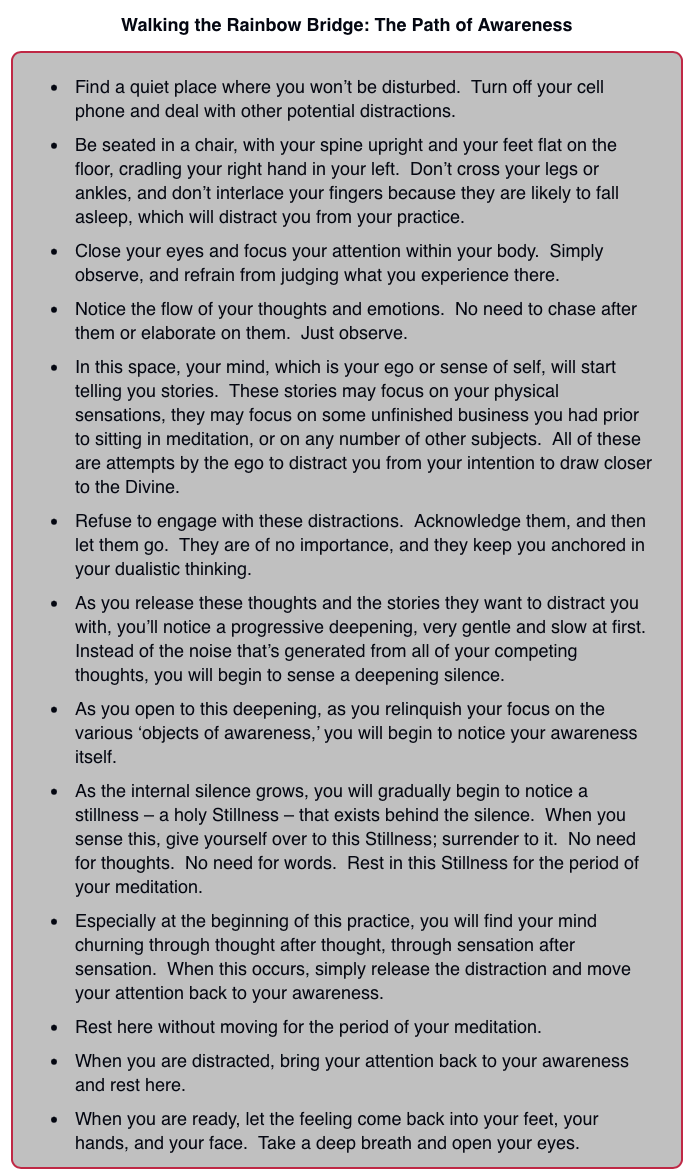
That’s enough for now, I think. I expect that you will find the meditation practice outlined in this newsletter to be very valuable on your inward journey. Please remember to practice daily, if your time permits.
Fundamentally, I believe that our intention to draw near to the Divine is the most important element in our lives. It is our intention that pushes us to meditate. It was your intention to draw closer to our Lord that pushed you to read this newsletter and to consider practicing meditation. I see this intention as one of the many gifts that our Lord so freely gives us. We can rejoice because, despite all apparent difficulties, our God is with us and in us!
Also, please remember that you are free to contact me if you have any questions about the practices I present or the experiences they yield. I will do my best to address your concerns as time permits. Just email me at ken123kaisch@google.com.
With love,
P.S. Several of you have expressed the desire for an online meditation class. If there is enough interest, I will try to figure out how to hold a group class on the web. If you have an interest, please write me at ken123Kaisch@gmail.com.
P.P.S. Several of you have expressed the desire for an online meditation class. If there is enough interest, I will try to figure out how to hold a group class on the web. If you have an interest, please write me at ken123Kaisch@gmail.com.
Humility as a Tool → Letting go → Fear → Openness → Acceptance & Growth
If you are finding this newsletter course helpful, you may want to consider Dr. Kaisch's latest book, Inside the Invisible: The Universal Path to Spiritual Transcendence.👇
39: The Problem of Non-dual Meditation
Edition #39: Inside the Invisible
Some months back, I promised you a new and exciting form of meditation. After making the promise, I realized that I didn’t really know enough about this new form of meditation to share it with confidence. So, I dithered and delayed.
My general rule of thumb is to share only those meditation practices that I know are effective. I typically rely on history and usage to determine this. If a meditation practice has been developed by our forebearers and used over a longish period of time, I tend to feel more confident in putting my trust in that practice. Then I realized, after promising this new form of meditation, that it didn’t have the historical antecedents that I usually use to guide my teaching. As a result, I held off from sharing this with you.
So let me begin by addressing a central issue in all forms of meditation. It is an invisible problem and a subtle one, one that is typically overlooked. It is a problem inherent in the use of language – the problem of subjects and objects. While the goal of meditation is union with the Divine, almost all meditation practices operate within the dualistic paradigm: that is, we are here and God is somewhere else, apart from us.
This leaves us with the paradox. We are seeking union, but we are using tools that reinforce the dualistic paradigm that rules our lives.
Let me try and put this in more concrete terms. You no doubt remember the story of getting the donkey to pull the cart by dangling a carrot in front of its nose – a carrot that it can never reach. In our case, however, by using dualism to try and overcome itself, it is more like you and me chasing an ice cream cone in the hot sun that is constantly three or four feet ahead of us. We run and run and run, but still the ice cream cone stays ahead of us. And should we ever manage to catch up with it, we will find that the ice cream has melted, leaving us a cone full of divine No – thing! (Sorry, but I have a weird sense of humor!)
Okay, maybe that wasn’t the very best example. But here is the dilemma: I am right here, and as I meditate, I postulate that God is somewhere over there, apart from myself. Either I have set up a dualistic framework for my meditation, or I have simply participated in the dualism that guides most of our waking hours.
At issue is how to overcome this too-familiar dualism. As long as we maintain this dualism, we will be unable to connect with the Divine. As long as we postulate that God is out there somewhere, we can think and talk about the Divine, but we will be unable to enter into union with the Divine.
Let me walk you through this for a moment:
When we pray the Lord’s Prayer, we pray to our Father in heaven – a Being who is in a place – heaven – far apart from us.
When we pray the Jesus Prayer, we ask Jesus, who we believe is apart from us, for mercy.
When we pray with Centering Prayer, we still find ourselves in that dualistic framework – we are here and the Divine is elsewhere.
The logic of this is terrifying! No matter what we try, we cannot draw closer to God. We cannot use language – either in thought, or in written or spoken word – because language is built on the subject/object duality. While this framework is quite handy for getting things done in our day-to-day life, it absolutely sabotages our attempts to draw closer to God.
This is a dilemma that haunts all forms of meditation and all forms of prayer. It’s not the exclusive province of Christianity or Buddhism, or any of the major world religions. It’s a dilemma that is faced by all.
~
When I was in college, I remember reading a science fiction story about a two-dimensional world. While I remember neither the title nor the author, I do remember being struck by the dilemma of trying to describe experience using only two dimensions rather than our customary three. This dilemma is very similar to the dilemma faced by all spiritual seekers. How do we overcome the perceptual limitations imposed by our frame of reference?
As always, when I face a dilemma like this, I turn to the spiritual literature. Our problem has been faced before, and with great success by a few. So, what do our great saints have to say about this? How did they resolve this problem?
Let’s start with the gospel of John. In chapter 14, Jesus says, “I am in my Father, and you in me, and I in you.” In effect, Jesus says, ‘I am in my father and my father is in me; just as I am in you and you are in me.’ When we stop and truly listen to this passage, we realize that there is no distance between the Divine and ourselves. Jesus already exists in us. There is no abyss to cross; no distance to cover.
We see from this that the dualism that besets us is just an artifact of our own minds. We project this mental artifact onto the world and ‘discover’ that the world is inherently dualistic. This is simply not true.
Other scriptural evidence suggests the same. In the gospel of Luke, in chapter 17, Jesus says, “The kingdom of God is within you.” In our dualistic thinking, we project that the Kingdom is outside of ourselves. We create a duality between the material and the spiritual worlds, but the creation of this duality traps us in the material. The gospel of Luke indicates, according to Jesus, that this is a profound error. The Kingdom is right here, within our deepest selves. We only need to wake up, i.e., to drop our dualistic thinking, in order to experience this profound and marvelous Unity.
Moving outside of the canonical books of Scripture, we have the gospel of Thomas. This book was found in 1945 near Nag Hammadi in Egypt, and it contains 114 sayings attributed to Jesus. The third saying in this collection states, “The kingdom is inside you and it is outside you. When you know yourself, then you will be known, and you will know that you are the child of the Living Father.”
Here, Thomas asserts there is no boundary between the inner and the outer. Drilling down into the meaning of this saying, Thomas states that the Divine has no boundaries. The Divine is found everywhere: in subjective experience and in objective experience. There is no place where God cannot be found.
Moving back into the canonical Scriptures, we have a passage from Paul’s letter to the Colossians. In chapter 3, Paul states, “Christ is all, and in all.” This may be the most explicit non-dual affirmation in the New Testament. There is nothing that can exist that is outside of Christ – “Christ is all.” Not only can nothing exist outside of Christ, but Christ is “in all.” In this passage, we hear echoes of Thomas, who stated that the kingdom is inside and outside of us.
So, what does this mean? It means that we are inextricably part of the Divine. Our pain comes from our failure to recognize our true nature – that Christ is within us and within all of Creation around us. That there is nothing that can separate us from the love of God!
There are many more passages in the New Testament that point to the non-dual nature of Reality. These passages are typically overlooked because they do not fit our typical frame of reference which is dualistic. There is a massive tragedy hidden in this oversight.
Most Christians and most believers of all sorts adhere to this dualistic framework. They have literally put connection with God out of reach. In some ways, it’s like the gold held in Fort Knox. We delude ourselves by saying that it belongs to all of us, but good luck trying to get your hands on a single bar of bullion!
~
In this edition of Invisible, I have tried to make clear the dangers of our commonly held dualistic frame of reference. I believe that our dualism literally prevents us from seeing and experiencing the Divine – the Divine that is all around us and deeply within us, in our innermost depths.
Our dualism even extends to our meditation practice and our efforts to experience God. In our next newsletter, I hope to introduce you to a meditation practice that transcends this pervasive dualism. Until then, please don’t stop your meditation practice. Even within the dualistic paradigm, meditation prepares us for the experience of God. It trains our minds to focus and to maintain that focus over extended periods of time. It calms our emotional turmoil, and it introduces us to that Great Silence in which we find our Lord.
With love,
P.S. Several of you have expressed the desire for an online meditation class. If there is enough interest, I will try to figure out how to hold a group class on the web. If you have an interest, please write me at ken123Kaisch@gmail.com.
P.P.S. Several of you have expressed the desire for an online meditation class. If there is enough interest, I will try to figure out how to hold a group class on the web. If you have an interest, please write me at ken123Kaisch@gmail.com.
Humility as a Tool → Letting go → Fear → Openness → Acceptance & Growth
If you are finding this newsletter course helpful, you may want to consider Dr. Kaisch's latest book, Inside the Invisible: The Universal Path to Spiritual Transcendence.👇
36: Does Meditation Lead to Passivity?
Edition #36: Inside the Invisible
I had an interesting conversation recently with Father Ian, an Episcopal priest who serves a nearby community. Father Ian carries on a significant social action ministry and is very committed to social justice. As we talked about this newsletter and the Christian forms of meditation, he posed a significant question. He asked, “Will your efforts to teach meditation lead to a withdrawal from the social problems we are currently facing?”
This question is especially important now, as our country and the world seem to be roiling with political and social turmoil. The newspapers this morning are reporting that President Trump has been bragging about “taking away the freedom of speech.” This is simply the latest of many elements in the political disruption caused by the new administration. In the face of these kinds of challenges, Father Ian’s question must be taken very seriously.
* * *
Father Ian’s concern is made more poignant when you understand the history behind it. In the 17th century, in both the Protestant and Roman Catholic traditions, two complementary movements arose and gained great traction with believers. Pietism for the Protestants focused on devotional Bible reading in small groups for the purpose of deepening one’s personal relationship with God. Inner transformation was valued here over theological precision. The early Methodist movement, with its emphasis on small groups meeting with a spiritual elder, was an example of this Pietist movement.
Quietism was a similar movement within the Catholic Church, emphasizing inner stillness and contemplation. The notion here was that the soul should remain passive and receptive, letting God do his work within each believer’s soul. Here, especially, there was a focus on surrendering one’s personal, ego-driven desires, and contemplative prayer was seen as the highest form of Christian devotion.
With both Pietism and Quietism, followers tended to withdraw from the world and worldly activities. In contrast with those around them at the time, their activities seemed passive. Rather than actively participate in social or political controversies, these followers of Jesus withdrew from the events of their day. Father Ian’s concern, if I understand him accurately, is a concern that the events of our day call forth a very different response from the faithful.
There is indeed some truth to the notion that the more one deepens in meditation, the more one withdraws from the events of this world. That being said, the situation is far more nuanced, and these nuances cry out to be explored, given our current fragmented political situation.
The central teaching that permeates our Lord’s work on this earth is the centrality of love. Jesus enjoins us to love God with all our hearts, and to love our neighbors as ourselves. In case his followers didn’t understand exactly what he meant by love, he showed them by consorting with the most despised members of his society. He broke bread with the poor. He hung out with tax collectors, including the tax collector Matthew who is reputed to have written the gospel.
Jesus appears to have avoided both the political and religious aristocracies of his time. There are no accounts of Christ having dinner with the powerbrokers, the elite, or the wealthy. In fact, he tells the story of a rich man wanting to throw a party and sending his servants to invite the powerful and well-to-do. These so-called ‘fortunates’ all refuse his invitation, so he sends his servants out a second time to invite the poor and the destitute. These are the people with whom Jesus typically rubs shoulders.
* * *
So let’s bring this to the present day. In virtually every newsletter I have written, I have encouraged you to meditate daily. Given Jesus’s example, we need to look at what meditation does. Does it, in fact, open our hearts to the kind of love that Jesus describes, or does it push us, willy-nilly, into an avoidance of the world around us? Here is what I have found from my own experience of meditating for decades.
I started to meditate in the late 60s, another period of great political and social upheaval. During those days, I saw myself as a revolutionary; I took part in marches and demonstrations, and I called for the violent overthrow of our government. In addition to these political proclivities, I had the explicit of agenda of wanting to draw closer to God. In my understanding at that time, this also meant withdrawing from the political agitation I had been involved with. My pursuit of a closer relationship with God was clearly ego driven; I wanted that experience for my own selfish gratification. As a result, I felt I had to turn my back on the world and the needs of others.
This isn’t something I am proud of, but I suspect that this ego-centered approach probably underlies most people’s turning to God. We simply find that the world is not satisfying, so we turn to God for our own self-satisfaction. If you can step back a pace, it’s really kind of ironic. You begin your spiritual journey to satisfy your ego’s drive to be special, but as you continue, you discover your connection with every other living thing. You realize you’re not so special after all, and as a result, you end up relinquishing the ego.
As you continue to deepen your journey, you find your heart being opened in strange and unexpected ways. You see a video clip on television of a building being bombed or a starving child with a distended belly and tears falling from his eyes, and you weep. Slowly, and without noticeable markers, you find your heart being changed. When you see someone else’s pain, you find yourself being touched more and more deeply. You find that their pain has become your pain too.
Ultimately, this pain forces you to change your ego-driven ways. You find yourself more and more concerned with the needs of others. You begin to change your selfish behaviors, and sometimes you even surprise yourself with these changes. It’s no longer enough to have your precious quiet time with God. You have to DO something. You feel called to make a difference in some way.
This is the result of your efforts to be more and more open to the Divine. Your spiritual practice has opened you to an awareness of your ego’s domination over your behavior. As you become aware of your extreme self-centeredness, you are naturally repulsed. You find yourself backing away from these self-centered behaviors. The love which has been engendered in your heart starts finding ways to express itself. Maybe you find yourself signing a petition; maybe you find yourself donating money to alleviate someone’s pain. Whatever the means that this love is expressed, you find yourself caring less about your own needs and more and more for the needs of others.
The central feature of all spiritual journeys is an increasing openness to the interconnection of all living beings. That is to say, the central feature of the spiritual journey is the development of love – putting the satisfaction of our own personal needs aside so that we can address the needs of others. As Jesus summed it up so concisely, “Greater love hath no man than he lay down his life for another.”
This kind of love is diametrically opposed to rock throwing and slogan shouting. It’s diametrically opposed to masking your face and hiding. It’s diametrically opposed to running away from confrontations with the authorities and those in power. These behaviors are simply ego driven, and that’s clear for everyone to see.
The kind of love which Jesus describes is open and comes from the heart. It’s slow to anger. It is nonviolent, just as Gandhi and Martin Luther King have shown us. And it’s far more difficult to love in this way, because it requires a change of heart. It doesn’t find its origin in anger; its origins come from opening our hearts and receiving God’s love.
So, the bottom line as I understand it is that regular meditation will slowly and gently open your heart to God’s love. This involves a twofold behavior change. First, we change our behavior by incorporating meditation as a regular part of our daily life. This change is typically driven by our desire to draw closer to God. The important point to notice here is that we start meditation as a result of our egos’ desires.
Second, as God gently opens our hearts, we find that there is more love in our lives. This increase in love sensitizes us to the pain that others are experiencing. The more we feel this pain, the more we are moved to address and resolve it. We are moved in this way because it is no longer somebody else’s pain – somebody out there. It has now become our own pain. And, like Gandhi and Dr. King, we find that we cannot rest as long as others are being persecuted.
* * *
Examining this process, we find that the love that Jesus speaks of is quite different from our popular conceptions of love. The popular conception of love seems to revolve around butterflies and happiness, and looking at the world through rose- colored glasses. It has nothing to do with self-sacrifice, and often revels in self-indulgence. It is the opposite of Christ’s sacrifice of himself on the cross.
Going deeper, Christ’s most significant sacrifice was not so much the sacrifice of his body. Rather, the deepest and most difficult sacrifice was that of his ego. We see this in his prayers in the garden of Gethsemane, when he reportedly sweats blood and asks his father to take the cup he is about to drink, namely his looming crucifixion, away from him if possible.
It’s strange, isn’t it, that if we truly follow Jesus, we will need to submit to a crucifixion. Ours is not a crucifixion on a visible cross; rather, our crucifixion happens, moment by moment, as we relinquish our selfishness and the demands of our ego. As each of you know, this is a difficult road that we travel. However difficult it may be, we can be confident in our Lord’s continued guidance and care.
I hope this addresses Father Ian’s concern, and any concerns that you might have had about the path that lies ahead and our ultimate destination. We are the Lord’s people, and we are his possession, not our own. Let us rejoice and be glad in it!
* * *
That’s all for this week. Again, I encourage you to continue with your daily meditation practice. You will find instructions in this regard in some of our previous newsletters. So, if you are one of our newer subscribers, you may want to dig into our archives. In our past newsletters, specifically in #5, 7, 21, 27, and 33, you will find instruction in several of the traditional forms of Christian meditation. All of the practices you’ll find in this newsletter have been developed by those spiritual elders who have come before us. You can trust that their continued practice will ultimately bring you into union with God.
With love,
P.S. Several of you have expressed the desire for an online meditation class. If there is enough interest, I will try to figure out how to hold a group class on the web. If you have an interest, please write me at ken123Kaisch@gmail.com.
Humility as a Tool → Letting go → Fear → Openness → Acceptance & Growth
If you are finding this newsletter course helpful, you may want to consider Dr. Kaisch's latest book, Inside the Invisible: The Universal Path to Spiritual Transcendence.👇
21: The Spiritual Exercise of the Jesus Prayer
Edition #21: Inside the Invisible
I am delighted to be here with you this week, because we get to explore and practice the Jesus Prayer, one of the oldest forms of meditation and contemplation in all of Christendom. I have practiced this form of meditation for roughly the last 50 years. During that time, it has taken me deeper and deeper, coming to a wordless contemplation of God. It is suitable for almost everyone, from beginners to very experienced practitioners.
Last week we explored a bit about monologistic prayer and the history and development of the Jesus Prayer. This week we will actually start our practice with this very special form of meditation, which has the power to take us deeply into God’s holy presence.
The Jesus Prayer
1. Position your body comfortably, spine erect, on a chair or cushions.
2. Ground yourself in your physical sensations. Close your eyes and slowly become aware of the sensations of your physical body. Feel the sensations as they flow through you. The sensations in your head...in your neck and shoulders...your elbows...your wrists and the palms of your hands...the sensations in your knees...your ankles and the soles of your feet.
3. Now open your awareness to feel God's Presence right here with you. Feel that Presence all around you...within you. Breathe in the Divine with every breath. Breathe God out. Let yourself rest in this Presence.
4. Be aware of the sensations in and around your head. You probably are aware of a sphere of energy around your head. This is where most of us 'live.' Let this sphere of energy begin to get heavy and drift downward toward your heart center. When you begin this, it may be a little difficult. We are so accustomed to having this energy in our heads that we don't know what it would feel like somewhere else. But let that sphere of energy gradually grow heavier and heavier. Let it sink down into your heart. If you have trouble with this, imagine that with each inhalation this sphere of energy is pushed down about an inch or so. With every breath, your head energy is moved downward, until your head rests in your heart. Anchor yourself here, so that you are able to perceive through your heart.
5. Now, in your heart and from your heart, say the words, "Lord Jesus Christ, have mercy on me...Lord Jesus Christ, have mercy on me." Let your heart repeat these words over and over again, feeling God's Presence right here with you.
6. When your attention wanders, be patient with yourself. Gently bring your attention back to the three operations of this meditation: feel God's Presence; put your head in your heart; and say the words, "Lord Jesus Christ, have mercy on me."
(To close your meditation)
7. When you are ready, let yourself come back to this place. Let the feeling return to your feet, your hands, and your face. Take a deep breath, and open your eyes.
The Interior Movement of the Jesus Prayer
The practice of the Jesus Prayer will take us on a predictable interior journey. At first, we are likely to have difficulty engaging in the three operations of the prayer simultaneously. While each of these operations is relatively simple, the first two are unusual for us in this culture. We seldom try to experience the Presence of God in a deliberate way. And we never strive to put our attention into our heart! So there will be a period of some frustration, as we try to keep each of these three things going at once. It can feel a bit like juggling, trying to keep three things in the air at the same time. Once you get the hang of it, though, the experience seems quite natural and enjoyable.
During the initial time of frustration, you will find yourself distracted, as with the previous practices. Your attention, while strengthened, is still not a focused tool. As you become aware of your distractions, the initial impulse will be to punish yourself: to engage in the punitive internal dialogue which emphasizes how inadequate you are to accomplish even the simple tasks of this prayer. This sort of inner dialogue is basically garbage! It is your ego, fiercely defending itself and its control over you. The best way to view this negative self-talk is to see it as just another distraction. You obtain no benefit from it, so simply withdraw your attention from these distractions, and re-engage in the three operations of the prayer.
The complexity of the Jesus Prayer, with its three specific and simultaneous operations, is actually a substantial aid toward the development of a stable attention. These three operations place such a load on conscious awareness, that it rather quickly moves beyond distraction. You notice I said 'rather quickly.' I mean this in relationship to other meditations which do not have this loading effect. Your progress may still seem slow to you. After continual practice, two things begin to emerge. First, you are more and more able to do all three operations of the prayer simultaneously. Second, the number and intensity of distracting thoughts and feelings seem to diminish. There is a gradual quieting of the mind, as if the intellect becomes content with the discursive activity of the prayer, while deeper changes are occurring in you beneath the words.
The Arising of Spiritual Phenomena
As your practice continues, several phenomena may arise that are important to understand. While there is no specific order to their occurrence, in my experience, they tend to follow the order described here.
First, there is the arising of internal heat. You will be sitting in meditation and you will become aware that your body is very warm, sometimes it even feels hot. You may begin to perspire profusely. This is one of the spiritual fruits of the deepening of your interior prayer. It is the action of God within us, burning away the subtle interior obstacles which keep God veiled from our awareness. You may find this warmth so intense that you become frightened of it, thinking that something is wrong. Don’t worry. You are simply tasting the first fruits of the interior life. As this experience comes, you may need to loosen your clothing before you meditate, or even wear lighter clothing, so that you are not too distracted by the heat.
The second phenomenon which frequently occurs is known as the gift of tears. This is the experience of inner grief and compunction, which seems to arise spontaneously as you explore your interior depths. This experience is cause for rejoicing, because it signifies a deepening of the interior cleansing which usually begins with the experience of interior heat.
The gift of tears may begin with a feeling of grief or sadness, centered in the heart or the throat. You may find tears beginning to trickle out of your eyes. On occasion, there is full-blown weeping, but more often it is just a sweet-sad grief which causes these tears. When this occurs, don’t be surprised if your tears continue, even beyond the period of your meditation. You may find your eyes 'gently leaking,' producing very small amounts of moisture throughout the day. Usually no one will notice this but you.
A third phenomenon, which is more rare than the first two, and which typically follows after a long period of practice, is the experience of interior light. There arises within your heart an interior light that carries with it such tender sweetness that you will marvel at its intensity. This is your first clear sight of that great Light that is Christ the Lord. Words do not suffice to describe it, nor the interior feelings which accompany it.
These three phenomena cannot be sought after. This is very important for you to understand. These phenomena accompany the deepening of practice in a natural way. So do not strive after the phenomena. Your striving after these 'markers' of experience will only serve to keep you from them. Instead, strive to be present to God at all times. As our Lord says, "Do this, and all else shall be added to you." As you continue your practice, you will find that your mind begins to quiet down. There is a gradual dawning of interior stillness. This occurs both within the practice of the Jesus Prayer and between the formal periods of practice.
Within the practice, your recitation of the words will be broken, from time to time, by a vast stillness. It is as if you have been traveling along a heavily wooded road in the mountains, where you cannot see anything because of the thick forest. Then suddenly the road breaks out of the forest and a stunning vista opens before you. You stand, dumbstruck with awe, held suspended in the vastness of all that you survey.
This is what interior silence is like. Your recitation of the words of the prayer will, at times, spontaneously cease, and you will stand in the Presence of God in awe. There are simply no words, only stillness. This deep experience cannot be achieved by 'wishing' it, by imagining it, by striving for it, or by promoting yourself beyond the reach of your own experience. It lies within you, awaiting your discovery. You can do nothing to hurry it. You can only open your heart to God, and fix your attention there. God will give you His grace in His own time, not in yours.
With the arising of this deep inner stillness, you begin to approach contemplation. The contemplative process is different in character than all the spiritual exercises that go before it. We will explore the contemplative process at a later time.
* * *
Let’s bring our meeting to a close for now. You have received the basic instructions for one of the most powerful meditative prayers that has ever been developed. It has the power to take you deeper and deeper into an intimate relationship with the Divine.
I encourage you to set aside time to practice the Jesus Prayer on a daily basis. I typically practice in the morning, on arising, and in the evening before I go to sleep. This form of practice provides me with spiritual bookends for my day, and this practice seems to make my days go more smoothly. I would encourage you to enter into this interior space throughout the day as well, even if it is just for a moment or two. The ultimate aim of all spiritual practice is to dwell in the house of the Lord, so why not move in today? LOL
Have a great week, and remember, if you have any questions about your practice, please drop me a line at ken123kaisch@google.com.
With love,
P.S. Several of you have expressed the desire for an online meditation class. If there is enough interest, I will try to figure out how to hold a group class on the web. If you have an interest, please write me at ken123Kaisch@gmail.com.
Humility as a Tool → Letting go → Fear → Openness → Acceptance & Growth
If you are finding this newsletter course helpful, you may want to consider Dr. Kaisch's latest book, Inside the Invisible: The Universal Path to Spiritual Transcendence.👇
20: The Jesus Prayer
Edition #20: Inside the Invisible
First, I need to apologize to you. I have been planning to show you a new spiritual exercise for some time now, but I finally realized that I have not prepared you for this more advanced practice. So please forgive my enthusiasm. In my excitement to share this new exercise with you, I forgot that many of you are not regular meditators. I’m afraid that if I share this new practice with you now, you may be a bit overwhelmed. So, out of the abundance of caution, and out of my concern for your spiritual growth and well-being, I’m having to walk back my promise to you.
Monologistic Prayers
In its place, I would like to introduce the Jesus Prayer, the oldest, commonly-used monologistic prayer in Christendom. Monologistic prayers are similar in many ways to the mantras of the Eastern religions. The word “monologistic” refers to the short prayers (mono logos = one word) developed within the Christian faith, which are continuously repeated during one’s meditation practice. These prayers are suitable for both beginning and advanced meditators, and they offer many benefits. Examples of these kinds of meditation include the Jesus Prayer, the prayer described in The Cloud of Unknowing, and the more modern Centering Prayer.
For beginners, monologistic prayers are great tools for learning to focus your attention. As we have said previously, a focused attention, capable of being sustained over long periods of time, is an absolute requisite for the kind of spiritual progress we are exploring. As you develop more and more comfort and expertise with these practices, these prayers can take you deeply into a profound inner stillness. This stillness is the precursor to those unitive states that signal we are reaching the conclusion of our spiritual journey.
The Jesus Prayer, in its several variations, holds the distinction of being the oldest continually-used monologistic prayer in Christendom. Furthermore, it has probably been used by more people, and in more varied circumstances than any other. It is one of the great treasures of the Church.
The Jesus Prayer has three parts which are practiced simultaneously. First, the practitioner opens to God's Presence, using one of the practices of Recollection. Second, the practitioner places his attention in the region of the heart. And third, he begins to repeat the words from the heart, "Lord Jesus Christ, have mercy on me."
The Development of the Jesus Prayer
The roots of this Prayer extend back to the time of Christ Jesus. From the earliest times, devotion to the name of Jesus has been a part of the Church. This devotion is embodied in two central references in the New Testament. The first, from St. Paul, says, "God...bestowed on Him the name above every other name, so that at Jesus' name, every knee must bend in the heavens, and on the earth, and under the earth." The second reference is in St. John's gospel: "Whatever you ask the Father, he will give you in my name." These texts form a powerful rationale for praying using the name of Jesus. The Jesus Prayer refines this by focusing directly and exclusively on the name of Jesus. In this way, the prayer functions as a tool through which divine grace is channeled into the heart of the believer.
The second element of the Jesus Prayer, embodied in the words, "have mercy on me," appeals for God's mercy and forgiveness. Here the one who prays focuses on their relationship to God, and asks for grace. In practice, as the meditator prays in this way, there frequently arises a deep sense of grief and an outpouring of tears. These tears seem to cleanse the soul from the passions which separate us from the Divine.
The third element, the frequent repetition of the prayer, is an attempt to follow St. Paul's injunction to "pray without ceasing." We hear mention of this practice of constant repetition throughout the surviving writings of the Desert Fathers. By this means, these early monks and nuns strove constantly to remember God, and to live and move in an awareness of God's constant Presence.
The fourth element, the quest for inner stillness, is the hallmark of non-discursive prayer, and the beginning of contemplation. Evagrios of Ponticus, who lived with the Desert Fathers, states that "prayer means the shedding of thoughts." Another translation renders the passage, "Prayer is the rejection of concepts." Evagrios' concern was to still the restless wanderings of the intellect so that the essential unity of the soul with the Divine can stand revealed. In most people, their mental turmoil obscures the Presence of God. Only through focusing our attention can we go beyond conceptual thinking into those unitive states where we dwell with the Divine.
The History of the Jesus Prayer.
While the four elements of the Jesus Prayer were clearly recognizable by the fourth century, it was not until Bishop Diadochus in the fifth century unified these elements into one recognizable prayer that the Jesus Prayer, per se, came into being. Diadochus was the first to bring these elements together for the purpose of entering into the state of non-discursive, imageless prayer. He states that the intellect is inherently “restless,” and needs some activity to satisfy its needs. He engages the intellect with the ceaseless repetition of the name of Jesus, which ultimately leads to quieting the discursive mind. Of importance is Diadochos' instruction to "give [the mind] nothing but the prayer, 'Lord Jesus'." This unvarying repetition brings the restless intellect into stillness, "reaching out beyond language into silence, beyond discursive thinking into intuitive awareness."
From this essential catalyst, the Jesus Prayer appears again in clear form in the deserts of Egypt, Sinai, and Palestine. St. John Climacus, who lived in the Sinai and wrote the core work, The Ladder of Divine Ascent, recommends the prayer. Due to the widespread influence of his writings, the Jesus Prayer spread throughout the Orthodox churches. St. John's followers, St. Hesychius and St. Philotheus, are even more explicit in extolling the virtues of the Jesus Prayer.
Thus, between the fifth and eighth centuries, the Jesus Prayer emerges as a recognized spiritual way, sanctioned by the church hierarchy and widely practiced by both monastics and the laity. In later centuries, as the Eastern churches declined in spiritual vigor, the practice of the Jesus Prayer fell into disuse. In each of the several revivals which have swept through the Eastern Orthodox churches, the Jesus Prayer has played a significant role. In Greece in the fourteenth century, and then again in the eighteenth century when the Philokalia was compiled, the Jesus Prayer was the central practice which fueled and sustained the revival. Again, in Russia during the late eighteenth and nineteenth centuries, the Jesus Prayer plays a now-familiar and significant role in revitalizing the faith of an entire people.
The Russian Pilgrim
We in the West are familiar with this last revival through the works of the anonymous Russian author of The Way of a Pilgrim. This anonymous author tells a fascinating story of his adventures during the decades before the freeing of the serfs in 1861. An orphaned peasant from the province of Orel, he was raised by a grandfather, along with his older brother. This brother was a drunkard and injured him repeatedly, first crippling his hand, and then burning his house down. Crippled and widowed, with no ties to keep him, the younger brother began his wanderings.
The pilgrim's spiritual journey started in a church, when he heard a reading of the words of St. Paul, "pray without ceasing." He began to wonder how this was possible, and asked every learned clergyman that he encountered. No one gave him a satisfactory answer. He kept looking for a method, but all he received were pious platitudes which begged the question. Finally the pilgrim found a staretz, a wise old spiritual guide, who taught him the following:
The continuous interior Prayer of Jesus is a constant uninterrupted calling upon the divine Name of Jesus with the lips, in the spirit, in the heart; while forming a mental picture of His constant presence, and imploring His grace, during every occupation, at all times, in all places, even during sleep. The appeal is couched in these terms, 'Lord Jesus Christ, have mercy on me.' One who accustoms himself to this appeal experiences as a result so deep a consolation and so great a need to offer the prayer always, that he can no longer live without it, and it will continue to voice itself within him of its own accord.
In addition, the staretz read to the pilgrim from the Philokalia, a compendium of writings from the early Fathers which describes the "detailed science of constant interior prayer." Various postures and other details about the Jesus Prayer were explained by reference to this work, introducing him to the writings of the early Church Fathers. As the pilgrim began to progress in the prayer, his psychology started to change. After a summer of practice, he reports:
I felt an absolute peace in my soul. During sleep I often dreamed that I was saying the Prayer. And during the day if I happened to meet anyone, all men without exception were as dear to me as if they have been my nearest relations....All my ideas were quite calmed of their own accord. I thought of nothing whatever but my Prayer, my mind tended to listen to it, and my heart began of itself to feel at times a certain warmth and pleasure...My lonely hut seemed like a splendid palace, and I knew not how to thank God for having sent to me, a lost sinner, so wholesome a guide and master.
The Three Operations of the Jesus Prayer
The Jesus Prayer, as it was taught in Greece and Russia, has three mental parts or operations, and all of these need to be present for the Prayer to be effective. All too often the Jesus Prayer has been taught as if it has only one operation, that of saying the words. This is the most misunderstood point in the practice of this great prayer. The spiritual giants who have used this prayer are unanimous in stating that the words are the least important of the three operations of the Jesus Prayer. The first and most important operation is the Recollection of God's Presence, opening ourselves to the immediacy of the Divine right here and right now. This is the first and most important part of the Jesus Prayer.
The second operation of the Prayer is to put the 'head in the heart', which means to move our attention from our head, where it usually resides, into our heart center, and to pray from the heart. In the words of St. Theophan the Recluse, a major figure in Russian mysticism in the nineteenth century:
In order to keep the mind on one thing by the use of a short prayer, it is necessary to preserve attention and so lead it into the heart: for so long as the mind remains in the head, where thoughts jostle one another, it has no time to concentrate on one thing. But when attention descends into the heart, it attracts all the powers of the soul and body into one point there. This concentration of all human life in one place is immediately reflected in the heart by a special sensation that is the beginning of future warmth....This warmth then holds the attention without special effort....From this there follows a rule of spiritual life: if you keep the heart alive towards God, you will always be in remembrance of God.
This means that if we keep our attention focused in our hearts, our hearts will always be oriented towards the Divine.
This mental operation of putting the attention into the heart is quite unusual for Western Christians. We tend to think of attention as something fixed in the head. Our reasoning goes like this: 'the brain is the organ of thought, so our attention must be physically rooted in the head.' If you have ever stubbed your toe or barked your shin, you know this is untrue. When one of these accidents happen, our entire attention is instantly unified at the location of the injury!
Actually, we can place our attention anywhere in the body that we choose. Placing our attention in the heart feels strange at first, and many wonder whether they get it right. But you will become more comfortable here as the practice becomes familiar.
The third, and least important of the three operations of the Jesus Prayer is the repetition of the words: "Lord Jesus Christ, have mercy on me" over and over. If our minds are particularly unsettled in our meditation, we may need to repeat this phrase quickly, to drive out the distractions. If our attention is collected and focused, we may adopt a more receptive attitude, and say the words slowly, with pauses in between the phrases.
Putting the three operations together looks like this. First, open yourself to feel God's Presence with you. Then feel the sphere of energy that surrounds your head. This is your attention. Move that sphere of energy slowly down into your heart. From your heart, not from your head, repeat the words of the prayer, "Lord Jesus Christ, have mercy on me". "The essence of the whole thing is to be established in the remembrance of God, and to walk in His presence."
The Jesus Prayer is not a visual meditation. You should not make pictures of the Lord or of yourself in this practice. Simply engage in these three operations. When your attention wanders from them, gently bring yourself back, and reestablish each of these three operations. If you notice, during the course of your practice of the Jesus Prayer, that you are no longer doing one of these operations, gently reestablish that part of the Prayer and then continue.
"The main thing is to stand before the Lord with the mind in the heart." Eventually, even the words of the prayer will disappear, as we begin to venture into the realms of contemplative prayer. This is the experience of hesychia, or inner stillness. When the words and thoughts of the Jesus Prayer disappear of their own accord, the one who prays has entered into the stillness of the Mind of God. This experience is one of sublime peace and tranquility. When this occurs, do not force yourself to continue repeating the Jesus Prayer. Let yourself dwell in stillness.
In summation, the purpose of the Jesus Prayer is to collect and order the attention, and to focus this attention on God in such a way that we are gradually drawn into the deepest awareness of the Divine Presence in all things and manners of life.
* * *
That’s all for this week. I know this newsletter is a bit lengthy, but I felt it important to review the history and practice of the Jesus Prayer before we begin to use it in our meditation practice. Over the last two thousand years, it has been a central prayer practice for much of the Christian Church. This is such an important practice, that you need to understand where it comes from and how our forebearers have used this meditation to journey into the Divine.
This week, I would encourage you to prepare for the practice of the Jesus Prayer by remembering that you are walking in God’s holy Presence. As you move through the events of your week, simply remember that God is with you. Remember that God’s holy Presence surrounds you and makes its dwelling within you. Next week, I promise, we will go into the actual practice of the Jesus Prayer, and I will show you several variations that you can use.
Thank you once again for your faithfulness in exploring this material with me. Let us pray for one another, that we can let go of everything that separates us from that wondrous love of God, so that we can fully enjoy that magnificent Presence.
With love,
P.S. Several of you have expressed the desire for an online meditation class. If there is enough interest, I will try to figure out how to hold a group class on the web. If you have an interest, please write me at ken123Kaisch@gmail.com.
Humility as a Tool → Letting go → Fear → Openness → Acceptance & Growth
If you are finding this newsletter course helpful, you may want to consider Dr. Kaisch's latest book, Inside the Invisible: The Universal Path to Spiritual Transcendence.👇
19: The Goal and Function of Meditation
Edition #19: Inside the Invisible
I have received several questions this past week about meditation. As I looked at them altogether, I realized that I had been assuming things and not everyone had the same understanding that I did. As a result, I thought I better pause our essay series once again and attempt to address some of these questions. In many respects, they are very basic questions, and for that reason, they are important to address. The questions included: Is meditation really that important? What will meditation do for my spiritual life? Do I need to practice every day? So here is my attempt to address them. This is for those of you who have ever wondered about the purpose of meditation, or how it functions in our inner world.
On the face of it, meditation is a very strange process. You are supposed to sit completely still for long periods of time in order to what? See God? Have a spiritual experience? Heal some dread disease? Calm your anxious mind? What exactly is the purpose of meditation?
This is not unimportant. If you are not clear about the purpose of your meditation practice, you are likely wasting your time. Knowing why you are doing something – the purpose of it and the goal towards which you are aimed – gives you a clear focus and the ability to self-correct when your practice starts getting wonky. So, let's start with a bit of background.
We live in a divided world, and we ourselves are frequently of two (or more) minds. According to the great spiritual masters of all the major religions, this division is artificial in nature. Our true nature is to be in union. This union is variously understood, depending on the practitioner's belief system. It may be a union with God, a profound union within your own self, often described as self-realization, or a communion with the Divine. The purpose of meditation is to facilitate our perception of this underlying union.
The Importance of a Clear Target
One of the requirements for success in any endeavor is having a distinct and measurable target. If you don't know what you are trying to achieve, how will you know if you have achieved success? Perhaps more importantly, how will you self-correct if you don't know where the target lies? You simply don't know if you are left or right of the target, whether you are north or south of it. In this essay, I hope to provide some clarity regarding the target of the spiritual life.
Each of the six major world religions, Hinduism, Buddhism, Taoism, Judaism, Christianity, and Islam, teaches some form of deep, wordless prayer. Each religion has its own name for this process, but for our discussion, we will lump all of these terms together under the label ‘meditation.’ Each religion has various practices that fall under the general label of meditation.
There are two common problems for those trying to implement these practices. First, there are too many targets. I am most familiar with Christianity, and there are literally hundreds of different prayer practices that are commonly called 'meditation.' If you are to be successful in your spiritual quest, having multiple targets is just not helpful. If there is one clearly defined target, your chances of hitting that target go way, way up.
If you add to this problem within Christianity the hundreds or thousands of practices described by Hindus, Buddhists, and so on, the situation goes from really difficult to impossible. Which practice should you follow? Perhaps more importantly, why should you follow this method and not that one? Or any method at all?
That brings us to the second problem. None of these methods give us a clear target for which to aim. They say, in effect, “Do this practice and enlightenment, or salvation, or communion with the Divine will occur.” While that may be all they can say, it leaves the spiritual practitioner with precious little to go on. I've noticed that there are very few enlightened or realized spiritual masters roaming around. You may have noticed the same thing. So, how do we know that we are practicing in the correct fashion? How can we self-correct if we don't know what the target is?
Accepting this lack of clarity as the normal state of affairs seems wrong. In our era, we have actually gathered a considerable amount of information about the spiritual journey from the perspectives of the different world religions. What we haven't had was a compilation of this wisdom. We have tended to see these different religious systems as competing with one another. We have yet to understand them as simply having different perspectives on a common problem. This seems inexcusable given the wealth of spiritual knowledge available to us from these multiple sources.
The Unitive State
The end state of the spiritual quest is variously described as union with God, communion with God, enlightenment, and self-realization. While these descriptions appear to describe different phenomena, my research into the major world religions leads me to believe that these differences are simply matters of perspective. If you view an object from the left side, from the top, and the back, you are highly likely to get three different pictures, resulting in three different descriptions of the same object.
In our case, regarding the goal of spiritual practice, the different perspectives are provided by the theologies and worldviews of the different religions. Each of the major world religions views spiritual matters through the lens of their particular revelation. For example, the multiple gods and goddesses of the Eastern religions are markedly different from the one God described by Judaism, Christianity, and Islam.
Supporting this notion – that a common process underlies these apparent differences regarding the ultimate spiritual goal – are the descriptions of the end states of the spiritual journey as described by these different religions. In my book, Inside the Invisible: The Universal Path to Spiritual Transcendence, you can explore this in-depth.
All six describe a unification that takes place during and at the end of the spiritual journey. Not surprisingly, these religions describe this unification somewhat differently, given their theological differences. For example, Advaita Hinduism and Dzogchen Buddhism speak of this as an interior unification of the personal self, the ego, with itself. This is congruent with their particular theologies. Christianity and Islam describe a union with God as the end state of the spiritual quest. Judaism, because of its belief that G_d is totally Other, believes that the closest a person can come to the Divine is a deep communion.
The point here is to look beyond their apparent differences and notice that they all speak of a unification of some kind. This has some interesting implications, both for the spiritual journey and for the practice of meditation.
To have a unification, especially a unification of this kind, indicates that there must be a profound underlying separation. Most of us, and most of the time, are unaware of any kind of spiritual separation. We go about our typical day without thinking about God or noticing any separation from the Divine. This merely shows how profound our separation is. We don't even know that there is one!
Of course, this is not surprising. We don't typically notice the presence of God as we go about our daily round, do we? It is as if we are blind to our spiritual life most of the time. This is a separation of the most profound sort! The practices of meditation are designed to overcome this felt separation.
How Does It Work?
All forms of meditation are ultimately aimed at helping you achieve stillness. This is the ultimate goal of meditation. From birth, our minds are involved in constructing our reality. We don't notice this construction process because so much of it happens before we have language. One of the more interesting findings of recent psychological research has been that almost all of what we remember is mediated by our language. Have you ever wondered why you don't remember things in your first few years? Because you didn't have language yet, you could not lay down long-term memories. Hence, no early memories.
The goal of meditation is, first, to get you to stop talking to yourself. Notice what happens as you begin to meditate. Your mind rumbles around for a bit, and then you finally settle down into a brief stillness. That stillness ends when you notice it and comment to yourself, “Ah, I think I've got this now.” It usually takes a while for a novice meditator to recognize this comment as just another thought and that you are back constructing your artificial reality again.
This stopping of thoughts cannot be any kind of suppression of thoughts because that is just more of the same – it's just a fancy kind of thinking. The stopping – the acquisition of stillness – will first come in little moments, interspersed among your thoughts. Then, it will gradually lengthen as you are able to maintain your focus. When this happens, you start to make true spiritual progress.
As you continue your practice, your stillness deepens and lengthens. As this happens, you begin to perceive the reality which underlies our multiple separations. You start to see how your self-talk constructs your reality. You begin to perceive the subtle, unitive reality that lies underneath all of our mental busyness. Your perception will continue to deepen and finally unite you with the Ultimate.
To learn more about this journey, you can read Inside the Invisible where I describe this journey in detail.
So How Do You Achieve Stillness?
It is one thing to say that the target or goal of meditation is the achievement of stillness. But for anyone who has ever tried meditation, you know how difficult stillness is to achieve. So, to end this essay, let's focus on achieving this interior state.
Most of us have a constant stream of chatter in our heads – our self-talk. As I understand it, there are two main ways of achieving stillness, and you are likely to choose one or the other based on whether you prefer to process cognitively or emotionally.
The cognitive path involves letting go of your self-talk. While this sounds easy, it is most certainly not! You let go in this moment, and in the very next moment, you are off chattering about something else. Almost always, I find that my self-talk during meditation is of earth-shaking importance – things like remembering to pick up some eggs and milk when I finish my meditation. Perhaps you have had similar experiences?
As a result, the 'letting go' process is constant. You let go of this thought, the next one, and the one after that. Sometimes this is so arduous that you get up from meditation more tired than when you sat down. If you can step back for a moment and look at the whole process, you will see just how undisciplined our minds are. At times, this whole business of trying to achieve stillness reminds me of herding cats.
In addition to the 'letting go' process, there are other approaches. These different approaches involve the same kinds of processes as 'letting go.' Some people describe it as the process of surrender. You surrender your passing needs and the self-talk accompanying them to draw closer to the Divine. Still others, notably the anonymous mystic who wrote The Cloud of Unknowing, describe a related process that he calls humility. Humility, as our anonymous author describes it, is the process of seeing yourself as you actually are, not as you imagine yourself to be. So humility, as it is understood here, is not some mental self-flagellation but rather a cultivation of self-observation that results in a recognition of our deepest self – a self already profoundly connected to the love of God.
On the other hand, the emotional path involves the internal cultivation of qualities like love, compassion, gratitude, etc. This path typically pulls attention away from the intellect and moves it into your heart center, sometimes called the heart chakra. This spiritual center in your chest is the place that the spiritual masters of all the major religions say is the place where it is easiest to encounter the Divine.
Let's take the cultivation of gratitude as an example of this process. You sit in your meditation, letting go of the initial distractions and minor discomforts. Then, you move your attention from your head into your heart center. This movement is not always clearly understood. Many think that their attention permanently resides in their head – a kind of fixed feature like your nose or mouth. Anyone who has ever stubbed their toe or barked their shin knows the fallacy of this. When this kind of trauma occurs, absolutely ALL of your attention is directed to the point of injury! This shows that attention can be placed wherever you need it to be.
What people haven't known is how to move their attention out of their heads in a more gentle manner. You begin by feeling the sphere of energy that surrounds your head, the energy we typically describe as our ‘self’ or our ‘ego.’ Then, slowly, move this energy down your spinal column and into the region of your heart, taking several minutes or so to complete the journey. Just feel that sphere of energy getting heavier and heavier until it comes to rest in your chest. Then, when your attention is rooted in your heart, begin to cultivate gratitude.
When I say, 'cultivate gratitude,' I do not mean that you make up a feeling about some false thing that you think you should be grateful for. Instead, think about those aspects of your life for which you really feel gratitude. For example, I have had a knee problem since childhood from playing sandlot football. When my knee is not hurting, it is easy to feel gratitude for that. I often start here, with my not-hurting knee, and I generate feelings of gratitude for that. Then, my mind turns to other things I'm grateful for. Some days, it is quite a list.
As these feelings of gratitude multiply, I find a kind of quiet developing – the stillness we talked about earlier. If I stay with it, this stillness gradually deepens until I find myself floating in a wordless ocean of gratitude. It is here, in the stillness, that the emotional and the cognitive practices of meditation flow together and become one.
As you can see, with both the cognitive and emotive approaches to meditation, entering into stillness takes time and constant practice. To achieve genuine stillness, daily practice is required. For most of us, this means daily practice over a period of years. As my own practice has deepened, I find that I am learning to live within this inner stillness, so that its cultivation is becoming a constant feature of my inner life. It is a deeply peaceful place; and when I can enter this state, it often feels like I am coming home.
Conclusions
We have covered a lot of ground in this essay. We discussed the importance of making a clear target for our meditative practice. We have identified the pre-existing and underlying unitive state that is not perceptible by our ordinary consciousness. We discussed that the goal of meditation is stillness because it is through our inner stillness that we can pierce through our apparent separation and perceive what is ultimately real. It is through stillness that we can perceive the Divine. Finally, we talked about two different meditative methods that can take us into stillness – a cognitive-based method and an emotional one.
As one of my seminary professors encouraged me, I would encourage you to "read, mark, learn, and inwardly digest" this material. It will serve you well on your spiritual journey.
With love,
P.S. Several of you have expressed the desire for an online meditation class. If there is enough interest, I will try to figure out how to hold a group class on the web. If you have an interest, please write me at ken123Kaisch@gmail.com.
Humility as a Tool → Letting go → Fear → Openness → Acceptance & Growth
If you are finding this newsletter course helpful, you may want to consider Dr. Kaisch's latest book, Inside the Invisible: The Universal Path to Spiritual Transcendence.👇
18: Letting Go of the Ego
Edition #18: Inside the Invisible
Last week, we took a stab at letting go of our identification with our ego, our small sense of self. Using the Dis-Identification Exercise, we explored letting go of our body, our emotions, and our intellect to see what happened. Since I haven’t received any reports of people’s heads exploding or a sudden mass vanishing of readers of this newsletter, I have to suspect that everyone survived this.
You see, we are like the ugly duckling in Hans Christian Anderson’s fairytale of the same name. We think of ourselves as beings that are much smaller in stature and capability than we actually are. In the fairytale, a swan’s egg was put in a duck’s nest. When the baby swan hatched, the mother duck and her little babies all looked at this interloper as ugly, awkward, clumsy, and somehow defective. Since all the baby swan heard were these horrible things about himself, he believed them. He concluded that he was a defective duck. He only realized the truth about himself when he saw a flock of beautiful swans soaring overhead. At that point, he realized his true identity. He was not a duck; he was, in fact, the most beautiful and graceful of birds.
This story accurately depicts our human situation. We think of ourselves as limited, and often defective or lacking. This is a grotesque misunderstanding. It completely overlooks the fact that the Divine dwells within us. Within the Christian faith, it overlooks the astounding message found in John 14. Here Jesus says, in effect, “I am in my father and my father is in me. In just the same way, I am in you and you are in me.”
Let me state this as clearly as possible: God lives within you. Whatever you have been told about yourself, if this is not central to your understanding, then your understanding is incomplete. As a result of all of the misinformation we have received over our lifetime, we have identified with the limited, small self and have been unaware of the larger Self that is within us. The purpose of our work here is to let go of that small self so that we can participate fully in the Self, which is our true nature as human beings.
If this understanding were only found in Christianity, we might have to dismiss it as delusional. Unicorns, after all, don’t really exist except in our imaginations. But this Christian understanding is echoed in the scriptures of every major religion around the world. I especially like the Hindu formulation of this truth, “Thou art That.” In this formulation, ‘That’ refers to God, that Other that we all are searching for.
Think about this with me for a moment. We have searched over and over in so many different ways to find a valid path to God. Feeling separated from the Divine, it seems like there is an abyss that surrounds us – an unbridgable chasm that keeps us from our goal. But when we look carefully, this abyss is actually something we have created with our own thoughts.
Jesus tells us there is no abyss. Our minds tell us there is. So, who are you going to believe?
Most of the time, we believe ourselves. We fashion the truth about ourselves with our thoughts and our emotions. We decide we’re pretty or ugly, smart or stupid, good or bad, healthy or unhealthy. And then we put our trust in our own decisions, often with terrible results, and always with self-limiting results.
Our egos have created a protective envelope around us. The original purpose of these envelopes was to protect us from hurt. Sadly, hurt is an arrow that pierces all of our defenses. Our efforts in this regard, as you have no doubt noticed, are both ineffective and inadequate. Even though we recognize these inadequacies, we have not suspected that there was anything else, so we continue to hang onto that small self that we have created.
At this point, I need that crazy announcer for Ginsu knives to shout, “But wait, there’s more!”
The “more” is God. You are not the little self you have created and held onto all these years. You are a child of God, and God himself lives within you. When you
let go of the little self you have created, when you explore what is beyond that little self, you will experience the Divine.
So, how do we let go of this little self?
We will probably be more successful at this letting go if we understand more about the ego, so let’s look at the components that make up our little selves. What exactly is this ‘I’ composed of? Certainly, it contains all of our thoughts and emotions. As such, it contains all our value judgements, all our understandings about ourselves and the world around us. Using the image of the protective envelope that we developed above, it is as if this envelope serves as a movie screen, and we are projecting all of these thoughts, emotions, and judgments onto the screen. Then comes the sleight-of-hand! We identify with our projections. We think we are those projections.
This description sounds abstract, even a bit otherworldly, like it can’t really be real. Well, let me give you a real-life example. Back in the 1970s, before ethical considerations were considered important, one of my psychology professors conducted a study at a nearby elementary school. He gave an individual intelligence test to all of the fourth-graders towards the end of the school year. He then told the teachers who would have them for fifth grade that certain students were bright and others were kind of slow. Unbeknownst to the teachers, he was lying.
In actual fact, he had randomly assigned students to the bright group or the slow group. He returned to the school at the end of the students' fifth-grade year and interviewed the teachers. The teachers, believing that he had given them accurate information, confirmed the information he had given them the previous year. The ones he said were bright had, in fact, been generally perceived by the fifth-grade teachers as bright, and vice versa.
On the basis of his authority as a psychologist and as an expert in testing students' intelligence, this professor created a false reality for the teachers. Sadly, on the basis of the teachers' interactions with their students, I suspect the students also began to perceive themselves in this false manner. This experiment shows how we create false realities for ourselves with the thoughts that others have about us and with our own thoughts.
The message that most of us have received all of our lives is that ‘God is far away in the heavens,’ and we are down here on earth, and the only way that we will meet God is after our death. Because we have been told of this by people we have trusted, we have come to believe it. Once again, who are you going to believe? Are you going to believe your parents and all of those who gave you this information, or are you going to believe Jesus and the great avatars of all the major religions who say that God is within you? The choice is always ours, isn’t it?
To counter this mistaken identification, this mistaken programming, I have come across a spiritual exercise, found in many religions, which invites us to let go of these identifications. It is one of those exercises that can be a bit frightening because it is something that most of us have never done before. That being said, it also offers us the great promise of freedom from our projections, and freedom from the tyranny of our small self. As we let go of the small self, which effectively blocks our perception of the Self, we open ourselves more and more to that wonderful Presence that lies within us.
Spiritual Exercise #4
Letting Go
1. Position your body comfortably, spine erect, and ground yourself in your physical sensations. Close your eyes and slowly become aware of the sensations of your physical body. Feel the sensations as they flow through you. The sensations in your head… In your neck and shoulders… Your elbows… Your wrists and the palms of your hands… The sensations in your knees… Your ankles and the soles of your feet.
2. Move your awareness to the region of your heart and establish your attention there.
3. Observe the flow of thoughts and feelings from the perspective of your heart center. No need to chase after these experiences; just be aware of them.
4. As you become aware of each object-of-awareness, let it go. Simply release it, and refocus your attention in your heart center.
5. Continue this process of letting go. Let go of your thoughts over and over again. Let go of everything that comes into your field of awareness. When fear or other emotions come up, let go of them as well.
6. After doing this for some time, you may become aware of the “self” who has these contents of awareness. It is as if you step back from the moment-to-moment flow of data and become aware of the larger context in which this data flows.
This awareness will come to you naturally, in its own time. When it occurs, view the “self” as just another content of your awareness. Let go of this “self.” And let go of what comes after the sense of self. And let go of what comes after that as well. Continue this process of letting go.
(To close your meditation)
7. When you’re ready, let yourself come back to this place. But the feeling return to your feet… Your hands… Your face. Take a deep breath and open your eyes.
I want to encourage you to practice this exercise on a regular, daily basis. Like many new things, it takes a bit of getting used to and a bit of practice. Let’s face it, most of our lives have been aimed in the opposite direction – towards acquiring things, not letting go of them! So this will likely feel very strange and unfamiliar when you first try it.
That being said, how else can we get to that expansive Self that lies hidden behind our ego, our small self? We have to find ways of letting go, and that is exactly what this exercise facilitates. Please remember to email me at ken123kaisch@google.com when questions arise about your practice.
With love,
P.S. Several of you have expressed the desire for an online meditation class. If there is enough interest, I will try to figure out how to hold a group class on the web. If you have an interest, please write me at ken123Kaisch@gmail.com.
Humility as a Tool → Letting go → Fear → Openness → Acceptance & Growth
If you are finding this newsletter course helpful, you may want to consider Dr. Kaisch's latest book, Inside the Invisible: The Universal Path to Spiritual Transcendence.👇
17: Cracking the Ego
Edition #17: Inside the Invisible
Over the past several months, we have spent considerable time exploring our human nature. We have looked at the nature of the mind and the nature and stages of spiritual growth. This week, I would like to return to a more practical matter and share a spiritual exercise designed to break through the hard shell of our selfishness, the obdurate ego.
You may think, at this point, that I have a rather negative view of the ego. That would be a significant misunderstanding. I believe that God created the conditions under which our sense of self is formed, and like all of his creations, when he looked on them, he found them good. I also have come to believe that our sense of self – our ego – is an intermediate step in our spiritual development. If we are to follow the Divine, we need to find ways of bursting through the ego’s constraints.
Let me try to explain what I mean by this, and to do so, we need to look at our early developmental stages. A newborn has no ego, no sense of self. She is simply open to experiencing everything. There are no filters to screen out certain events, and there are no thoughts because she does not have language yet. There are simply streams of sensation that pour through her consciousness. Adults who find themselves in the presence of a newborn soul are often struck by the innocence and the purity exhibited by these beautiful babies.
As the child acquires experience in this new body, she finds certain things are uncomfortable and others give her joy. As she learns language, she begins to incorporate into her growing sense of self those instructions which the adults give her. She learns that it’s okay to smile and laugh, but not okay to cry and fuss. She learns how to cooperate with the person who is feeding her. On the other end, she learns that bowel movements can be repugnant to the people around her. From these early beginnings, she learns the full repertoire of human behaviors.
Each of the instructions that she takes in from outside sources ultimately becomes a part of a relatively enduring sense of self – that part of us that we call the ego. Many of these instructions are helpful for her survival. They help her avoid adult anger. They teach her to avoid dangers and the fears that accompany threats to her person. If you will, the ego becomes the basic toolkit necessary for survival in human society. All of this is good and appropriate, but there is a darker side to this as well.
Let me illustrate how this works. The child is taught to be a good little boy or girl, and this establishes and reinforces certain patterns of adult–approved behavior. It also defines bad behavior, which is all the stuff that isn’t considered ‘good.’ So what is the developing child supposed to do with all the behaviors that are not considered okay? Behaviors that are ‘bad?’
The great Swiss psychiatrist, C.G. Jung, stated that all of these rejected parts of the self, the parts that we call negative or bad, don’t just disappear. Instead, they formulate a shadow self, embracing the so-called dark side of our human nature. Our shadows are composed of all of the parts of ourselves that we reject – the ‘not-me’ parts of us. You know, the angry, hateful, depressed, fearful parts that we have such a hard time accepting. These are the parts that we would like to have magically disappear.
So our ego is fundamentally a survival mechanism. It is that part of us that helps us survive from birth through early adulthood. As such, our egos are essential to human development. We cannot do without them. That being said, our egos come with significant limitations. While they function to keep destructive events away from us, they also keep us from accurately understanding both the world around us and our own selves. In addition, our egos tend to keep our negative thoughts and feelings inside of us, where they can wreak destruction. How many times, for example, have you found your mind repeatedly going over a negative situation or conversation, until you’re just sick of it?
You can think of your ego as constructing a wall. While that wall keeps negative things outside of itself, when negative things do get in, it holds on to them. We can see here that the ego is a two-edged sword: it confers benefits and at the same time burdens us with negative consequences.
The most profoundly debilitating consequence of an adult ego is that it keeps us from realizing our essential nature. We tend to identify with our bodies or with our minds when our actual identity is that we participate in the fullness of the Divine. The Christian mystics and indeed, the mystics of all religions, clearly state that we are one with God. They clearly state that God dwells within our hearts. Yet, because we identify with our bodies or our minds, we are unable to perceive the great treasure within each of us. Jesus himself says, “The kingdom of God is within you.” (Luke 17.21). Because of the ego's limiting effect, we fail to perceive this great truth.
Our primary spiritual task is to let go of our ego’s constraints so that we can experience our true self. Our true self is not limited to this body. It is not limited to the ever-changing play of emotions we experience. It is not limited to our ideas. Our true self participates fully in the Divine and has no limits. Indeed, one way of understanding the salvation that Christ brings to us is to understand that he is freeing us from the too-narrow constraints of our ego so that we can participate fully in the love of God.
So this is the task that is before us – to let go of our self so that we can experience our true nature as full participants in the Divine. To assist with this task, I have found the Dis-Identification Exercise developed by Roberto Assagioli to be extremely useful. Assagioli was an Italian psychiatrist who was a pioneer in inner spiritual work. He developed this exercise to help his clients let go of their false identifications so that they can experience the truth of their true nature.
This exercise works best if you can have someone read it to you. We have not yet found someone who can help us embed MP3 files in our text. If you have these skills and are willing to help us with this, please contact me at ken123kaisch@gmail.com. If you cannot find someone to read this for you, I suggest that you record it, since the exercise is much more effective if you can simply listen.
To begin this exercise, sit comfortably in your meditative position. Then slowly read the Dis-Identification Exercise adapted from Assagioli , or record the exercise and listen to the tape. Let yourself quietly affirm the truth of these words.
Spiritual Exercise 3
The Dis-Identification Exercise.
I have a body, but I am not my body.
My body is a precious instrument of experience. All that I can experience is mediated by my body, my senses. Through my body, I come to know the world outside of me and the world within me. Through my body, I act and do things in the world. But I notice that my body may find itself in different conditions of health or sickness; it may be rested or tired, but that has nothing to do with myself, my “I.” The changes my body goes through do not change my “I.” From this, I realize that I have a body, but it is only an instrument. Therefore, I affirm that I have a body, but I am not my body.
I have emotions and feelings, but I am not my emotions.
My emotions are a wonderful, many-colored palette that I use to value things and experiences. When I say I love someone, I am describing how I value that person. When I say that I’m angry at someone, I am describing another kind of value. I use this rich variety of valuing to order and understand my experiences. But I noticed that though my emotions change, sometimes swiftly and sometimes slowly, the “I” that has these emotions does not change. I noticed that I remain myself – in times of hope and in times of despair, in moments of calm and moments of irritation, my “I” is the same. From this, it is clear that my emotions are not myself. Therefore, I affirm that I have emotions and feelings, but I am not my emotions.
3. I have an intellect, a mind, but I am not my intellect.
My intellect is my instrument for wrestling with the world. Through my intellect, I take big things and divide them into smaller parts so that I can understand them. Then I recombine those small parts into a larger whole. I use my intellect to grapple with the vast complexity of things, so that I can master them. But I notice that though my thoughts change frequently, the “I” that has those thoughts does not change. I can think of many things, but I don’t become those things. As a result, I realize that I have an intellect, but it is only an instrument. Therefore, I affirm that, while I have an intellect, I am not my intellect.
4. Instead, I affirm that I am the center of pure awareness. When I go inside my self, my “identity,” I experience a vast space, open and without limit. My awareness is free to move in any direction, as quickly or as slowly as I would like. There is no limit to my movement. There is only this wonderful, vast awareness that I am…
5. Let yourself continue to explore these depths within. Take some time, perhaps five or ten minutes, and go wherever you please. If you find yourself distracted, simply bring your attention back to the vast spaciousness within yourself, and continue your inner journey.
(To close your meditation.)
6. Let yourself come back to this place. Let the feeling return to your feet… your hands… and your face. Take a deep breath, and when you are ready, open your eyes.
I would strongly encourage you to record this exercise and play it back for yourself many times. It is one of those great tools for opening our perception of what really is, as opposed to something that we think it might be. Just reading this over will not give you the necessary result. You have to open yourself to it’s deep truths for this spiritual exercise to be effective.
Because of our deep identification with our bodies, emotions, and intellect, we are often afraid to let go of those parts that we believe to be the whole of us. Mistaking these parts for the whole, we wonder what will become of us if we release them. Will we simply disappear? Will something terrible happen if we find ourselves without the partial self with which we identify?
Most people experience a great sense of freedom when they practice this exercise. It allows us to address our fears and our self-imposed limitations quite directly. As a result of doing this exercise multiple times, you begin to see that we are much more than we have thought ourselves to be. Here we begin to understand what participation in the Divine truly means. It means that we are, at our deepest levels, identical with the Infinite.
Once again, the Biblical story of Jacob and Essau comes to mind. We, like Essau, have forsaken our birthright for a bowl of gruel. This is not what God created us for!
With love,
P.S. Several of you have expressed the desire for an online meditation class. If there is enough interest, I will try to figure out how to hold a group class on the web. If you have an interest, please write me at ken123Kaisch@gmail.com.
Humility as a Tool → Letting go → Fear → Openness → Acceptance & Growth
If you are finding this newsletter course helpful, you may want to consider Dr. Kaisch's latest book, Inside the Invisible: The Universal Path to Spiritual Transcendence.👇
11:The Nature of the Mind: Part III The Function and Importance of Humility
Edition #11: Inside the Invisible
I hope you had some fun with your ego this past week. I find it amusing to push back against its demands from time to time. It has ruled us too long without ever being questioned. I recall a political button on the coat of Alosha, my Russian translator on my 1992 trip to Moscow. It said, “Question Authority!” I was shocked and amazed at his courage back then. The more I reflected on it, the more I have come to understand the importance of pushing back, especially against those unseen forces that are pushing at us and shaping our behavior. There are many kinds of oppression, but the oppression of the unchecked ego is perhaps the most significant I have experienced.
So how can we start pushing back when we feel the demands of our egos insisting that we do this or that? The answer is found in the spiritual literature of all of the major religions. Universally they state that humility is the key to spiritual freedom.
Humility! I can’t think of a single word that is more contrary to the American understanding of “the good life” than humility. Humility is simply not a word that is used in polite conversation. How could it possibly be essential to the spiritual life?
Of course, it only takes a moment’s reflection to see how humility is the exact antidote to the ego's excesses. The ego says, “Me–me–me. I am the center of the universe, and it is MY will that must be obeyed.” The ego whispers to us, “You won’t be successful/acceptable/loved unless you follow my directions.” What we saw in our time together last week was that following the ego’s directions will ultimately lead us to a state of complete isolation. The seduction that drives our egos is the belief that our ego boundaries can protect us from hurt. Sadly, nothing could be further from the truth. The ego can do many things, but it cannot protect us from being hurt.
So then, what is humility? The best definition that I found in all of my years of searching is the one given by the anonymous author of The Cloud of Unknowing. He said that humility “is… A true knowing and feeling of a man’s self as he is. Any man who truly sees and feels himself as he is must surely be humble indeed.”
To see ourselves as we truly are – that’s quite a tall order, isn’t it? It’s far more common that we see ourselves as we imagine ourselves to be. I, for example, am six feet tall, with a full head of hair, and of course, I’m irresistibly handsome, not to mention incredibly intelligent, blah blah blah. You know this BS well because you have your own version, don’t you?
The world that each of us inhabits appears to be centered around ourselves. From my perspective, you – my readers – exist because you are breathlessly anticipating your next newsletter from me. From your perspective, however, I am, at best, an interesting adjunct to you because, in your world, you are the center of the universe. The truth is, neither of us is the center. In actual fact, there are approximately eight billion of us competing for the center position. Pretty crazy, isn’t it!
When we zoom out and see ourselves from the perspective of everyone else in the world, our presumptions are laughable. Here we are, each competing to be the center of the universe! The sad truth is that none of us are this center. And yet, paradoxically, we carry the true center within each of us. To discover this deeper truth, we need to let go of our presumptions and experience what actually is. We need to experience Reality – the reality that the Divine makes its home in the hearts of each of us.
This brings us to the heart of humility. It involves our letting go of the position we aspire to. It involves accepting our natural limitations and living within those limitations. To do otherwise is an attempt to assume God’s position. Who really is at the center of the universe? It’s not you. It’s not me. It is the Divine. And the major obstacle to our realizing and experiencing this divinity within ourselves is our assumption that we are more than what we truly are.
So, you might ask, why don’t we just let go of this silly assumption? It clearly doesn’t work. So what’s the payoff?
When I let go, when I stop trying to control everything around me, my first experience is one of fear. I am afraid of what will happen if I let go. I’m afraid I won’t be good enough, and everyone in my life will reject me. I am afraid that I will be alone. As a result, I use my ego to put up walls to protect myself from the possibility of this happening.
Paradoxically, the more I put up my walls, the more I am alone. Those who are totally self-centered, those sad people who are consumed by their narcissism, are, in fact, totally alone. Their self-centeredness drives others away. The deep sadness here is that they cannot see they are doing this to themselves. They are creating for themselves the outcome they fear the most.
If we can get over our initial fear – and that’s a big if – what happens next is a feeling of openness. We open ourselves to all that is. In effect we are opening ourselves to the actual reality that we are one small part of humanity. By opening ourselves to what is, we have opened ourselves to Truth. Truth, when it’s used in this sense, is another word for God. It’s another word for Reality.
The limiting factor here is our fear. When we are afraid, we circle the wagons; we put up our boundaries, we hunker in the bunker, and we try to protect ourselves as best we can. So how can we overcome our fear? Ultimately, our fears are existential. We’re afraid that we will be overwhelmed and destroyed by our fears. So, we hang onto them, desperately.
In over 50 years of counseling people, I have yet to see psychology or any of the social sciences provide a clear remedy for this existential fear. I do, however, find a clear remedy in the holy Scriptures of all faiths. In Christianity, the religion most familiar to many of my readers, we find “Perfect love casts out fear” (1John 4.18). In Hinduism, Krishna tells Arjuna, “Simply surrender unto me. I shall deliver you from all sinful reactions. Do not fear.” (Bhagavad Gita 2.3, 18.66). In Buddhism, in the Dhammapada (1.5), we hear, “Hatred does not cease by hatred, but only by love; this is the eternal law.” I could continue with other citations on this topic, but I’m sure you get the idea.
Our egotism is ultimately a spiritual problem. As a result, it can only be solved by a spiritual means. To make spiritual progress, we have to let go of our fears. That means we need to separate ourselves from our egos and our ego-driven desires. Clearly, we cannot do this by ourselves. Our egos are not going to let go of us voluntarily. That would be a kind of self–suicide.
Thankfully, we have a marvelous ally in this struggle. God is on our side. If we can let go just a little bit, if we can acknowledge ourselves for what we are, if we can be humble, then the spiritual power that is God has an opening. In this opening, God’s perfect love takes hold like a little seed. That seed, if nourished with just a bit of water and sunshine, will grow and crack open that rock, no matter how large, no matter how solid, no matter how tough that rock might be.
This is the importance of humility.
Humility is founded on an honest and balanced perception of yourself. A humble person recognizes both their strengths and their weaknesses. Many in our culture think that humility is about the avoidance of arrogance and that certainly is part of the equation. The other part is avoiding false modesty, that position of falsely deprecating oneself. Humility involves an openness to taking responsibility for your mistakes, and a willingness to learn from them. With humility, you recognize that we are all equal as human beings.
There are many obstacles to the cultivation of humility. First and foremost, our egos keep taking the false position that we are the center of the universe. When you realize that 8 billion other human beings are vying for this position, you realize it’s absurdity. Other obstacles include the fear of appearing weak, a sense of personal insecurity, and low self-esteem. Often times our outward achievements and visible success push us towards arrogance. People who are emotionally defensive focus first on protecting the ego and this militates against humility.
All of these obstacles can be overcome with honest self-reflection. It also helps if you have a circle of friends and colleagues around you who feel free to challenge your self-centered assumptions. Two other practices are also helpful in cultivating a profound sense of humility. First, when you find opportunities to serve others, you’ll find that, as they become more and more important to you, your own self-importance seems to diminish. The other practice that is helpful in this regard is the cultivation of gratitude. We are each the recipient of countless gifts and blessings from the people around us. As we open ourselves to others, both through service and through gratitude, it is we ourselves who experience the most profound blessings.
All of this comes about as we open our hearts: to God, and to the people around us. Our heart opening results in a profound acceptance. This is not only an acceptance of others and their needs and concerns. More profoundly, it is an opening and acceptance of our own needs. Only as we become aware of our deepest needs will we be motivated to turn to God. The most stable and solid motivation for the spiritual journey is the one based on our own loneliness, our own desire for the deep, deep love that only the Divine can provide.
* * *
Well, that’s enough for this week. I want to encourage you to continue observing your self-centeredness. I don’t mean for this to be some kind of exercise in beating yourself up. Instead, just observe yourself as you truly are. With any kind of honesty at all, humility is the natural result of this kind of self-reflection. As always, please keep up your meditation practice. I look forward to engaging with you again next week.
With love,
P.S. Several of you have expressed the desire for an online meditation class. If there is enough interest, I will try to figure out how to hold a group class on the web. If you have an interest, please write me at ken123Kaisch@gmail.com.
Humility as a Tool → Letting go → Fear → Openness → Acceptance & Growth
If you are finding this newsletter course helpful, you may want to consider Dr. Kaisch's latest book, Inside the Invisible: The Universal Path to Spiritual Transcendence.👇
10: The Nature of The Mind: Part II The Function and Limits of the Ego
Edition #10: Inside the Invisible
Let’s pause for a moment and look again at the nature of the mind. We find ourselves in quite a pickle. On the one hand, we need our sense of self, our ego, to function in the world. On the other hand, that sense of self becomes an obstacle in our spiritual journey. How could this possibly be?
I hope you will indulge me as I spin out the story that I think explains our predicament. While this story is a product of my imagination, I think it explains how we got to this place. In addition, this story incorporates the notion of evolution, and thus might properly be considered as an hypothesis rather than a totally imaginative story. So let me begin…
Life appears to have originated through a variety of means on this planet. The first form of life that was able to spread widely was based on photosynthesis. The early one-celled organisms like algae developed photosynthesis to extract energy from the sun, which they used to power their microscopic lives. This form of life spread widely over the planet and, as it proliferated, developed into the many forms of plant life we see today.
The next significant development in this process was the development of critters that got their energy by eating those organisms that relied on photosynthesis. These critters were unable to utilize the sun’s energy directly, so they used it indirectly by consuming those organisms that employed photosynthesis. From here, there was a proliferation of lifeforms and we see their progeny today around the world.
There was an essential and little-noticed change that occurred when those critters that ate other critters began to develop. The animals that were successful developed rudimentary forms of an ego. They developed a drive to succeed. Actually, this may be an overstatement – they developed a drive to fill their little bellies. After hundreds of thousands of years, this drive morphed into what we now identify as the ego – the sense of self.
What this means is rather intriguing. If these hypotheses are correct, it means that God was responsible for creating the ego. That unitive consciousness we call God brought the components necessary for life together in one-celled organisms that used psychosynthesis for energy. In a later development, the Divine brought into being other organisms that consumed the photosynthesis–dependent critters. Life continued to evolve into more and more complex forms, and human beings are the current result. We have here an example of one form of life being superceded by another, more complex form. That process continues to this day.
We human critters have used our egos, first to feed our bellies, and now to drive ourselves to whatever we think constitutes ‘success.’ Our definitions of success have given us the modern world, with all of its wonderful complexity: with its extraordinary quantities of food, complex transportation systems, worldwide communications systems, medical miracles, and all the rest. Our egos have also given us pollution, inequitable distribution of food and other resources, and complex political systems that are constantly at war. What a bargain!
We are at an interesting inflection point. It appears that our egos, while giving us unimaginable successes, have also driven us to the brink of extinction. We are at a point where we need to look beyond the satisfaction of our personal, ego-driven desires. To do otherwise is to risk catastrophic breakdowns.
I think it no coincidence that there is a resurgence of interest in spirituality around the globe at just this point. Humanity as a whole seems to intuit that we cannot continue as we have in the past. We need to do something radically different – something that does not take us into World War III or ecological collapse. To do so, we need to find ways of functioning that are not ego-driven.
This is a significant challenge for all of humanity. Our egos appear to have taken us as far as they can. To go forward from here, we need to find ways to progress that go beyond the Me-Me-Me selfishness that has driven our massive accomplishments. You may think that I am in error on this point but imagine the alternative. Imagine some eight billion ego-driven individuals, each trying to assert “My Way” and “Me First!” It’s simply a recipe for disaster and enormous pain for all of us. It is a classic “no-win” situation.
Contemplative spirituality in all of the world’s religions presents a doable alternative. In my understanding, contemplative spirituality offers the only possible alternative to our present ego-driven society. While recognizing the importance of the ego, contemplative spirituality also recognizes the limitations of the ego. It offers a clear alternative to our ego-driven cultures – an alternative that can actually be implemented. It is not an easy alternative. It is not easy to trust that there is anything beyond the ego when all we have known to date is our ego-driven structures. I can’t think of any alternatives to this. Can you?
* * *
This week, let’s begin to push one of our spiritual exercises and take it further. This is exercise provides a way that we can take our spiritual practice into every part of our daily lives. By extending our practice in this way, we intensify its effectiveness. If you will, it provides a kind of turbocharging for your spiritual work.
To date, we have introduced our spiritual exercises as if they were something to be done as a kind of formal sitting meditation. Now we will extend our practice into our ordinary daily activities. In Week 7, we introduced you to heart-centered meditation. You learned to let your attention drift down from your head until it came to rest in the center of your chest. There you opened yourself to the Presence of God. You practiced here for a time, then left your meditation and went about your other activities. Now I want you to explore carrying your heart-centered focus with you throughout your day.
Extending Your Heart-Centered Meditation
Find a quiet place where you won’t be disturbed. Turn off your cell phone and deal with other potential distractions.
Be seated, close your eyes, and simply observe, while refraining from judging what you experience here.
Notice the flow of your thoughts and emotions. No need to chase after them or elaborate. Just observe.
Notice the flow of sensations through your body. No need to get caught up in them. Again, just observe what is.
Now, gently bring your attention to the region of your heart. Most start with feeling their attention in their head, where we think the self or ego lives. Gently feel your attention move slowly down through your neck, your shoulders, letting your attention come to rest in the region of your heart.
When you feel it resting here, open your heart to the Presence of the Divine.
Rest here without moving for the period of your meditation.
When you are distracted, bring your attention back to your heart and rest here with God.
When you are ready, let the feeling come back into your feet, your hands, and your face. Take a deep breath and open your eyes.
As you leave your formal meditation, carry your heart-centered awareness into your usual activities. Instead of operating from your head (your ego), let your heart guide you. Listen for its guidance. Remember that it is a still, small voice within you.
There is no need to strain yourself here; just be aware of what is happening in your chest and listen closely. As a friend told me once, ‘Learn to listen with your third ear, the one in your chest.’
If you feel a prompting to do something, experiment with it and see what happens.
Go through your day with your attention centered in your heart, listening for the Spirit’s promptings. When you lose focus, if it seems appropriate, come back to your heart and open yourself to God’s holy Presence again.
Remember, our goal here is not just to do these practices. Our goal is to use these practices to let go of our self-centered behavior so that we can enter into the fullness of God’s love. To overcome the constraints of our limiting egos so that we can realize the joy and bliss for which we were created.
* * *
Well, that’s all for now. I had two goals today. My first goal was to give you something to think about. As you see from the narrative above, it turns out that you are not just following these newsletters for your own benefit; you are also pioneering new structures for human beings that go beyond the limitations of our egos.
I also wanted to give you something concrete to do. Hence this powerful extension of our heart-centered meditation. Next week, we will deepen our discussion even further and examine what is necessary for each of us to move forward in our spiritual life. As you are no doubt noticing by now, this is not an easy journey. It is, however, a journey where the future of humanity and our planet are at stake. So, practice your meditation diligently, because you’re doing it for more than just yourself. You’re doing it for your children and your neighbors, and for people on the other side of the globe that you will never meet in this life.
With love,
P.S. Several of you have expressed the desire for an online meditation class. If there is enough interest, I will try to figure out how to hold a group class on the web. If you have an interest, please write me at ken123Kaisch@gmail.com.
Humility as a Tool → Letting go → Fear → Openness → Acceptance & Growth
If you are finding this newsletter course helpful, you may want to consider Dr. Kaisch's latest book, Inside the Invisible: The Universal Path to Spiritual Transcendence.👇
9: The Results of Meditating from Your Heart
Edition #9: Inside the Invisible
By now, you may be wondering what meditation will do for you. The concept of sitting and doing nothing is about as foreign to the modern American consciousness as anything we might imagine. For most of us, we have been exhorted since childhood to do do do. Perform! Produce! And now produce even more! These have been the Montrose mantras driven into our brains since childhood. And while these exhortations may result in an abundance of material wealth, they are not likely to enhance our closest relationships, and they certainly do not help our search for God.
Our material success depends on our drivenness, and our drivenness depends on our ego. As a result, we have created an internal structure that we call the “self”. In its most basic terms, our “self” is a tool. This tool has been refined by generations of our forebearers to garner success, however, you might measure success. But every tool has its limitations. The limitation of the ego is that it can start us on our journey to God, but it cannot take us to the goal of union with God.
Here is why. The ego is about boundaries. This is mine, and that stuff over there is not mine; it’s yours. There is a very clear boundary between my stuff and everything else. The ego defines the dimensions of success for us: getting into this favored school, obtaining this special job, advancing up the corporate ladder, and getting this particular partner. The ego defines what it wants and then drives us to obtain the desired objects. It is a highly effective tool that has been developed over many millennia. Its roots are found deep in the animal kingdom, and those species with the strongest egos (also read, the strongest drive to success) are the ones that have survived.
So here’s the good part. The ego was originally created by God, and it functioned to help creatures survive and thrive. It is a fabulous tool for that purpose. But all tools have their limits. For example, I could use a hammer to chop down a tree. If I hit the head of the hammer in the same spot, over and over again, for a very long period of time, I would eventually break all of the wood fibers and the tree would fall over. It would be a very inefficient use of my time and a very poor use of the hammer. The hammer is much more effective pounding nails, but it could be used to chop down a tree.
In the same way, the ego is a very effective tool for creating boundaries and pushing us toward success. It is not at all effective in bringing us to God. While it can start us on the journey, it cannot bring us Home.
For spiritual purposes, the ego is a tool that can be employed during the start in the middle of the journey. It can set the goal and it can help us as we start. For example, it can help us start a meditation practice. Starting meditation goes against much of what we have learned as necessary for success in our culture. I mean, really, sitting down with your eyes closed and doing “nothing” – what benefit could that possibly bring?
So, let us look at it now from the other side, the spiritual side. While the ego is about setting boundaries, the spiritual journey is about transcending boundaries and entering into union with the Divine. So you see, the ego can get you started, but it cannot take you to the end of the journey. The ego sets boundaries, it doesn’t transcend or dissolve them. It’s the wrong tool for the job.
The spiritual journey is about entering into successively deeper experiences of union. For our journey to be successful, we need to find ways to overcome the very boundaries that our ego erects.
When stated this clearly, it’s likely to bring up fear for you. Our egos are about maintaining control, and the spiritual journey is about giving control over to God. In fact, I have heard some of my Christian friends rail against meditation for just this reason. They fear that if you empty your mind, demonic forces might come in and take over. Their fear is unfounded, and no one has ever shown any evidence that this sort of thing occurs. As a matter of fact, the opposite occurs. Abundant research verifies that those who have meditated for a long time show more significant levels of happiness and inner peace. Besides, imagine how nice it would be to have that constant chatter in your head be still for a change!
Let me illustrate this by means of the poem. This poem was written by the 13th century Islamic mystic, Jelaluddin Rumi. It is to my mind, one of the most lovely of poems, for it speaks of entering into the mystery that is God. In the words of Rumi:
The clear bead at the center changes everything.
There are no edges to my loving now.
I’ve heard it said
there is a window
from one soul to another.
But if there is no wall,
there is no need for the window
Or the latch.
The clear bead of which Rumi speaks is the heart, that spiritual center in your chest. He says poetically that when the heart is clear – when it has been purified from sin and is no longer cloudy or opaque – there is no need for our ego boundaries. He speaks here of a heart that is united with the Unseen. When our hearts are clarified and purified like this, when they are in union with God, our boundaries disappear. And it’s not just the boundary between us and God that disappears; it’s the boundary between us and each other, and the boundaries between us and the natural world.
In a word, it is freedom. Freedom to live from our deepest nature which is and always has been in union with the Divine.
How different this is from our normal ego-driven state. We have boundaries all over the place. We like this one and that one and that one over there, but we don’t like these others. And those strange ones over there, we don’t even see or acknowledge them. They don’t exist for us. And with all of these boundaries, we often find ourselves alone. Utterly by ourselves. And this state is so hideous that human beings cannot survive it. They find ways to check out and end their lives.
Rumi goes on to say, “If there is no wall, there is no need for the window or the latch.” There is no need to be alone. When we find ourselves alone, it is because we have erected walls and closed the latches. And our Lord tells us that all of this is a lie. The gospel of Matthew tells us, just before Jesus ascends into heaven at the end of the book, “Know that I will be with you always, even to the end of time.” This is the promise of Christianity and the promise of all of the major religions. God is not some strange being, far, far away. God is right here, with us, in our hearts, an abiding Presence. And there is nothing that we can do that can possibly separate us from the love of God.
The spiritual journey is to realize and experience that holy Presence within us. The most amazing thing about this journey, in my understanding, is that we have already succeeded. We're just not aware of it yet! The focus of our spiritual work is to remove the artificial boundaries that separate us, one from another, and from God.
6
That’s all for this week. I hope you spend some time thinking about how your ego functions. Watch what you feel attracted to and repulsed by. Notice when you feel you have to do something and delay the doing of it for just 30 seconds or so. Instead of blindly doing what your ego directs, push back a little. See what happens when you do. Remember, it is just a tool, nothing more. And like all tools, it has a proper function and use, and a much wider range of inappropriate uses. And keep up your meditation practice. Especially when it seems difficult. (That’s when the ego is pushing back at you! LOL)
Next week, we will continue exploring the nature of the mind. In addition, we will show you a way to turbocharge your practice. So stay tuned…
With deep affection,
P.S. Several of you have expressed the desire for an online meditation class. If there is enough interest, I will try to figure out how to hold a group class on the web. If you have an interest, please write me at ken123Kaisch@gmail.com.
Humility as a Tool → Letting go → Fear → Openness → Acceptance & Growth
If you are finding this newsletter course helpful, you may want to consider Dr. Kaisch's latest book, Inside the Invisible: The Universal Path to Spiritual Transcendence.👇
8: The Nature of Mind: Part I
Edition #8: Inside the Invisible
By now, if you are practicing the spiritual exercises of the past weeks, you are coming to see the nature of your own mind. I find it fascinating to watch these mental processes – talk about ‘streaming!’ The internet and Netflix are pikers compared to my restless, ever-moving, mind. There is a ceaseless stream of chatter about everything and nothing, and for years it seemed impossible to get it to stop.
Recently, I read a fascinating book by a Harvard neuroscientist, Dr. Jill Bolte Taylor. She had a massive stroke in her 30s that destroyed her ability to use words. As a result, she could neither speak nor think. She remarked, much later, on the marvelous interior stillness that she experienced during those years. Can you imagine – to live a life where you are not beset by the constant chattering in your head?
In effect, we have been captured by our chatter. It owns us, not the other way around. We have come to believe that our “I,” our self, is reality. Our sense of self is maintained by our constant internal chatter. We talk about everything; it is a never-ending stream of words, often full of ‘sound and thunder, but signifying nothing.’ When I began trying to control this inner blather, it seemed like an impossible task. No matter what I did to try to contain it, the chattering monkey in my head eventually seduced me, and I began to listen to it even though I knew it would lead me nowhere. I felt helpless.
I tried suppressing this mentation. That sometimes worked for a few minutes, but I always felt this oppressive weight when I did so. After a time, I realized that this was a dead end. I was replacing my inner stream of chatter with this oppressive weight. I tried meditating for long periods, but all that did was make me the hapless victim of my thinking for longer periods. I finally decided to stop resisting this chatter and simply look at what was going on.
Here is what I found. My mind – and by that I mean my ability to reason and think – appears to have two primary functions: analysis and synthesis. When we analyze something, we focus our attention and break down what we observe into its component parts. Synthesis, on the other hand, is the process of combining those parts together, often in new and unusual ways. That’s it. That’s all my mind does. Everything else is just entertainment.
Entertainment? Yes, when you look at it dispassionately, it is just one of my ways of entertaining myself. I comment about everything around me. I gossip to myself. I make snide comments, and nasty ones, too. I make value judgments and criticize constantly. And on and on – you know this because you do it too.
To what end? What is the purpose of all this chatter? Very little actually escapes my head with a verbal comment, so why am I doing this? What is actually going on? Basically, I am talking to hear myself talk. And with every comment, I am reasserting my place as the center of the known universe. Ahh… our common fantasy, this. I am the center of all I survey. In effect, I am assuming God’s place as ruler of the universe. As Bill Cosby used to say, to great effect, “Righttttttt…”
Our ego steps in and starts proclaiming, “Me-me-me!” All of our interior self-talk has the function of reinforcing this ego position of superiority. It reminds me of The Wizard of Oz. The wizard speaks with a thunderous voice and proclaims himself to be the All-Powerful Oz, the great and wonderful Oz. The magnificent bull-shitter, Oz. That’s me, and I suspect it may be you as well.
Most of the time, we don’t notice the amazing self-centeredness of our self-talk. We simply accept it as normal and natural, since it has been with us for all of our conscious existence. And then, something different happens. We are silenced by the beauty of a sunset. We are awed by the courage of someone rushing into a burning building to save a little girl. Our inner chatter is stilled, and in the sudden silence, we find ourselves open in a startling new way.
It is in this inner stillness, in this silence, that our hearts open to the Divine.
Which brings me to our third spiritual exercise. This practice will help you quiet your mind and the ceaseless production of (often useless) thoughts. In this exercise, you will use your imagination, a faculty of the mind, to still the mind.
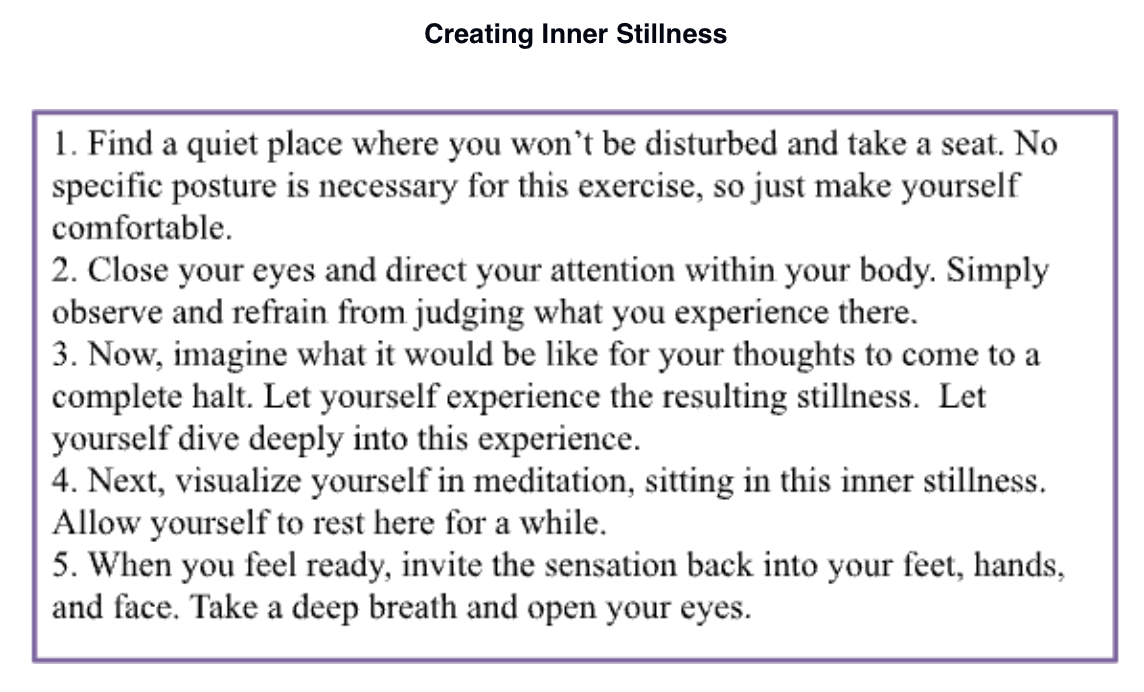
This is a process that you can employ frequently and to great advantage. In effect, you are giving yourself a specific target to aim at. This practice allows us to focus our attention, and to pull it away from the trivial chatter that is too often our most frequent companion.
So, use this stilling exercise multiple times a day. It prepares you for a much deeper meditation experience. Underneath all of our chatter is a perfect Stillness, and in this place, our hearts will find their rest. In that Stillness, we find our deepest Self, and our true home.
That’s it for this week, folks. Next week, we will use a deep poem by a 13th- century spiritual master to explore what being still looks like, and what we can expect from this practice. So, keep up with your daily practice. If you are new to this, try meditating multiple times a day for just five minutes or so. See you next week…
With deep affection,
P.S. Several of you have expressed the desire for an online meditation class. If there is enough interest, I will try to figure out how to hold a group class on the web. If you have an interest, please write me at ken123Kaisch@gmail.com.
Humility as a Tool → Letting go → Fear → Openness → Acceptance & Growth
If you are finding this newsletter course helpful, you may want to consider Dr. Kaisch's latest book, Inside the Invisible: The Universal Path to Spiritual Transcendence.👇
7: Heart-centered Meditation
Edition #7: Inside the Invisible
Perhaps the most significant difficulty with our first spiritual exercise is the lack of a clear target. If there was a clear ‘X-marks-the-spot’ target for your meditation, you could focus your attention there, and you probably would have felt more successful. At the very least, you could tell when you stayed on the target and when it eluded you. But what kind of target does the Presence of God present to you? Is it some image of the Divine? Is it a particular kind of inner feeling? Or something else entirely?
There was actually a good reason behind this lack of specificity. If you had some kind of clear target, instead of pursuing the actual real Presence, you would likely imagine something. Something that you thought fulfilled the parameters of your search. The only thing that could be said of such an imagining is that it is a fantasy – something that does not exist in reality. What a terrible way to start your journey toward that which Is, the ultimate Reality behind all our apparent observable reality.
The truth is, we humans have this marvelous ability to perceive patterns – to fill in the blanks, so to speak, with what we believe completes the pattern. Let me give you a simple numerical example: 1, 2, 3, __. Now, fill in the blank.
Most probably inserted a ‘4’, but how did you come to that number? You guessed, right? You assumed it was an ascending numerical sequence, and the single space indicated a single digit, so you assumed ‘4’. But maybe I was giving the last four digits of my phone number, or my social security number, or something else. There was no way of knowing without more information, so you hallucinated a number to fit.
While this ability to make and perceive patterns is helpful in many situations, it becomes a liability in our search for the Divine. It is, I believe, the primary reason why there are so many radically different ideas about God. Sadly, almost all of these ideas tend to lead us astray. If nothing else, none of our thoughts begin to encompass the vastness and majesty of God.
That being said, we humans have trouble with vagueness. I remember working with a woman who had wrestled with an unidentified chronic illness for years. She was terribly depressed because her doctors could not find a diagnosis. One day she
came into my office all smiles, just glowing with happiness. “They finally figured it out,” she said with a grin. “I have stage four pancreatic cancer!”
This was a virtual death sentence, yet it made her very happy. Finally, she had something concrete and real. Never mind that it meant her death; the certainty made her happy.
So how can we use our need for certainty in our quest? How can we create a target that is easier to work with, but one that doesn’t compromise our search right at the get-go?
To answer this, we need to look at our spiritual forebears. All of the great religions talk about a spiritual center in our bodies in the region of our heart. They say that the place where the Divine is most accessible to us is in this spiritual heart center. Several Christian mystics have stated that the veils which separate us from God are most transparent in the spiritual center of our heart.
St. Symeon the New Theologian (949-1022), an Eastern Orthodox saint, taught that we can experience the Divine directly, in the region of the heart. He was working from a very ancient practice, the Jesus Prayer, which originated with the Desert Fathers in the 2nd and 3rd centuries. (More on the Jesus Prayer in later editions of this newsletter.) In Western Christendom, the anonymous English author of The Cloud of Unknowing also describes the heart as the primary focal point of contemplative prayer.
Of specific interest to us, the anonymous author of The Cloud of Unknowing invites his reader to put “a cloud of forgetting” beneath him – letting go of everything that might distract him from the love of God. Then, he invites us to put a “cloud of unknowing” between ourselves and God. He rightly says that we can never ‘know’ God like we can know the objects around us. Better to not speculate, then, and to place one’s self in the presence of God and rest there, without fabricating ideas or emotions about the experience. And that, of course, was the point of our first spiritual exercise.
Moving forward, we can make our spiritual journey easier, quicker, and more productive by centering our attention in our hearts. So, let me introduce you to the practice of heart-centered meditation.
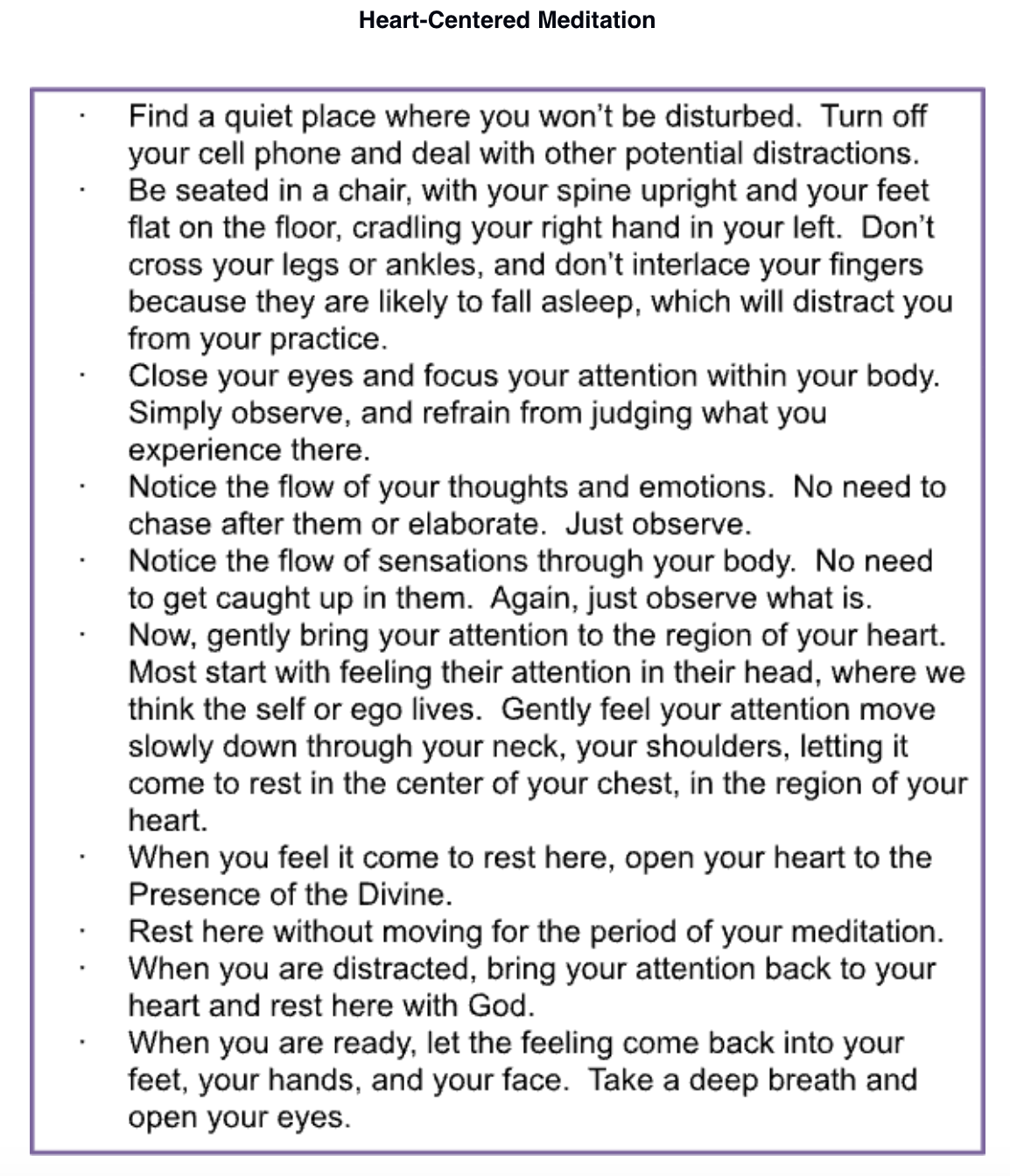
If you have difficulty moving your attention out of your head, first feel the sphere of energy around your head. Then imagine that sphere descending about an inch or so with every breath you take. When that sphere reaches the center of your chest, imagine reaching out from your heart to someone you love. Then reach out to another and another. This tends to anchor your attention in your spiritual heart center.
I have had people say they can’t move their attention out of their head because that is where it is supposed to be. That’s a common misperception. If you have ever stubbed your toe, barked your shin on something, or hit your fingers while hammering a nail, you know this is just not true. When you stub your toe, ALL of your attention is suddenly focused on the hurt toe. There isn’t even a particle of attention left to think about anything else. It’s just that we don’t pay much attention to what is actually going on inside of us. When you start noticing what is happening inside of yourself, you start to see some amazing things.
With practice, you will come to know your inner world. As you get more and more familiar with your heart center, your ability to focus without interruption will gradually increase. As you let go of your thoughts and emotions, you will experience a certain stillness in your inner world, a stillness that is free from your ego driving this thought and that one. This is not something you can force. You can’t say to yourself, ‘Stop chasing that thought,’ and expect to be successful. Why not? Well, stop and observe what part of you is doing the talking. It’s your ego that is attempting to exert power and direct your mental traffic here. And guess what – your ego is not likely to participate in its own demise.
This is the paradox of spiritual work. You have to find a way to go deeper inside to find the Divine dwelling within, but the tool you have always used to get things done – your ego – is not effective here. Remember what happens with seeds that are planted? The seed has to die in order for the new growth to occur. The same happens in the spiritual realm as well.
That’s all for this week, folks. Next week, we will start looking more deeply into the nature of the mind because the more you know about your inner world, the easier it is to negotiate your way home. Keep up with your daily practice. If you are new to this, try meditating multiple times a day for just five minutes or so. See you next week…
With deep affection,
P.S. Several of you have expressed the desire for an online meditation class. If there is enough interest, I will try to figure out how to hold a group class on the web. If you have an interest, please write me at ken123Kaisch@gmail.com.
Humility as a Tool → Letting go → Fear → Openness → Acceptance & Growth
If you are finding this newsletter course helpful, you may want to consider Dr. Kaisch's latest book, Inside the Invisible: The Universal Path to Spiritual Transcendence.👇